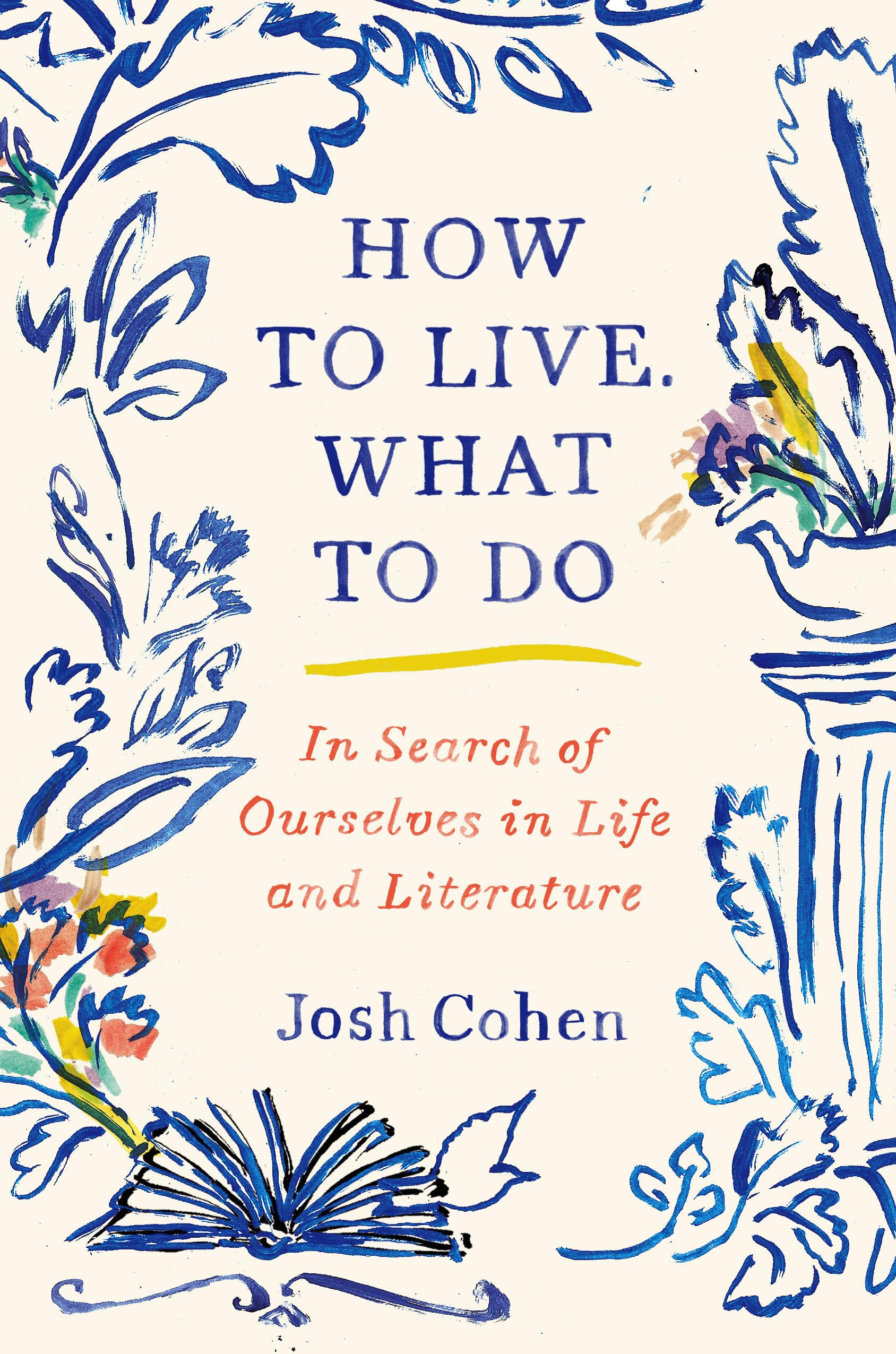
How to Live. What to Do: In Search of Ourselves in Life and Literature
$14.62
by Josh Cohen



A brilliant psychoanalyst and professor of literature invites us to contemplate profound questions about the human experience by focusing on some of the best-known characters in literature—from how Virginia Woolf’s Mrs. Dalloway copes with the inexorability of midlife disappointment to Ruth's embodiment of adolescent rebellion in Kazuo Ishiguro’s Never Let Me Go. “So beautiful ... a fantastic book.” —Zadie Smith, best-selling author of White Teeth In supple and elegant prose, and with all the expertise and insight of his dual professions, Josh Cohen explores a new way for us to understand ourselves. He helps us see what Lewis Carroll’s Alice and Harper Lee’s Scout Finch can teach us about childhood. He delineates the mysteries of education as depicted in Jane Eyre and as seen through the eyes of Sandy Stranger in The Prime of Miss Jean Brodie. He discusses the need for adolescent rebellion as embodied in John Grimes in James Baldwin’s Go Tell It on the Mountain and in Ruth in Kazuo Ishiguro’s Never Let Me Go. He makes clear what Goethe’s Young Werther and Sally Rooney’s Frances have—and don’t have—in common as they experience first love; how Middlemarch’s Dorothea Brooke deals with the vicissitudes of marriage. Vis-a-vis old age and death, Cohen considers what wisdom we may glean from John Ames in Marilynne Robinson’s Gilead and from Don Fabrizio in Giuseppe Tomasi di Lampedusa’s The Leopard. Featuring: • Alice—Lewis Carroll, Alice's Adventures in Wonderland / Through the Looking Glass • Scout Finch—Harper Lee, To Kill a Mockingbird • Jane Eyre—Charlotte Brontë, Jane Eyre • John Grimes—James Baldwin, Go Tell It on the Mountain • Ruth—Kazuo Ishiguro, Never Let Me Go • Vladimir Petrovitch—Ivan Turgenev, First Love • Frances—Sally Rooney, Conversations with Friends • Jay Gatsby—F. Scott Fitzgerald, The Great Gatsby • Esther Greenwood—Sylvia Plath, The Bell Jar • Clarissa Dalloway—Virginia Woolf, Mrs. Dalloway • And more! “So beautiful. I really enjoyed it. A fantastic book.” — Zadie Smith “Successful fiction, like successful therapy, Cohen notes, ‘sets a mirror before us, in which we see not only the self we know but the self we don’t.’ Relatability gives way to a more transformative recognition: seeing ourselves as others see us, or seeing ourselves as others, as strangers-and therefore as people whose stories and scripts aren’t as fixed as we thought . . . By the end of this wonderful book, we have learned to read its title not as a prescription but as a set of questions.” —The Times Literary Supplement “Cohen makes the case for fiction as a crucial aid to introspection, suggesting that our ability to see ourselves in literary characters runs parallel to the all-important ability to see ourselves.” — LitHub’s “Most Anticipated Books of 2021 Part 2” “Absorbing . . . Uniformly insightful. . . Compelling . . . An engrossing consideration of how reading fiction can lay a pathway for emotional and intellectual enrichment.” — Kirkus Reviews “Original . . . Fascinating . . . The premise is a brilliant one with plenty of room for fun.” — Publishers Weekly JOSH COHEN is a psychoanalyst in private practice and a professor of modern literary theory at Goldsmiths, University of London. He is the author of many books and articles on modern literature, cultural theory, and psychoanalysis, including How to Read: Freud, The Private Life: Our Everyday Self in an Age of Intrusion, and Not Working: Why We Have to Stop. He lives in London. from Childhood Part 1: Play “Let’s pretend”: Alice # There’s nothing all that exceptional about Alice. Unlike a lot of Victorian child heroines, she’s no paragon of angelic wisdom and delicacy. She is stubborn, awkward, impatient, often daft; she is, in short, a kid. But then why is she the first stop on our literary life journey? What does a kid like Alice have to tell us about how to live and what to do? Perhaps the most important insight into childhood we glean from psychoanalysis is that we forget most of it, particularly the parts that most matter. The years up to three or four tend especially to be shrouded in a fog of amnesia. Our childhood feelings become ever more inaccessible to us. The sheer intensity of our daily life experiences come to seem to us comical and alien. We laugh at the sobbing, screaming, tyrannical monster we once were, as though they had nothing to do with who we are now. This chasm between adult and child is as much a problem for adults as it is for children. The Hungarian psychoanalyst Sándor Ferenczi called it a “confusion of tongues”; adults and children seem to speak the same language but are separated by a cognitive and emotional chasm that mires them in permanent misunderstanding. The child’s world is too elastic and excitable, the adult’s too rule-bound and repressed. The child doesn’t yet know what an adul