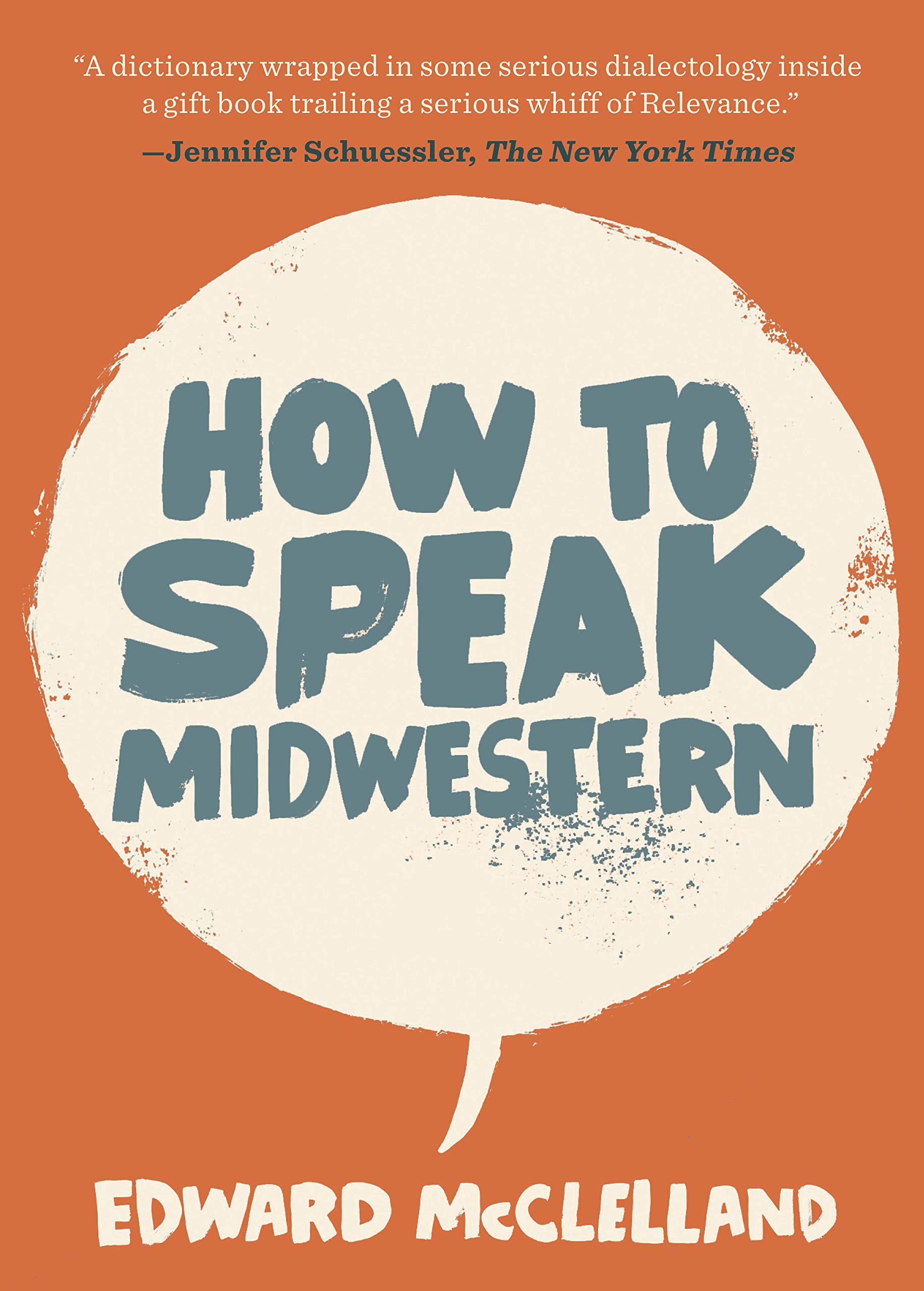



A dictionary wrapped in some serious dialectology inside a gift book trailing a serious whiff of Relevance - The New York Times In this book on Midwestern accents, and sayings, Edward McClelland explains what Midwesterners say and how and why they say it. He examines the causes of the Northern Cities Vowel Shift, explains the nasality of Minnesota speech, and details why Chicagoans talk more like people from Buffalo than their next-door neighbors in Wisconsin. He provides humorous definitions of jargon from the region, including: -squeaky cheese -city chicken -shampoo banana -the Pittsburgh toilet -FIB -bubbler -Chevy in the Hole -jagoff The book also includes detailed glossaries of slang from Buffalo, the Great Lakes, Illinois, Indiana, Iowa, Michigan, Minnesota, Ohio, Pittsburgh, St. Louis, and Wisconsin slang and sayings. This delightful romp through the region is the perfect gift for Midwesterners, and the perfect book for anyone wanting to learn more about the region's dialects. An amusing glossary to the lingo of the [Midwest's] more industrial states. ―Washington Post “A delightful romp through the dialects and vocabulary of the region.” ―Lansing City Pulse “A dictionary wrapped in some serious dialectology inside a gift book trailing a serious whiff of Relevance.” ―The New York Times McClelland leavens his writing with pop-culture references ... and touches of humor. ―Milwaukee Journal-Sentinel There is scholarship [in How to Speak Midwestern], a deep understanding of grammar and ethnic history, as he traces certain speech patterns down to a single city. But McClelland, a Michigan native, also has a voice, opinions and a few punchlines. ―Star Tribune How to Speak Midwestern is a fascinating read, whether you hail from WOWOland, the UP, Cereal City, or Baja Minnesota. ―Chicagoist In his delightful new book, Edward McClelland argues that the dialect of the Midwest is one of the country’s most linguistically significant ... [How to Speak Midwestern is] a long-overdue study of the middle-American vernacular, and how that vernacular informs our identity. At its heaviest, the book is a socio-economic treatise worthy of a university library; at its lightest, it’s a regionally specific Urban Dictionary. ―Inside Hook Edward McClelland is a journalist. His writing has appeared in publications such as the Columbia Journalism Review , Los Angeles Times , New York Times , and Salon . He is the author of Nothin' But Blue Skies and Young Mr. Obama . He lives in Chicago. How to Speak Midwestern By Edward McClelland Belt Publishing Copyright © 2016 Edward McClelland All rights reserved. ISBN: 978-0-9977742-7-6 Contents INTRODUCTION, INLAND NORTH, MIDLAND, NORTH CENTRAL, GLOSSARIES, CHAPTER 1 INLAND NORTH The first time I visited Houston, I asked a local, "How far is it to Dallas?" "To where?" she replied. "To Dale's house?" Using speech patterns acquired during my childhood in industrial Michigan, I had pronounced the name of Texas's second-largest city as "Dayel-is." That's what linguists call " a raising," and it's a signature of the Inland North accent, which is spoken from Rochester, N.Y. on the east to St. Louis and Milwaukee on the west, an area roughly coterminous with the Rust Belt. The Inland North accent originated in the mid-nineteenth century, and was spread through the lower Great Lakes by Yankee settlers migrating west along the Erie Canal and across Lake Erie. The influence of New England and western New York can be seen all over the Upper Midwest. Place names were transplanted — my own hometown of Lansing, Mich., was named for Lansing, N.Y., in the Finger Lakes region, and Saugatuck, Mich., was named for Saugatuck, Conn. The Midwest's private liberal arts colleges were founded by Eastern clergymen seeking to spread the doctrines of abolitionism, women's equality, and temperance. Ohio's Oberlin College and Michigan's Olivet College were both the creation of John Jay Shipherd, a Presbyterian minister educated in Vermont. Northwestern University, in Evanston, Ill., was founded by Methodists from western New York's Burned-over District, the forcing ground of many of the era's most fervent religious revivals. Cultural geographers such as David Hackett Fischer and Colin Woodard have lumped New England and the Upper Midwest together in a single region called "Greater New England" or "Yankeedom," sharing the values of social reform and communitarianism. If the Midwest was settled from New England, then why don't Midwesterners talk like New Englanders? Because the first waves of settlement came from western New England, west of the Connecticut River, an isolated agricultural area that was phonologically distinct from coastal Rhode Island, Massachusetts, and Maine. One of the most significant differences was rhoticity. When the Pilgrims arrived in Plymouth in 1620, they almost certainly pronounced their r 's, since this was standard speech in England at the time.