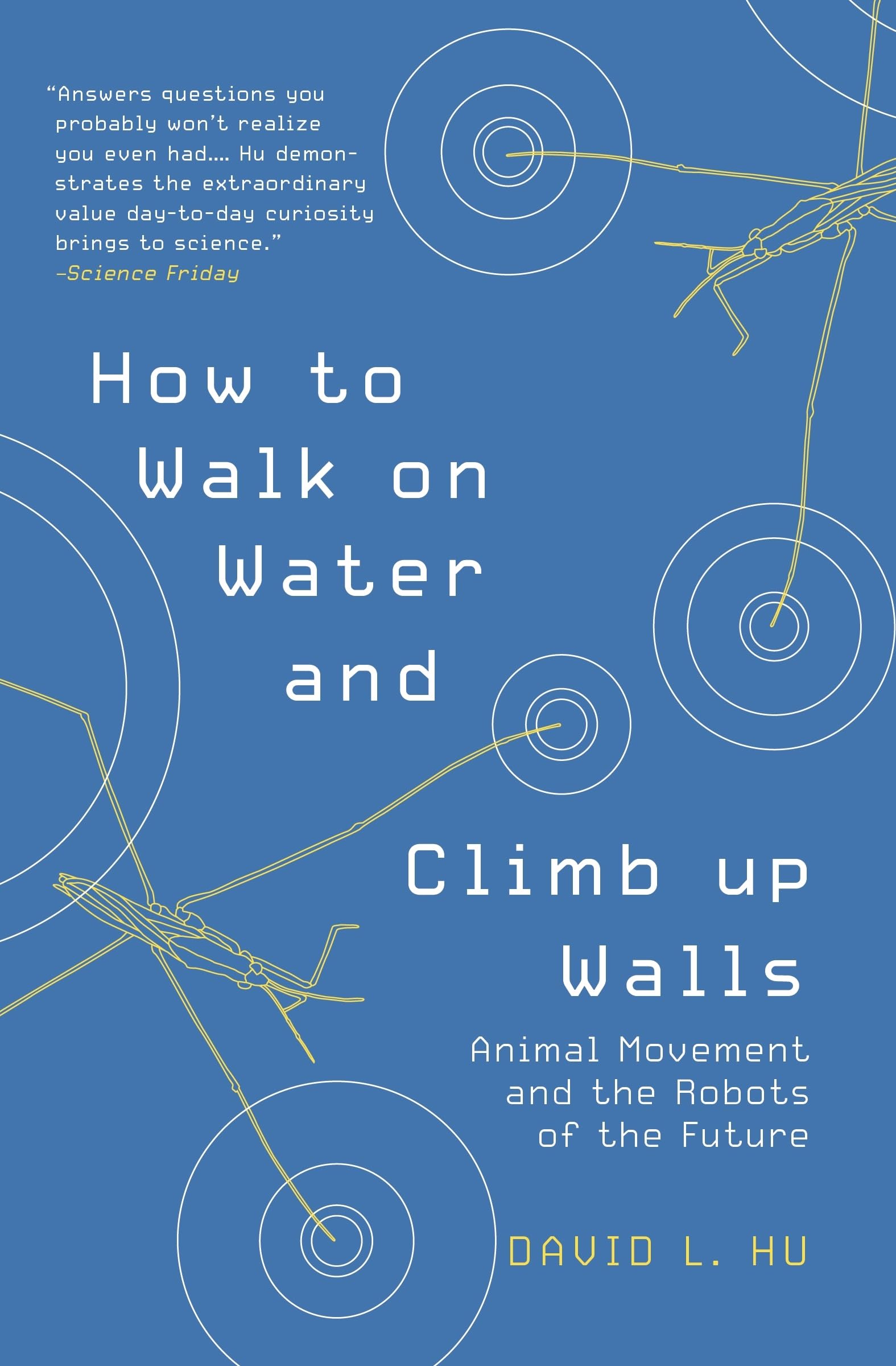



Discovering the secrets of animal movement and what they can teach us Insects walk on water, snakes slither, and fish swim. Animals move with astounding grace, speed, and versatility: how do they do it, and what can we learn from them? How to Walk on Water and Climb up Walls takes readers on a wondrous journey into the world of animal motion. From basement labs at MIT to the rain forests of Panama, David Hu shows how animals have adapted and evolved to traverse their environments, taking advantage of physical laws with results that are startling and ingenious. In turn, the latest discoveries about animal mechanics are inspiring scientists to invent robots and devices that move with similar elegance and efficiency. Integrating biology, engineering, physics, and robotics, How to Walk on Water and Climb up Walls demystifies the remarkable secrets behind animal locomotion. "Co-Winner of the AIP Science Communication Book Award, American Institute of Physics" "Longlisted for the Young Adult Science Book Award, AAAS/Subaru SB&F Prize for Excellence in Science Books" "Finalist for the AAAS/Subaru SB&F Prizes for Excellence in Science Books, Young Adult Science Books" "One of Inverse's Best Science Books of 2018" "Answers questions you probably won’t realize you even had. . . . Hu demonstrates the extraordinary value day-to-day curiosity brings to science." ―Christopher Intagliata, Science Friday "[Hu] describes both the silliness and profundity of his brand of research . . . . Middle school science teachers and nerds everywhere will thank him." ―James Gorman, New York Times "[An] engrossing tour of faunal motion." ―Barbara Kiser, Nature "Hu distills the complex science that demystifies how flying snakes glide and sharks make for remarkably efficient swimmers. Breaking down these concepts is not easy and Hu is up to the task." ―Ronak Gupta, The Wire "This highly accessible and exciting book is a quick, enjoyable adventure." ―Grrl Scientist, Forbes David L. Hu is professor of mechanical engineering and biology, and adjunct professor of physics at the Georgia Institute of Technology. He lives in Atlanta.