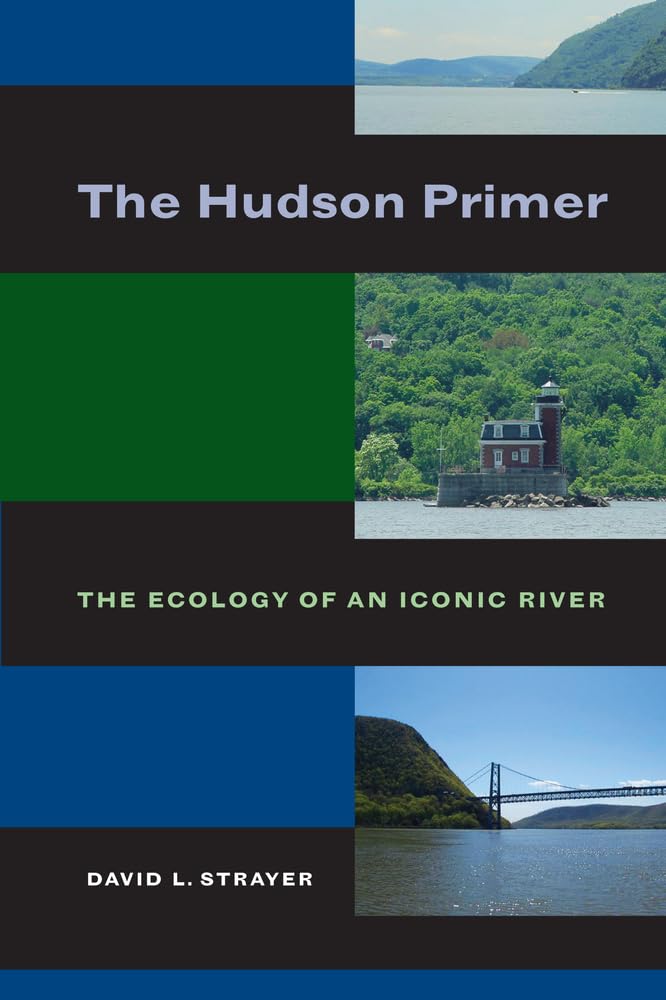



This succinct book gives an intimate view of the day-to-day functioning of a remarkable river that has figured prominently in history and culture―the Hudson, a main artery connecting New York, America, and the world. Writing for a wide audience, David Strayer distills the large body of scientific information about the river into a non-technical overview of its ecology. Strayer describes the geography and geology of the Hudson and its basin, the properties of water and its movements in the river, water chemistry, and the river’s plants and animals. He then takes a more detailed look at the Hudson’s ecosystems and each of its major habitats. Strayer also discusses important management challenges facing the river today, including pollution, habitat destruction, overfishing, invasive species, and ecological restoration. “An informative and eminently readable book. [Strayer] distills decades of research on the Hudson, one of the best studied rivers anywhere, into a book that is accessible to a general audience. . . . The reader does not have to live near the Hudson for the book to be both relevant and compelling. . . . It is the author’s personal involvement in the research and conservation on the river that makes the book interesting to read.” ― Ecoscience “Easy to read, provides a wealth of information... it outlines in a way understandable by non-scientists.” ― Freshwater Biology “Highly recommended.” ― CHOICE “It is to Strayer’s credit that he takes many difficult subjects and often technical information and conveys it in understandable and digestible portions.” ― Quarterly Review of Biology “This succinct book gives an intimate view of the day-to-day functioning of a remarkable river that has figured prominently in history and culture. . . . David Strayer distills the large body of scientific information about the river into a non-technical overview of its ecology.” ― Northeastern & Southeastern Naturalist It is hard for scientists to write about their work with simplicity and clarity. It is even more rare for it to be a good yarn. In The Hudson Primer, Strayer does both in a book that is highly readable, succinct, and still rigorous and comprehensive. Excellent reading for any parent who wants to play knowledgeably in a river with their child, for any resident who wants to understand recent and ongoing environmental management controversies, or for any lifelong student who just wants to know more about how rivers work. --Emily Bernhardt, Duke University Strayer's clear writing brings to life the Hudson as a living, breathing ecosystem that is at once captivating and vulnerable. River science becomes a story that is a must-read for those who care about the Hudson. --Margaret A. Palmer, University of Maryland “It is hard for scientists to write about their work with simplicity and clarity. It is even more rare for it to be a good yarn. In The Hudson Primer, Strayer does both in a book that is highly readable, succinct, and still rigorous and comprehensive. Excellent reading for any parent who wants to play knowledgeably in a river with their child, for any resident who wants to understand recent and ongoing environmental management controversies, or for any lifelong student who just wants to know more about how rivers work.”--Emily Bernhardt, Duke University “Strayer's clear writing brings to life the Hudson as a living, breathing ecosystem that is at once captivating and vulnerable. River science becomes a story that is a must-read for those who care about the Hudson.”--Margaret A. Palmer, University of Maryland David L. Strayer is Senior Scientist at the Cary Institute of Ecosystem Studies. He is the author of Freshwater Mussel Ecology: A Multifactor Approach to Distribution and Abundance (UC Press) and Hudson River Fishes and Their Environment , coedited with John Waldman and Karin Limburg, among other books. The Hudson Primer The Ecology of an Iconic River By David L. Strayer UNIVERSITY OF CALIFORNIA PRESS Copyright © 2012 The Regents of the University of California All rights reserved. ISBN: 978-0-520-26961-3 Contents Acknowledgments, ix, Introduction, 1, 1. The Physical Character of the Hudson and Its Watershed, 11, 2. Water, Circulation, and Salinity in the Hudson River, 25, 3. A Brief Introduction to the Hudson's Water Chemistry, 43, 4. Habitats, Biological Communities, and Biota, 58, 5. Ecology of the Major Habitats in the Hudson River: The Freshwater Channel, 75, 6. The Brackish-Water Channel, 91, 7. The Vegetated Shallows, 108, 8. Wetlands, 121, 9. PCBs and Other Pollution in the Hudson, 135, 10. Habitat Change and Restoration in the Hudson, 148, 11. Hudson River Fisheries, 160, 12. Nonnative Species and Their Ecological Effects, 173, Conclusion: A Few Parting Thoughts, 193, Index, 199, CHAPTER 1 The Physical Character of the Hudson and Its Watershed The physical structure of a river and the surrounding landscape sets muc