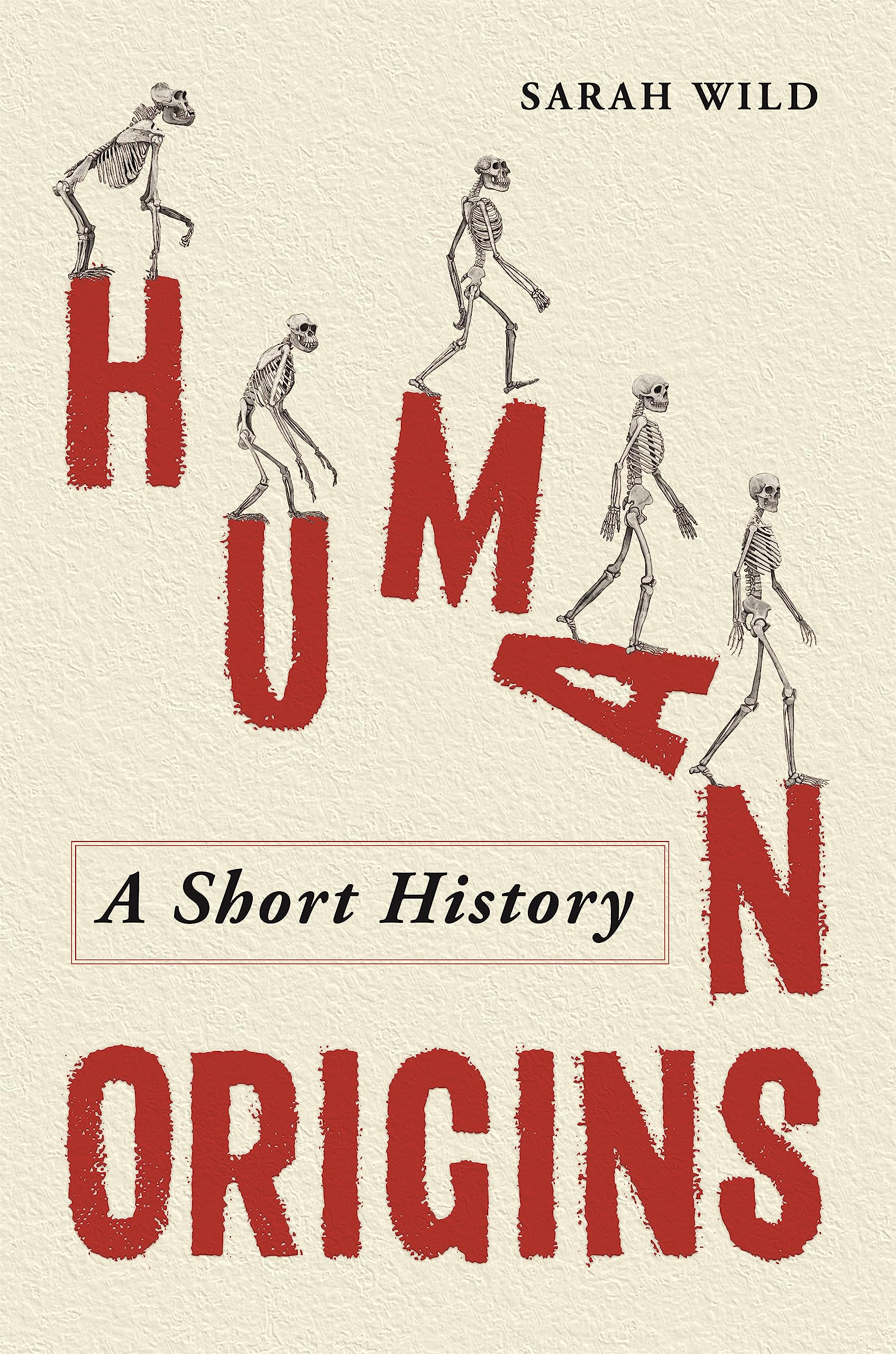



Humans are the dominant species on the planet. But how did we get here? Human Origins takes the reader on a fascinating 7-million-year journey from our earliest primordial ape-like roots through to the present day. For almost a hundred years, scientists have been trying to decipher the secrets of humanity's evolution . At first, they relied on rare pieces of ancient skulls and bone fragments. But every year, they make new discoveries, uncover new fossils and develop new techniques to tease apart the story of our evolution. So far, from skeletons to teeth, humanity has found more than 6,000 hominin individuals . These individuals span several species, all of which tell the tale of human evolution : how our brains changed over time, what we ate, how we lived. Including the latest scientific findings , Human Origins will also look at some of the biggest questions that remain: What makes humans unique? Where did the Neanderthals go? And are humans still evolving? Sarah Wild studied physics, electronics and English literature at Rhodes University, South Africa, and for an MSc in bioethics and health law, before becoming a freelance science journalist. She has also written books, won awards, and run national science desks. Her work has appeared in Nature , Science , Scientific American , and Undark , among others, and she has appeared on the BBC’s World Service and the Inside Science program. She lives in a tiny village just outside Canterbury in the UK. PRIMATES All living organisms contain DNA, a molecular blueprint that children inherit from their parents. Sometimes genetic information changes slightly as it is passed on. Often these mutations mean nothing – a tiny blip in the complex, long code of life – but over time and in successive generations, the changes can accumulate and set plants and animals on a different evolutionary path from their ancestors. As time passes and juveniles grow into adults that have offspring of their own, a species can change permanently, developing into a different sub-species or even – over multiple generations – a new species altogether. Salamanders which fell into a cave in Slovenia many years ago lost their skin colour and sight, and their snouts got longer. Today, we know these populations as the European olm. Meanwhile, on the Galápagos Islands, finches developed differently shaped beaks, depending on the food they could access. These small, superficial changes help animals adapt to altered environments. But over the course of millennia, evolutionary modifications can transform one species into another. Human evolution studies tend to focus on the evolutionary fork in the road, between 5 and 9 million years ago, when humans and chimps parted ways. But in reality, the slow accumulation of changes had been taking place long before then. Many key genetic events had been set in motion millennia prior to our hominin ancestors walking upright. The traits that make humans, well, human – our short thumbs adapted to grasping, hip sockets that sit firmly in our pelvis and allow us to put one foot in front of the other, and giant brains capable of introspection and music and art – had been millions of years in the making. Based on molecular dating, scientists estimate that the primate lineage branched off from other mammals between 80 and 90 million years ago. One possibility for the oldest known almost-primate is the Purgatorius. This sharp-toothed creature was scampering through the Purgatory Hill region of Montana in the United States more than 63 million years ago. About the size of a rat, the tree-climbing mammal, known as a ‘proto-primate’, appeared soon after the dinosaurs became extinct. It laid the basis for Plesiadapiformes, a group of recognized early primates. Plesiadapiformes had long fingers suited to tree-climbing, and back teeth that could chew. A contender for the title of the oldest known actual primate is Altiatlasius koulchii, an extinct creature that lived and died 57 million years ago in what is now Morocco in north-western Africa. It is difficult to say more about A. koulchii since everything we know about it is based on ten upper and lower molars and a fragment of a jawbone. Today, there are more than five hundred different types of living primates, and new species are recognized each decade. Primate comes from the Latin for ‘prime’ or ‘first rank’. In 1758, Swedish taxonomist Carl Linnaeus first classified the natural world into units. He grouped humans, apes and monkeys together based on their physical similarities, and labelled them the ‘highest order’ of mammals, hence ‘primate’. Over time, and following Charles Darwin’s publication of On the Origin of Species almost a century later, the primate category has broadened rather significantly. It is now a large and varied group of animals, ranging in size from the mouse lemur, which is as heavy as two tablespoons of sugar, through to the gorilla, which c