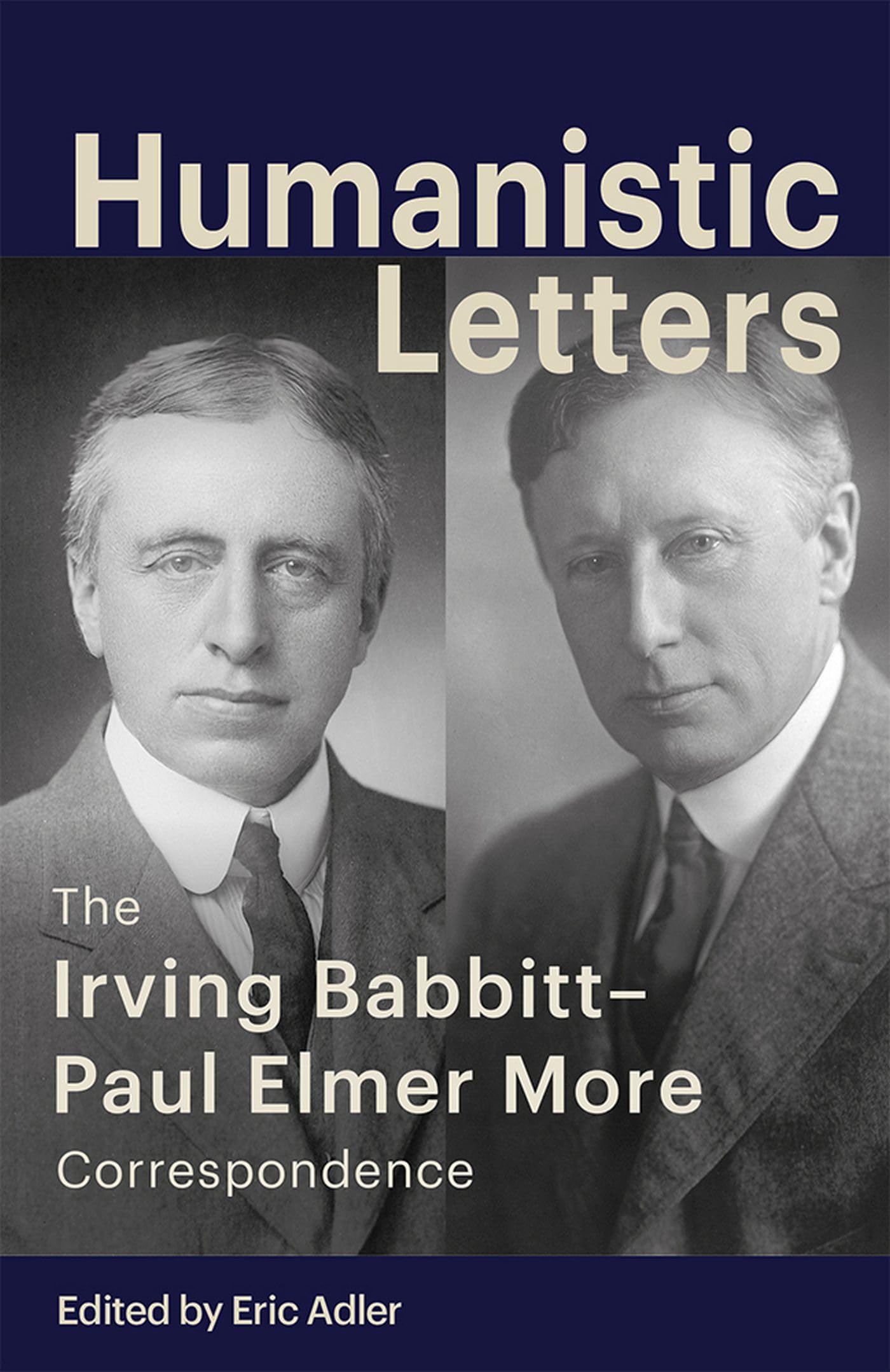



Irving Babbitt (1865–1933) and Paul Elmer More (1864–1937) were the leading lights of the New Humanism, a consequential movement of literary and social criticism in America. Through their writings on literary, educational, cultural, religious, and political topics, they influenced countless important thinkers, such as T.S. Eliot, C.S. Lewis, Russell Kirk, Benedetto Croce, Werner Jaeger, and George Will. Their work became the source of heated public debates in the 1920s and early 1930s. The belligerent criticisms of Babbitt and More—composed by such famous intellectuals as Ernest Hemmingway and H.L. Mencken—have ensured that the New Humanism has seldom been properly appreciated. Humanistic Letters helps remedy this problem, by providing for the first time the extant correspondence of Babbitt and More, which gets to the heart of their intellectual project. “The New Humanism, an early 20th century intellectual movement led by Irving Babbit, ‘the Buddha of Harvard,’ and Paul More, ‘the hermit of Princeton,’ has been largely forgotten. But Eric Adler's erudite exegesis of their correspondence demonstrates its timeless relevance given that (in Babbit's words) ‘man is in danger of being deprived of every scrap and vestige of his humanity by this working together of romanticism and science.’”— Walter A. McDougall , University of Pennsylvania, Pulitzer Prize-winning historian “New Humanism was one of the most consequential movements of the last century. At long last we now have the literary record of letters between its two principal figures, Irving Babbitt and Paul Elmer More. Eric Adler’s Humanistic Letters is a much-needed window into two highly creative minds at work enlivening tradition and reinvigorating first principles against the dominant currents of their age, and ours. It’s an American cultural treasure.”— Jeffrey O. Nelson , The Russell Kirk Center for Cultural Renewal, Publisher and Editor-at-Large of The University Bookman “Irving Babbitt and Paul Elmer More were two of the most profound American thinkers in the twentieth century. They challenged the Zeitgeist and were denied the reputation that they deserved, but an expanding literature testifies to their enduring and now growing influence. Although their letters to each other are numerous, readable, and very illuminating, nobody has published them--until this moment. Eric Adler's edition was worth the wait. It is a model of its kind. It has a lengthy, very informative and insightful introduction, a chronology of the two thinkers, biographies of figures relevant to the correspondence, an elaborate bibliography, and very helpful notes to the letters. Scholars and others will treasure this meticulously wrought and intellectually stimulating volume.”— Claes G. Ryn , author of Will, Imagination and Reason: Babbitt, Croce and the Problem of Reality "Such a book has as an immediate purpose to introduce readers to the correspondence and world of two literary giants. Another purpose is to whet the appetite for more. One cannot read the Babbitt and More letters without wanting to delve deeper into their world and the conversation about wisdom and education they carry on. In this way, Humanistic Letters is a grand success."— Front Porch Republic "The ancient admotion to 'know thyself' must now mean as well to 'know thy history,' as the late John Lukacs wrote sixty years ago. In 2020, Eric Adler's Battle of the Classics advanced our understanding of the history of classical humanism and its fate in the modern world, calling for an imaginative renewal that goes beyond mere restoration. Once again, with this exceptional edition of the Babbitt-More correspondence, he has deepened our understanding of two titans of the New Humanism, rescuing them from caricature and wooden categories satisfying only to simple minds. These letters are fresh, timely, and brimming with wit, learning, and a bit of gossip. They invite us to engage decades of wise analysis of the crisis of American culture and education a century and more ago, a world of trials, tribulations, and occasional triumphs for two outstanding critics whose time has come again. This publication, too long delayed, is cause for celebration." — Richard M. Gamble , Hillsdale College, author of A Fiery Gospel: The Battle Hymn of the Republic and the Road to Righteous War “This volume is an impressive work of scholarship in several ways. The bibliographic material is extensive and will afford readers numerous opportunities to pursue in more depth any number of topics of importance to one or both thinkers. The letters themselves are made much easier to understand thanks to Adler’s extensive contextualizing footnotes as well as his brief biographies of key family members and other figures who feature prominently in the correspondence." — The University Bookman Eric Adler is Chair and Professor of Classics at the University of Maryland. He is the author of three books, including The Battl