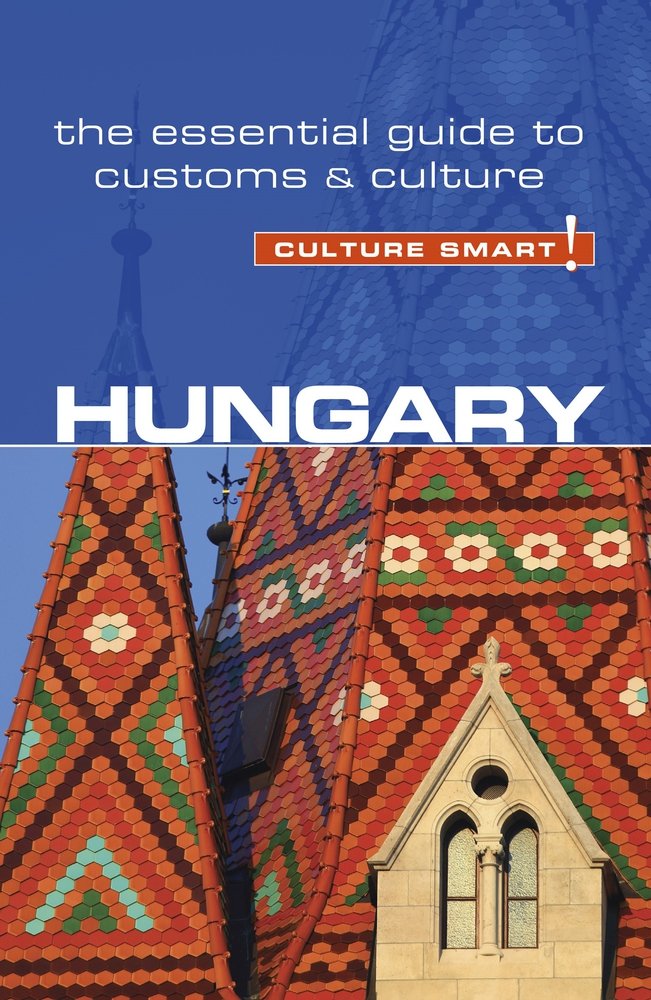



A landlocked country in the heart of Europe, Hungary was a powerful medieval kingdom. Intimately involved in European history and culture, the Hungarians have always been proud of their distinctive identity, reinforced by the fact that their language bears no resemblance to that of any of their neighbors. Today, following the collapse of Communism, Hungarians feel part of Central Europe again, the Europe of science, culture, and civic virtue, of gem-like Baroque churches and 19th century schools, town halls, barracks, and railway stations. This beautiful and beguiling land is home to the magnificent city of Budapest on the banks of the Danube, to the largest lake in central Europe, and to charming spa towns and hot springs. Hungarian openness and hospitality have been tested by the migrant crisis on Europe’s doorstep, and the rise of populist parties. After setting the context in a brief historical overview, Culture Smart! Hungary offers practical advice and important insights into different aspects of Hungarian life today, to help deepen your understanding and appreciation of this complex and talented people. "Culture Smart has come to the rescue of hapless travellers." Sunday Times Travel "... the perfect introduction to the weird, wonderful and downright odd quirks and customs of various countries." Global Travel "...full of fascinating-as well as common-sense-tips to help you avoid embarrassing faux pas." Observer Brian Mclean and Kester Eddy are British writers who have both lived in Budapest for many years. Each brings specialist knowledge to the book, the former in Hungarian history and culture and the latter in political and economic affairs. Hungary - Culture Smart! The Essential Guide to Customs & Culture By Brian McLean Bravo Ltd Copyright © 2017 Kuperard All rights reserved. ISBN: 978-1-85733-868-3 Contents Map of Hungary, Introduction, Key Facts, Chapter 1: LAND AND PEOPLE, Chapter 2: VALUES AND ATTITUDES, Chapter 3: CUSTOMS AND TRADITIONS, Chapter 4: FRIENDS AND MANNERS, Chapter 5: HUNGARIANS AT HOME, Chapter 6: TIME OUT, Chapter 7: TRAVEL, HEALTH, AND SAFETY, Chapter 8: BUSINESS BRIEFING, Chapter 9: COMMUNICATING, Further Reading, Acknowledgments, CHAPTER 1 LAND & PEOPLE "Hazám, hazám ..." "Homeland, my homeland, my all! My whole life I owe to thee," sings the troubled medieval patriot Bánk bán in the eponymous 1860 opera by the Hungarian composer Ferenc Erkel. You won't meet a Hungarian who disagrees. People from larger countries may sometimes take theirs for granted, but not people from smaller, more vulnerable countries like Hungary. Patriotism there runs as deep as deep can be. GEOGRAPHICAL MATTERS Hungary is a landlocked country in the center of Europe. Budapest, the capital, lies about 890 miles (1,425 km) from London, 980 miles (1,575 km) from Moscow, 500 miles (800 km) from Rome, and 655 miles (1,050 km) from Istanbul, as the crow flies. Hungary's area of 35,919 square miles (93,032 sq. km) makes it similar in size to Portugal, or to the state of Indiana. It has an irregular egg shape. Hungary occupies the center of the large, relatively flat Carpathian Basin. It is surrounded by the Alps, the Carpathians, and the Dinaric Alps, but none of these ranges extend into Hungary, where the highest point — the peak of Kékes-teto, 60 miles (95 km) east of Budapest — is only 3,326 feet (1,014 m) above sea level. Going clockwise, the countries across Hungary's 1,377 miles (2,217 km) of frontier are Austria, Slovakia, Ukraine, Romania, Serbia, Croatia, and Slovenia. The Danube, Europe's second-longest river after the Volga, arrives from Slovakia and follows the border east, before turning due south to bisect the country and enter Serbia. The part of Hungary to the west of it is called Transdanubia (Dunántúl). To the east lie the Northern Uplands (Északi hegység) and the Great Plain (Alföld). Transdanubia has three major lakes, all shallow and fringed with reeds. The largest by far is Balaton (232 square miles, or 600 sq. km). The second is Ferto (Neusiedlersee), straddling the border with Austria. Between Balaton and Budapest lies Lake Velence. The main ranges of hills in Hungary form an almost straight line from southwest to northeast, from the Balaton Uplands to Buda Hills and continuing on the opposite side of the Danube as the Northern Uplands. The western border with Austria runs through Alpine foothills. Badacsony, overlooking Lake Balaton, is one of several obvious extinct volcanoes in Hungary, but there are no active ones today. No earthquake recorded in the territory of present-day Hungary has had a magnitude greater than 6 on the Richter scale. The last earthquake fatality was in 1956 at Dunaharaszti, south of Budapest, when a makeshift house collapsed. The population of Hungary peaked at around 10.7 million in 1981 (similar to that of Ohio or Illinois), but has since fallen to 9.8 million (January, 2016). The population den