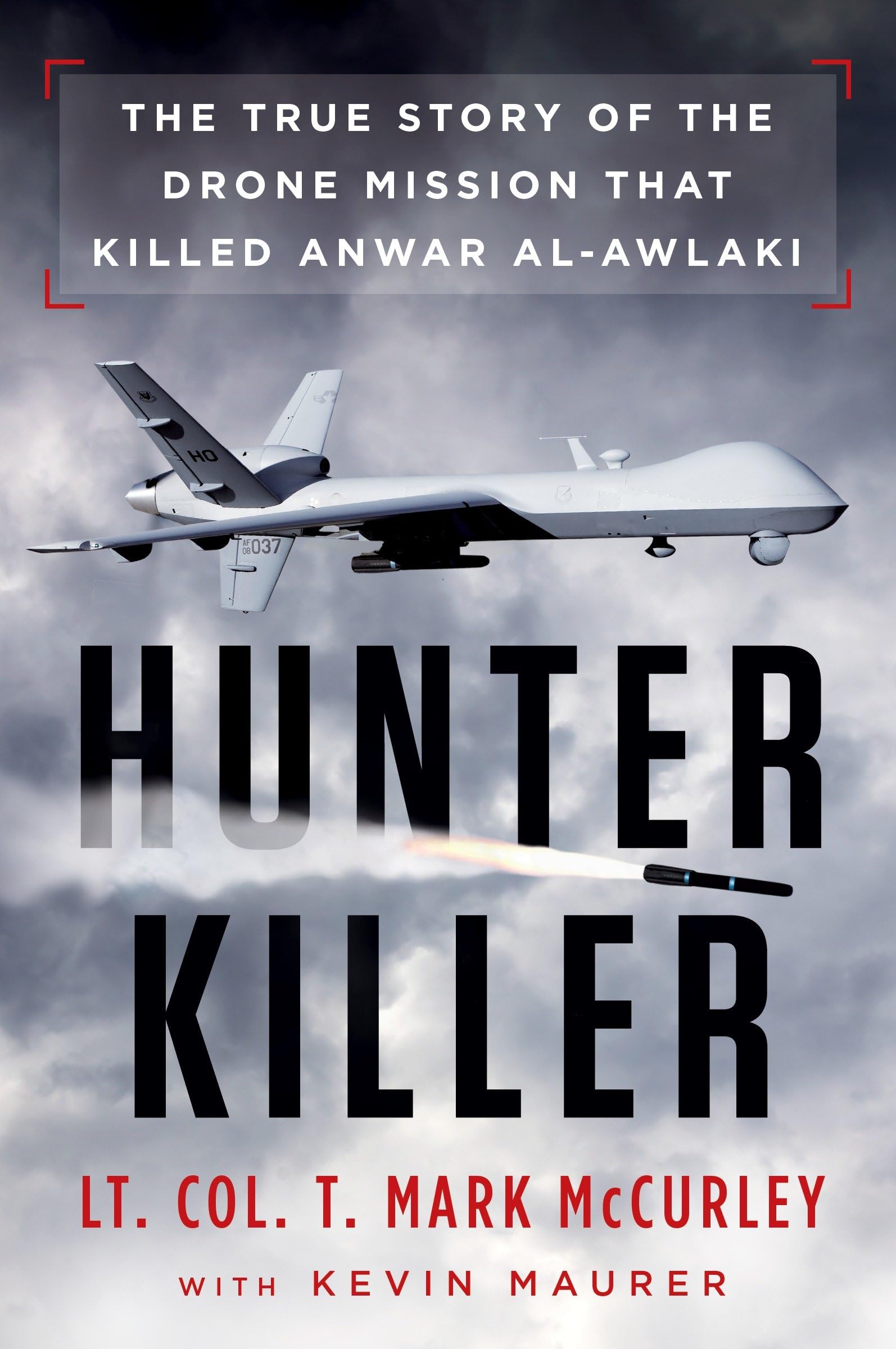
Hunter Killer: The True Story of the Drone Mission That Killed Anwar al-Awlaki
$13.83
by T. Mark Mccurley



The firsthand account of the hunt for al-Qaeda terrorist Anwar al-Awlaki—and the drone squadron that found him. In September 2011, with Saddam Hussein and Osama bin Laden both dead, the United States pinpointed American-born terrorist Anwar al-Awlaki as priority target number one. In order to eliminate the threat, Air Force Lt. Col. T. Mark McCurley and his squadron were called upon to turn their RPAs’ main function as tracking and surveillance devices into strategic weapons. Much was resting on the mission—al-Awlaki was the face of al-Qaeda propaganda, and his loss would have serious repercussions in AQ’s recruitment efforts. The Air Force had only a limited amount of time and firepower—it was up to McCurley and his Predators to neutralize the threat before al-Awlaki disappeared underground forever. Remotely piloted aircraft (RPA), commonly referred to as drones , have become the new face of modern warfare, and Lt. Col. McCurley provides an insider look at the evolution of the RPA program. No book has ever told the story of the drones and the pilots who fly them. Until now. With an unprecedented bird's-eye view, Lt. Col. McCurley details the start of their sixty-day surveillance of al-Awlaki up through the day the drones were ordered to take the shot, when the war on terror experienced a critical success. Praise for Hunter Killer “A veteran’s gritty, engrossing account of America’s RPA service in today’s far-flung conflicts.”- Library Journal (starred review) “An Air Force veteran tells an exciting tale of tracking terrorist leaders by remote piloted aircraft, the future of military aviation… An illuminating tale of a pilot on the cutting edge.” – Kirkus LT . COL. T. MARK McCURLEY is a retired Air Force pilot and former intelligence operator. In 2003, he volunteered for the secretive Predator program, deploying five times to Iraq, Afghanistan, and other locations, where he has flown the MQ-1 Predator and the MQ-9 Reaper, accruing more than one thousand combat hours in flight. KEVIN MAURER is an award-winning journalist and the bestselling coauthor, with Mark Owen, of No Easy Day: The Firsthand Account of the Mission That Killed Osama bin Laden . He has covered special operations forces for a decade. AUTHOR’S NOTE I am an operator. I am not a door kicker. I do not fast rope, rappel, or jump out of airplanes. Never have I been called upon to assault any position, be it fixed or fluid, though I have been trained to do so. I do not claim to be like the SEALs or Special Forces. That wasn’t my career path. But I am still an operator. A fighter. In 2003, more than a decade into my Air Force career, I faced a third consecutive assignment to a noncombat unit. I volunteered for the only combat job available to me at the time—the RQ-1 Predator. Dog, my squadron commander, looked sidelong at me when I made my request. A crusty, old-school fighter pilot, he shared the same belief as the rest of the Air Force, and even myself. Predators were for chumps. “Mark, are you sure you want this?” he asked. Dog deeply cared about his people and would cheerfully work any assignment for me if I truly desired it. “This won’t be good for your career.” Careerism had never been my goal. I had long ago elected to deviate from the normal, expected path and bounce from aircraft to aircraft with each assignment. The Air Force expected officers to stick with one aircraft their whole careers. Each community told me the same thing. A change would be bad for my promotion opportunities. “Sir,” I said. “I just want to get into the fight. Do my part.” I had felt that way since September 11. I had been leading a T-6A formation sortie over Valdosta, Georgia, when the Federal Aviation Administration directed us to land. The controller was both curt and professional, but it was unusual since military often were exempted from such directives. After we’d landed, our engines had barely spun to a stop before the excited crew chief ran up to us, asking if we had heard the news. Someone had flown an airplane into the World Trade Center. At first, we had reacted skeptically. After all, inexperienced pilots flew their little aircraft perilously close to the towers all the time. Sightseers did stupid things like that. But, when I’d gotten to the 3rd Flying Training Squadron duty desk, I joined two dozen instructor pilots and students huddled around the screen watching clips of an airliner barreling into the first tower. The video repeated and repeated. And then it changed. It was subtle at first, then nightmarishly clear. The “LIVE” icon flashed as the airliner plunged again into the tower. Another aircraft thundered into the second tower. We all knew one hit was an accident. Two was intentional. We were in a war unlike any other fought by the United States. And I wanted to do my part. Dog sighed. “All right, I’ll work this for you.” “Thank you, sir.” Hunter Killer is the story of an extraordinary group of young men and women with