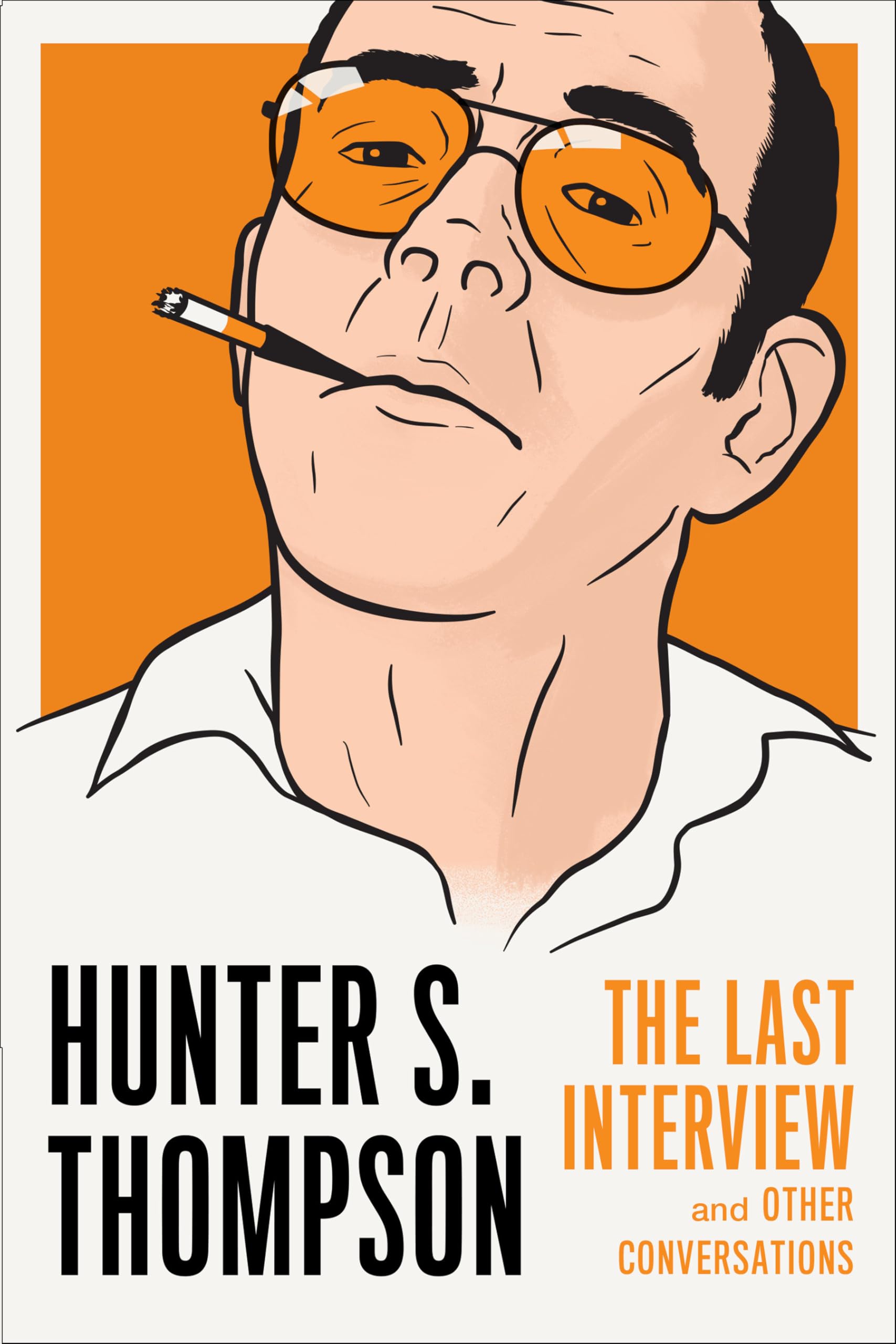
Hunter S. Thompson: The Last Interview: and Other Conversations (The Last Interview Series)
$15.99
by Hunter S. Thompson



Hunter S. Thompson was so outside the box, a new word was invented just to define him: Gonzo. He was a journalist who mocked all the rules, a hell-bent fellow who loved to stomp on his own accelerator, the writer every other writer tried to imitate. In these brutally candid and very funny interviews that range across his fabled career, Thompson reveals himself as mad for politics, which he thought was both the source of the country’s despair and, just maybe, the answer to it. At a moment when politics is once again roiling America, we need Thompson’s guts and wild wisdom more than ever. HUNTER S. THOMPSON (1937-2005) was the inventor and pretty much the sole practitioner of Gonzo journalism. His first book, Hell’s Angels , is the definitive work on the motorcycle gang. Gonzo was born with the 1970 magazine article, The Kentucky Derby Is Decadent and Depraved , and reached a peak with Fear and Loathing in Las Vegas . His reporting on the 1972 campaign trail earned him accolades for being unafraid to tell the wretched truth about politics. On the basis of those pioneering works, Thompson became a celebrity and lived a life of wild abandon. When he killed himself, he left a note saying “No more fun.” DAVID STREITFELD is the editor of The Last Interview books on Gabriel García Márquez, Philip K. Dick and J.D. Salinger, all published by Melville House. He is a reporter for The New York Times, where in 2013 he was part of the team awarded the Pulitzer Prize for Explanatory Reporting. He lives in the San Francisco Bay Area with his family and too many books. Hunter S. Thompson: The Last Interview INTRODUCTION DAVID STREITFELD I once spent many agonizing minutes watching Hunter Thompson, who liked to boast that he could use the English language as both a musical instrument and a political weapon, trying to sign his name. This was in late 1990, in a hotel room in New York City. A publicist asked him to autograph his latest book before she left, a little souvenir of hours spent trying to get the writer to do the most basic things, like get out of bed. Hunter would start writing, get distracted, pause, gather his wits, stare at his hand as if it were an alien life form, throw something. I thought, Signed books by this guy must be really scarce. A few decades later, with Gonzo nostalgia in full swing, eBay was auctioning a signed copy of Generation of Swine or Songs of the Doomed nearly every day, usually with just the scribbled letters “HST.” Collectors sometimes bid hundreds of dollars. Most of the autographs must be fake, but probably a few are real. At this point, who can tell the difference? It’s been almost half a century since the work that made Hunter’s name and more than a decade since his suicide, but he was so controversial, so denounced, and so celebrated that the smoke still hasn’t cleared. He was influential and entertaining, everyone must give him that, but did he ever become the artist that he so palpably longed to be? Was he a madman, or was he a writer who played a role and got trapped in it? Did his prodigious intake of drugs and alcohol weaken his work, or make it possible in the first place? Like most of the great American writers, he did his best work first; is his life a tragedy of blown opportunities and persistent decline, or fundamentally a success? Hunter himself was plagued by doubt, and other opinions were sharply divided. Tom Wolfe, who worked some of the same territory, called him “the greatest comic writer of the twentieth century.” But Hunter’s first wife, Sandy, who made his career possible in so many ways, said, “Hunter wanted to be a great writer and he had the genius, the talent, and, early on, the will and the means. He was horrified by whom he had become and ashamed—or I really should say tortured. He knew he had failed.” That’s pretty harsh. Few writers achieve the hallowed groves of immortality, and those that do follow different roads. Hawthorne, Melville, Gabriel García Márquez, and Nabokov made it on their work alone. Mark Twain, Oscar Wilde, F. Scott Fitzgerald, Hemingway, and Kerouac all found that the stories they wrote merged with the story they lived, and so did Hunter. It happened gradually but inexorably. The first edition of Hell’s Angels from 1967 has a picture of a member of the biker gang on the cover. The Modern Library edition, printed thirty years later, bears a photo of Hunter, who always made clear he was not an Angel. One of Hunter’s biographers, William McKeen, calls him “the favorite writer for many people who didn’t read books.” He stands in front of his work, often obscuring it. The books about him, including a half-dozen full-scale biographies, outnumber the books he wrote. There are movies (both Bill Murray and Johnny Depp played Hunter, not very successfully), documentaries, memoirs, comic books, lavish oversized reprints designed for the coffee table rather than the shelves, even a memorial beer. The original work is scarcely necess