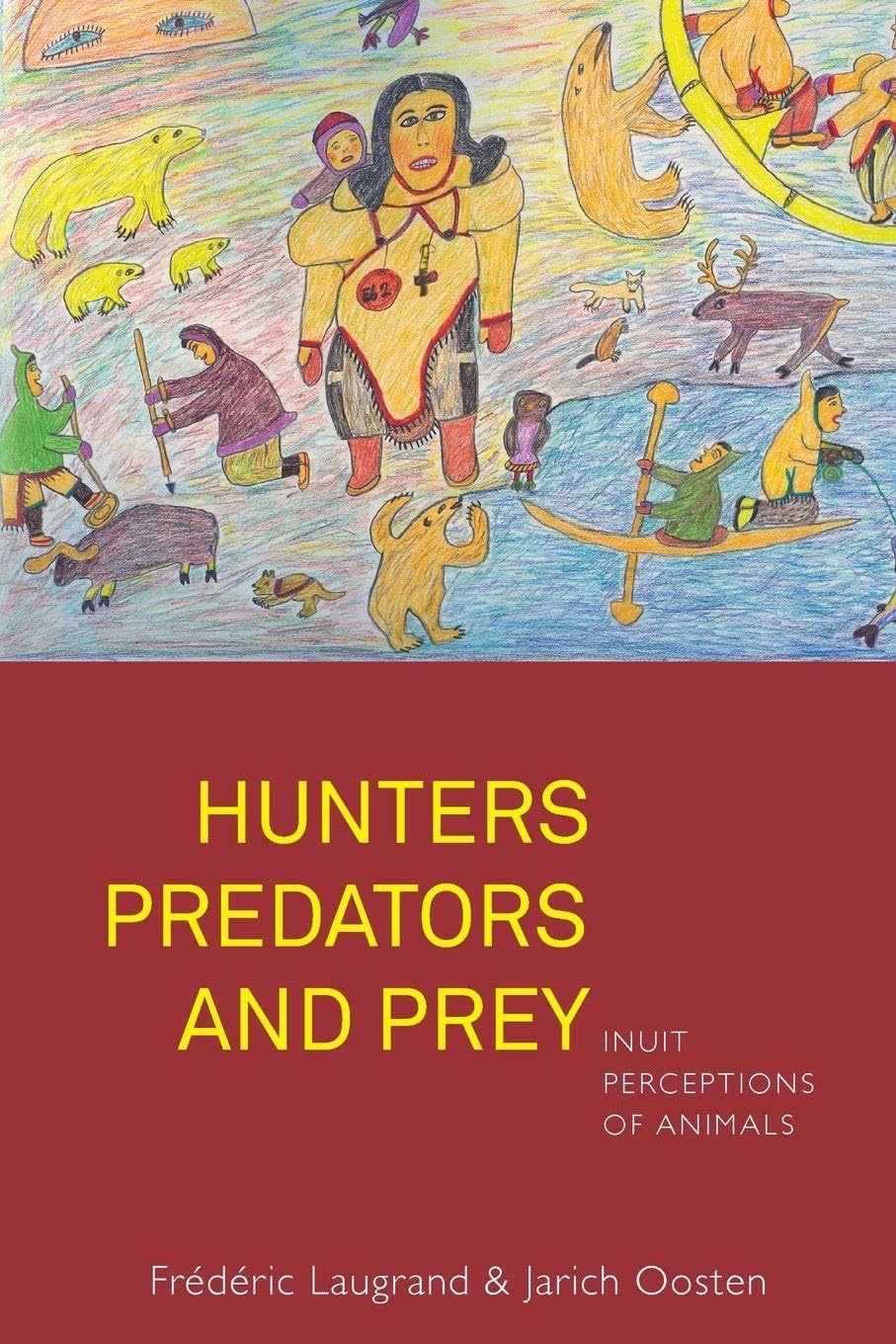



Inuit hunting traditions are rich in perceptions, practices and stories relating to animals and human beings. The authors examine key figures such as the raven, an animal that has a central place in Inuit culture as a creator and a trickster, and qupirruit , a category consisting of insects and other small life forms. After these non-social and inedible animals, they discuss the dog, the companion of the hunter, and the fellow hunter, the bear, considered to resemble a human being. A discussion of the renewal of whale hunting accompanies the chapters about animals considered ‘prey par excellence’: the caribou, the seals and the whale, symbol of the whole. By giving precedence to Inuit categories such as ‘inua’ (owner) and ‘tarniq’ (shade) over European concepts such as ‘spirit ‘and ‘soul’, the book compares and contrasts human beings and animals to provide a better understanding of human-animal relationships in a hunting society. “This is a beautiful and deeply humbling book whose detailed accounts show the depth, power, and wisdom of a worldview too often dismissed or forgotten. For all scholars of the Arctic and indigenous peoples and of major interest to thoughtful philosophers. Essential.” • Choice “The book is useful for anyone interested in the human ecology of the circumpolar north. The book meticulously covers much of what is known about the ways that Inuit morality and religion influence how Inuit perceive the natural environment, revealing a vast body of beliefs and narratives that connect Inuit to the natural world both culturally and cosmologically. It is a useful reference source that can be read as one reads a dictionary, handbook, or encyclopedia, by keyword or by topic. It includes, for example, an excellent index and glossary of indigenous terms.” • Human Ecology “This volume collects and synthesizes [the authors’] research, thereby becoming the most comprehensive English-language source on Inuit perceptions of animals… a landmark contribution to the study of Inuit human–animal relations. Hopefully it will stimulate future research on attitudes toward less charismatic animals, such as fish, ground squirrels, and auks, all of which figure significantly in arctic life.” • Alaska Journal of Anthropology “Specialists in Northern anthropology will appreciate the volume’s bibliography and helpful glossary of hunting-related Inuktitut terminology. On a more general level, the volume represents a valuable contribution to the wider literature on the extension of personhood beyond humanity in hunter-gatherer societies. The research will be useful to any scholar grappling with the question of how a hunter’s cosmological perspective on prey animals influences the hunting process.” • Inuit Studies “… the book is excellent. It is a very strong volume, required reading for any scholar of the Arctic or for those whose work focuses on human animal relationships. The information in the book has provided me with insights about animals that I had never actively considered in my own work.” • Anthropos “…this book provides a hugely worthwhile description and analysis, in their own words, of Inuit hunters’ perceptions, traditions, practices and stories of animals and the socio-ecological setting they share. Moreover, it offers an invaluable resource to aid in, and acts as a call for, Inuit understandings to be given due precedence in discourses concerning Arctic resource use, land management and animal welfare/conservation. This book would, therefore, be a valuable resource for anyone interested in Arctic, ecological or human-nonhuman anthropology.” • Social Anthropology/Anthropologie sociale. “Hunters, Predators and Prey is far from another general work on Inuit hunting. In every respect, it is a deep (and in my view, timely) analysis of Inuit-animal relations. This volume is, indeed must be, daunting, addressing as it does the deep ontological understanding of Inuit about animals in relation to themselves. It also has multilayered importance. First, it is a very powerful anthropological contribution to our understanding of Inuit relations to the world around them. Second, it draws upon a range of sources, first and foremost the authors’ own interviews with Inuit Elders…Last, this volume has critical relevance to contemporary discussions about Inuit and wildlife.” • Arctic Review “…reading this book expanded and enriched my general understanding of Inuit worldview. Indeed, since animals are so central to Inuit society, if one comprehends the complex intellectual framework linking animals with people, one has taken an important step toward understanding Inuit lifeways at the broadest level. As such, this book is recommended for a wide array of scholars―not just those engaged with Inuit culture, past or present, but also scholars interested in general approaches to understanding hunter-gatherers and how humans in worlds very different from ours imagine the human-animal relationship. As nature beco