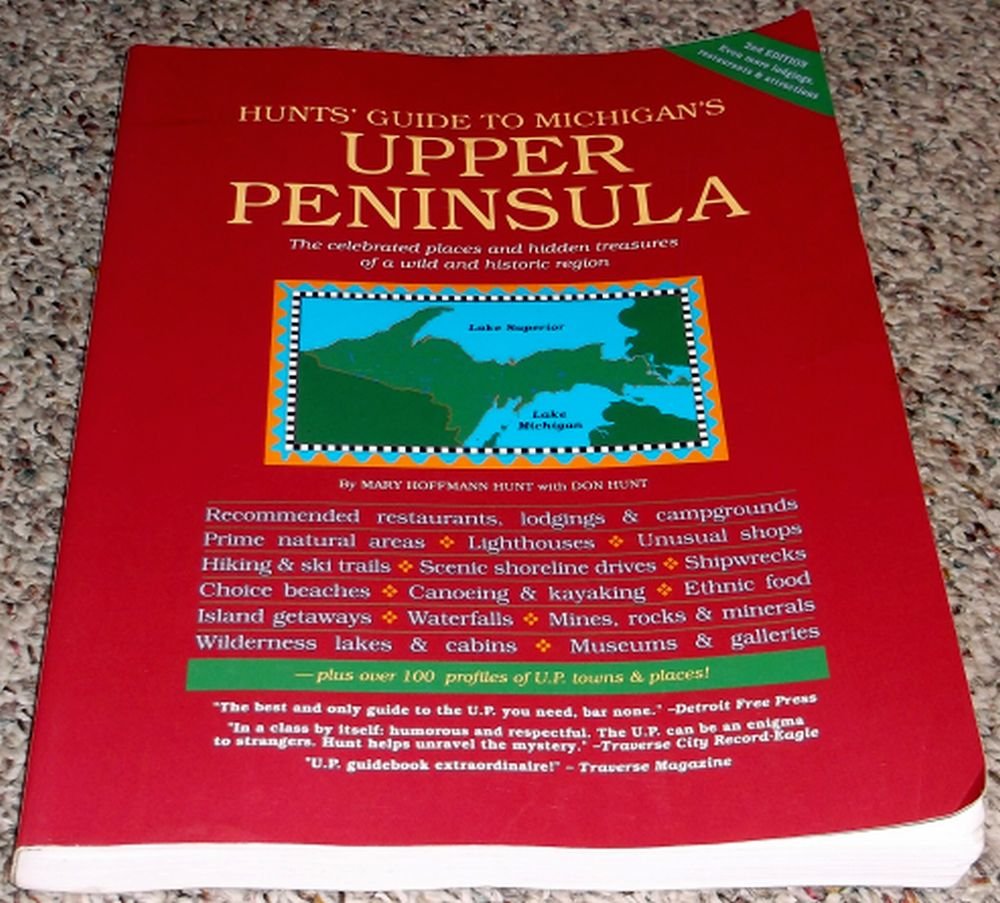



Completely revised and updated guide to both the celebrated places and off-the-beaten-path destinations of a wild, historic region originally based on mining and logging. The Upper Peninsula has mostly escaped rampant tourist development. This guide includes lodgings, restaurants, and campgrounds, chosen for scenery, tranquility, and often walkability as well. Regular notes are made for places that are family-friendly, handicap-friendly, and/or take pets. Opportunities for hiking, fishing, swimming, diving, paddling, looking for rocks and minerals, cross-country skiing, and snowshoeing are noted. Visiting waterfalls, lighthouses, art galleries, specialty shopping, and museums are popular activities covered here. A large page format permits annotated maps and many illustrations. Fully indexed. ". . . looks at things with fresh eyes and sees interest in things like [our] working harbor and grand public libraries." -- Marinette Eagle-Herald, December 4, 2001 "Everyone who reads this will learn something, maybe even about their own home town. Descriptions are skillful and accurate." -- Marquette Mining Journal, December 2, 2001 "Jam-packed with useful bits of information and maps. [Every] boatwatching or lighthouse-visiting opportunity in the U.P. [is] included here." -- Great Laker magazine, Winter 2002 "Presented in the hands-on, no-fluff style that makes the Hunts' guides so popular." -- Michigan Out-of-Doors, November, 1997 "The best and only guide [to the U.P.] you need, bar none. [Includes] cool things like kayaking and bird migrations." -- Detroit Free Press, September 30, 2001 The publisher, Mary Hoffmann Hunt (huntsguides@yahoo.com) Why this remote place is ideal for relaxed vacations and adventures Here are four wonderful things about Michigans Upper Peninsula. Our guide is designed to put people in touch with these things. 1. The U.P. is BEAUTIFUL and mostly UNDEVELOPED, with the largest expanse of public land east of the Mississippi. In the North Woods, a distinctive northern ecosystem, its a place of rocks, hardwood and evergreen forests, and many clean inland lakes and trout streams plus well over a thousand miles of Great Lakes shoreline along lakes Superior, Michigan, and Huron. With a little selective planning, visitors can get away from it all and enjoy nature without crowds. Simple pleasures are its highlight: hiking to waterfalls, picking berries, fishing and birding, paddling, seeing the Milky Way in a dark sky and sometimes the Northern Lights. Bring a few boxes for beachcombing treasures colorful granites and sandstones, volcanic rock with tiny gemstone bubbles, occasional agates, and limestone fossils in the eastern U.P. The U.P. is not for shoppers or the fashion-forward. Its elemental simplicity is a tonic for jaded kids. 2. Its INEXPENSIVE. Locals are notoriously thrifty. In places with a year-round economy (starting at Marquette and Escanaba going west), restaurants have to be priced for locals. Gourmet fare is rare, but so are potatoes from a box. Older resorts and motels are almost always clean; small lakefront resorts survive. Some areas have B&Bs and new motels with pools for visitors who prefer atmosphere and amenities to value. 3. VISITORS DONT NECESSARILY HAVE TO PLAN AHEAD, even in July and August, if they stay at highway motels or state or national forest campgrounds without electricity and hot showers. Late August and early September is the best time of all. (Advance reservations are essential at many small resorts, however.) 4. LOCAL CULTURE is a SURPRISING HIGHLIGHT. Small museums are everywhere and often quite interesting; some large museums, especially the Seaman Mineralogical Museum in Houghton, are major destinations. Many artists have studios in Marquette County and the Keweenaw. Historic architecture from the mining and logging booms of the late 19th century is impressive by any standards. When the area was an economic hot spot it attracted many ETHNIC GROUPS: Yankees, Cornish, Germans, Swedes, Norwegians, French-Canadians, Finns, Italians, Croats, Slovenians, and others (mentioned in chronological order). Their influence is evident in music and food, especially Italian and Finnish, plus the famous U.P. soul food, the pasty Cornish with Scandinavian rutabagas added. Take time to talk to people; the distinctive local dialect is a mix of the Scandinavian accent of the Upper Midwest, made famous in the movie "Fargo," with French-Canadian cadences. (The "eh?" is French.) As outsiders from downstate Michigan, the authors were a little worried about whether they would pass muster with locals, no-nonsense folks who are put off by pretense. Local feedback has been good. The most perceptive comments from any source are those of retired Finnish-American metallurgist Tauno Kilpela of Atlantic Mine in Copper Country. He thanked the Hunts for "taking a long look, and an honest and friendly look, at Gods Country." Mary and Don Hunt founded the A