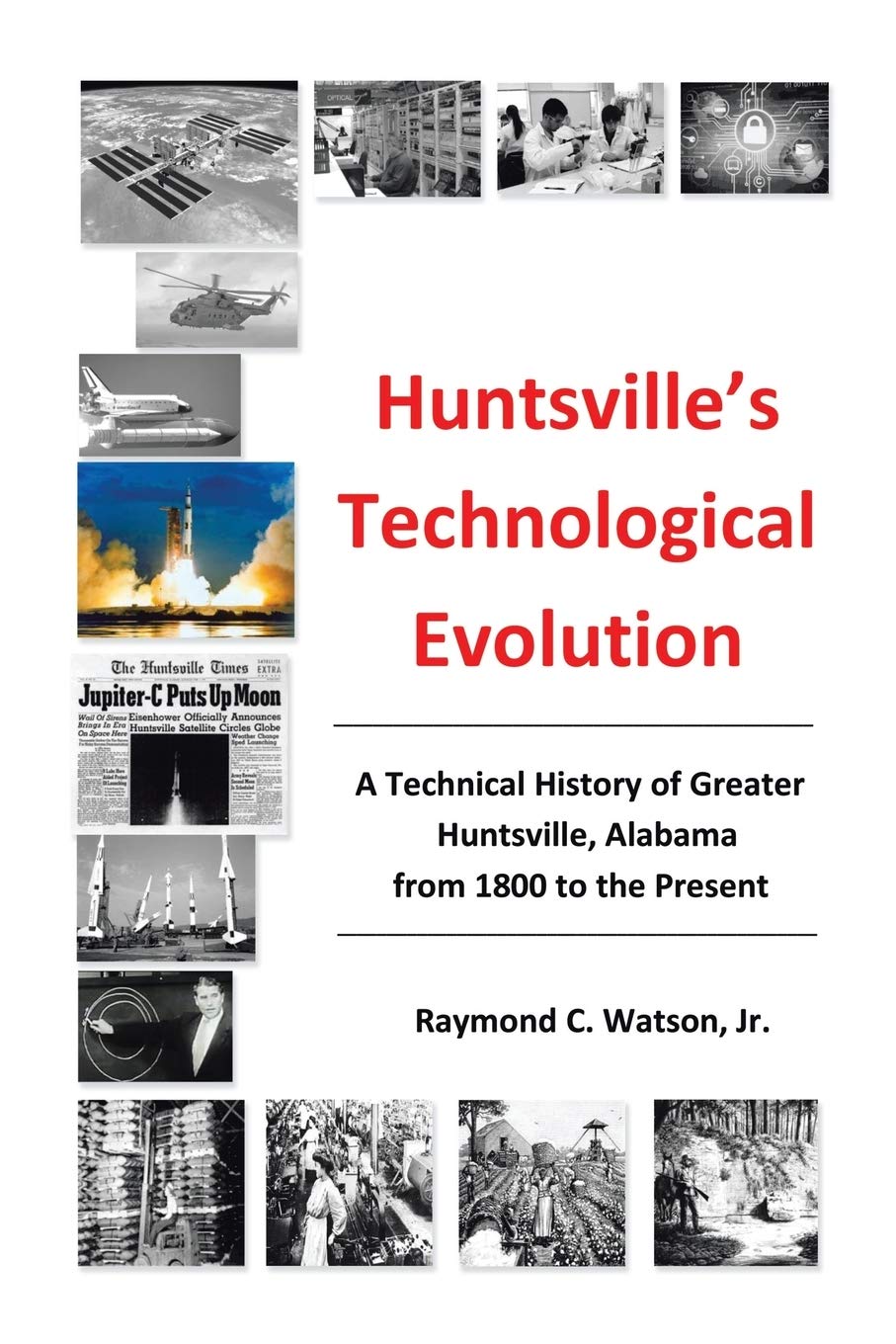
Huntsville's Technological Evolution: A Technical History of Greater Huntsville, Alabama from 1800 to the Present
$16.63
by Raymond C. Watson Jr



Huntsville's Technological Evolution A Technical History of Greater Huntsville, Alabama from 1800 to the Present here have been many books written about the historical development of Huntsville and Madison County, Alabama. Most of these have centered on the cultural aspects, and there has certainly been much of importance from this standpoint. Others have diverse emphases; one masterpiece of the early 1970s - A Dream to Remember, in multiple volumes by James Record - is a highly detailed history of Madison County government. However, it is the author's opinion that the technological evolution of Greater Huntsville provided the foundation on which this region stands - and, until now, this has not been given an end-to-end treatment. This book is divided into five eras; these and the approximate dates covered are Origins and Maturing (1800-1890); Manufacturing (1890-1949); Rocket City (1949-1970); Diversification (1970-2000); and Present and Beyond (2000-?). There is also a Prologue and an Epilogue, both included as an integral part of the text. In addition to documenting the technological evolution in a series of eras, a major attempt was made to cite the individuals and groups that made it happen. Greater Huntsville - a term for the city and much of the surrounding Madison County that was adopted when the city limits were not enlarged as needed - is now primarily a Federal Government metropolis. Correctly, the political aspects of this are acknowledged, and detailed information about the many agencies and associated contracting firms are included, but the people deserve and are given full credit. There are about 1,150 individuals noted in the book - covering over two centuries Huntsville's Technological Evolution A Technical History of Greater Huntsville, Alabama from 1800 to the Present By Raymond C. Watson Jr. Trafford Publishing Copyright © 2015 Raymond C. Watson, Jr. All rights reserved. ISBN: 978-1-4907-6553-2 Contents Prologue, 1, Ch. I – ORIGINS and MATURING, 7, Ch. II – MANUFACTURING ERA, 69, Ch. III – ROCKET CITY ERA, 117, Ch. IV – DIVERSIFICATION ERA, 233, Ch. V – PRESENT and BEYOND, 351, The Author, 440, Index, 441, Image Sources, 469, CHAPTER 1 ORIGINS and MATURING The 19th century – 1800 through 1899 – is the originating and maturing period of Huntsville and Madison County. To cover the history – particularly the technological evolution – of this area in this extended period, the information has been divided into the four segments: Early Times, King Cotton, Transportation and Utilities, and Maturing Times. To an extent, these are also time periods, but there is considerable overlapping. EARLY TIMES The area eventually containing Madison County was in the region called Ah-la-bama by the native Muscogee (also called Creek) Indians who occupied the lower portion of the region; in their language, Mvskoke, this was a phrase meaning, "We will rest here." There is little recorded as to the first exploration of this area – some historians believe this was by Spanish explorer Hernando de Soto in 1540. French maps from the late 17th century show a large traversing river looping south and then north around the area – later called the "Great Bend" – certainly indicating early French explorations (the town of Mobile was formed by the French River first appears on maps of the late 18th century; it is believed to have come from Tanasi, a Cherokee Indian village. NATIVE AMERICANS The area in North Alabama adjacent to the Tennessee River is commonly called the Tennessee Valley, herein simply "the Valley". The Cherokee Indians were the first well-identified inhabitants spread across the Valley, but in about 1650, they withdrew from the region to an area in the mountains to the northeast, reserving the flat portions of the Valley as a large hunting ground. Shawnee Indians then moved southward from around the Cumberland River and occupied land in the Valley. This led to many years of warfare between the Cherokees and intruding Shawnees. The Chickasaw Indians from the western portion of the Valley eventually teamed with the Cherokees, and by the early 1720s, the Shawnees had been driven northward into the Ohio River area. Then for almost half a century, the Tennessee Valley was without permanent occupancy. In about 1765, some of the Chickasaws moved into an area near the Tennessee River in what is now the southern portion of Huntsville, and formed a large settlement. This was challenged by the Cherokees, and they attacked their former allies. In 1769, there was a major battle at the Chickasaw settlement; the Chickasaws won, but at such a great loss that they withdrew from the settlement. Thereafter, the area of the abandoned settlement was known as the Chickasaw Old Fields (a square with about three-mile sides); this became a benchmark for future divisions of the land. Through the following three decades, both tribes claimed the land on both sides of the river, westward