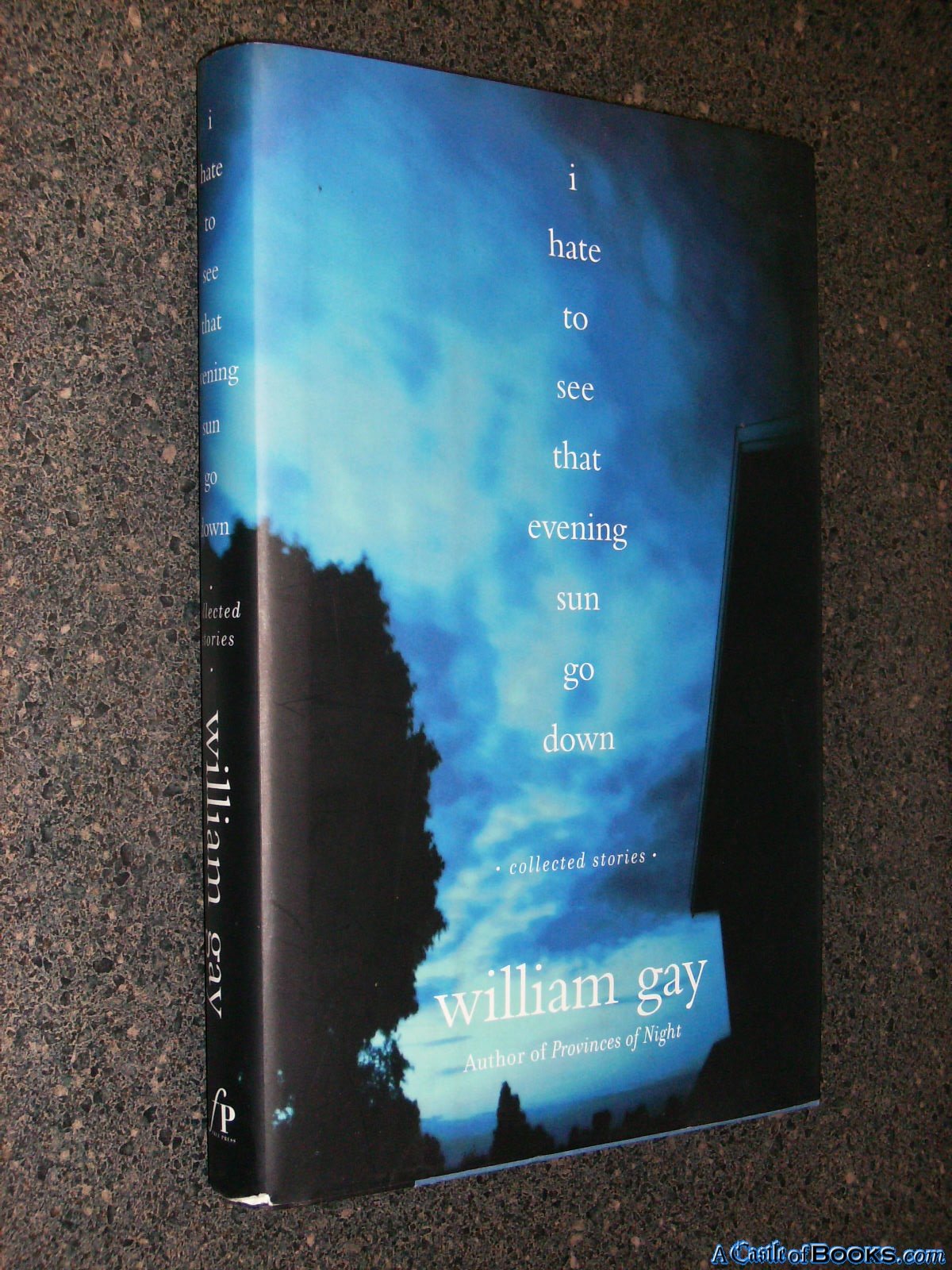



William Gay firmly established himself as "the big new name to include in the storied annals of Southern Lit" ( Esquire ) with his debut novel, The Long Home, and his critically acclaimed follow-up, Provinces of Night. Like Faulkner's Mississippi and Cormac McCarthy's American West, Gay's Tennessee is redolent of broken, colorful souls hard at work charting the pathos of their interior lives. His debut collection, I Hate to See That Evening Sun Go Down, brings together what Gay's dedicated readers are eager for and what new readers will find the perfect introduction to his world: thirteen stories that are mined from this same fertile soil teeming with the grizzled, everyday folk that Gay is famous for bringing to life. In these pages readers meet old man Meecham, who escapes from his new nursing home only to find his son has rented their homestead to "white trash"; Quincy Nell Qualls, who not only falls in love with the town lothario but, pregnant, is faced with an inescapable end when he abandons her; Finis and Doneita Beasley, whose forty-year marriage is broken up by a dead dog; Bobby Pettijohn, who is awakened in the middle of the night by the noise and lights of a search party looking for clues after a body is discovered in his backwoods. William Gay expertly sets these conflicted people who make bad choices in life and love against lush back-country scenery, and somehow manages to defy moral logic as we grow to love his characters for the weight of their human errors. Diverse as these tales are, what connects them is the powerful voice of a born storyteller. Gay (Provinces of Night; The Long Home) offers a collection of stories whose characters arrive at a crossroads and usually choose the wrong path, be it violence, arson, or suicide. In the title story, an elderly man escapes his retirement home and uses extreme measures to rid his house of the family who is renting it. "The Paperhanger" involves a Pakistani doctor's wife, her difficulties with the titular paperhanger, and a missing child. In "Closure" and "Roadkill on the Life's Highway," a quest for a hidden stash of money gives the protagonist the means to come to terms with his estranged wife. Gay often fails to connect characters with the reader, so it's hard to understand why they make their violent, irrational decisions. But in the stronger stories the truth of the characters comes through. For larger public libraries and collections of Southern fiction. Christine DeZelar-Tiedman, Univ. of Minnesota Lib., Minneapolis Copyright 2002 Cahners Business Information, Inc. *Starred Review* A bitter, betrayed teenage girl murders her former boyfriend, a fellow named Bonedaddy. A seemingly happy marriage is torn apart when a husband shoots his wife's dog. This is the South of Gay's short fiction, "a countryside so beleaguered and desolate even the dead were fleeing it." He brings to these stories the same astounding talent that earned his two novels, The Long Home and Provinces of Night , a devoted following. In "The Paperhanger," the most haunting in this consistently excellent collection, the daughter of a Pakistani family disappears. The paperhanger, in the house at the time of the girl's disappearance, along with other workers building the family's dream house, is only briefly a suspect. The girl's mother sits for weeks on her half-finished veranda as her marriage and life fall apart before meeting a horrifying fate at the hands of the paperhanger. The ordinary evil of the characters, each of them broken, is the hallmark of these gut-wrenching tales, stories told from half-finished verandas about wholehearted attempts to bandage the wounds of the human spirit with cheap wallpaper. John Green Copyright © American Library Association. All rights reserved William Gay is the author of the novels Provinces of Night and The Long Home. His short stories have appeared in Harper's, The Georgia Review, The Atlantic Monthly, GQ, Oxford American, and New Stories from the South, 1999-2001. The winner of the 1999 William Peden Award, the 1999 James A. Michener Memorial Prize, and the recipient of a 2002 Guggenheim fellowship, he lives in Hohenwald, Tennessee. Used Book in Good Condition