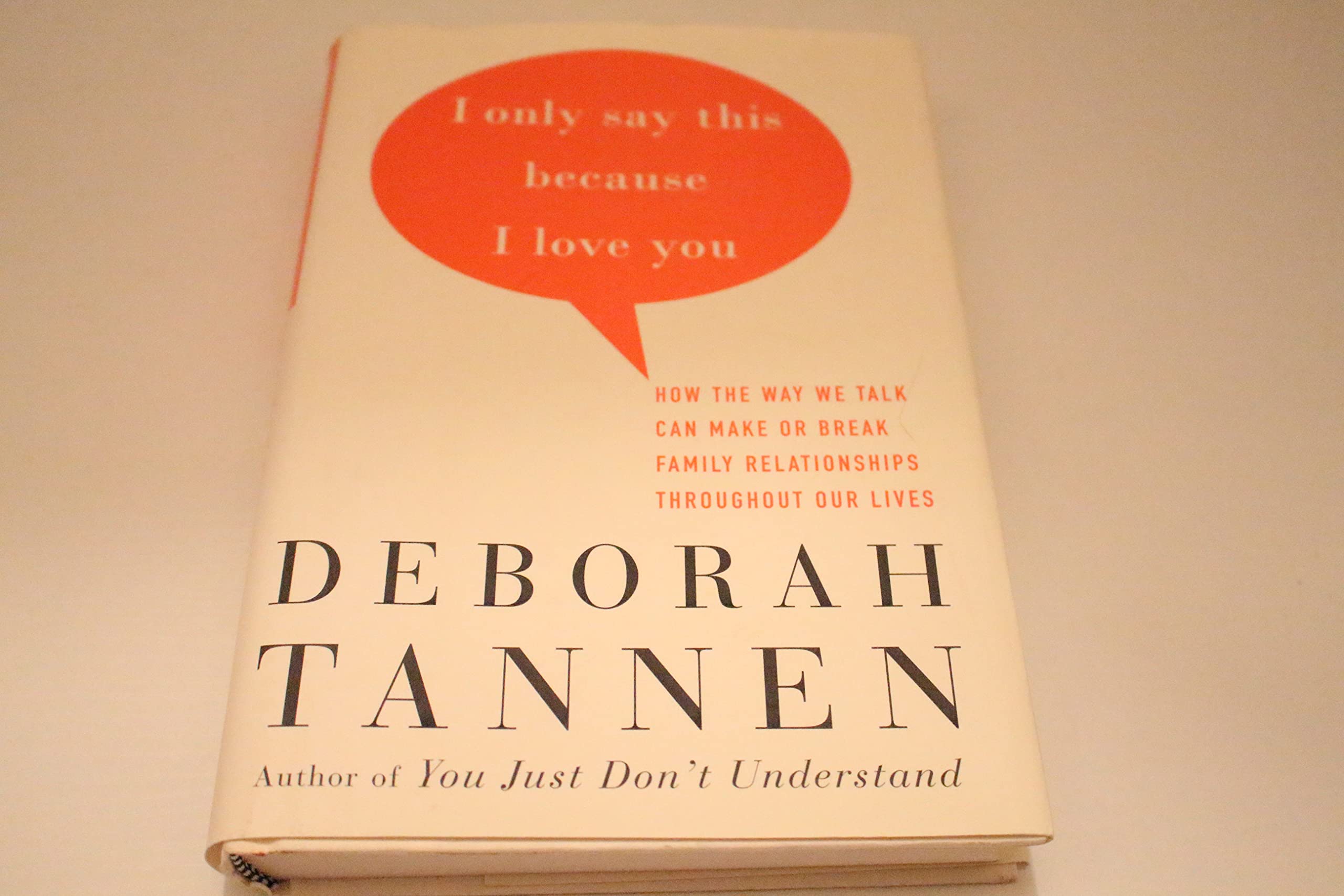
I Only Say This Because I Love You: How the Way We Talk Can Make or Break Family Relationships Throughout Our Lives
$10.40
by Deborah Tannen



Why does talk in families so often go in circles, leaving us tied up in knots? In this illuminating book, Deborah Tannen, the linguist and and bestselling author of You Just Don't Understand and many other books, reveals why talking to family members is so often painful and problematic even when we're all adults. Searching for signs of acceptance and belonging, we find signs of disapproval and rejection. Why do the seeds of family love so often yield a harvest of criticism and judgment? In I Only Say This Because I Love You , Tannen shows how important it is, in family talk, to learn to separate word meanings, or messages, from heart meanings, or metamessages — unstated but powerful meanings that come from the history of our relationships and the way things are said. Presenting real conversations from people's lives, Tannen reveals what is actually going on in family talk, including how family conversations must balance the longing for connection with the desire for control, as we struggle to be close without giving up our freedom. This eye-opening book explains why grown women so often feel criticized by their mothers; and why mothers feel they can't open their mouths around their grown daughters; why growing up male or female, or as an older or younger sibling, results in different experiences of family that persist throughout our lives; and much, much more. By helping us to understand and redefine family talk, Tannen provides the tools to improve relationships with family members of every age. "Everything we say to each other echoes with meanings left over from our past experience--both our history talking to the person before us at this moment and our history talking to others," says Deborah Tannen, one of the world's most famous linguists. We react not only to the message, but to the "metamessage": our interpretation of the unstated meaning, based on tone, relationship, and our past associations. Add in the connections and control issues among family members, and it's no wonder families have so much trouble understanding each other! I Only Say This Because I Love You is aimed mostly at adult family interactions. Professor Deborah Tannen, the popular author of You Just Don't Understand , uses anecdotes filled with dialogues to illustrate why we hear criticism when the other person meant to convey caring, how family members create alignments with secrets and broken confidences, the dynamics of arguments, the power of apologies, gender patterns in family talk, and communication with teens. You're bound to recognize your family members--and yourself!--in Tannen's examples. You won't find quick, easy answers for improving communication in your family, but you will discover another dimension of understanding what's really going on. Now if you could just get your mother to read the book! --Joan Price The author of 17 books (e.g., That's Not What I Meant!, You Just Don't Understand), Tannen (linguistics, Georgetown) returns to her first love, "the language of everyday conversation" among family members, using transcripts, anecdotes, and literary examples. With lively prose and genuine concern for people, Tannen brings linguistic concepts metamessage, re-framing, indirect request to bear on dozens of situations to help lay readers strengthen family ties. Her audience needs to realize that she blurs lines between linguistic science and art; she is also a poet, translator, and playwright, and she frequently dips into social sciences and philosophy. Discussions of connection and control, apology, and talking with teens draw on psychology more than linguistics, and Tannen's judgments are sometimes partial, in both senses of the word, and open to dispute. This is nevertheless a fine stimulant to conversation, constructive argument, and research. Essential for larger public and academic libraries, along with Suzette Haden Elgin's works (e.g., The Last Word on the Gentle Art of Verbal Self-Defense, 1987). E. James Lieberman, George Washington Univ. Sch. of Medicine, Washington, DC Copyright 2001 Reed Business Information, Inc. Linguist and best-selling author Tannen explores how caring and concern, connection and control are communicated between family members. She uses research, conversations with actual family members, personal recollections, and literature and movies to illustrate the complexities of communication within families. Family communication is marked by intimacy and indirection. Who first knew your secrets and your hot buttons? Who else can reduce you to a sniveling adolescent with a single word? Parents and siblings have power based on age and role in the family, and their ways of talking reinforce that power. "Family relations are a web of alliances drawn and redrawn by talk, as information is shared, repeated, kept secret, or revealed." Sibling rivalries, jealousies, resentments, secrets, and gossip are all elements in the constant struggle to balance our need for connectedness with our resis