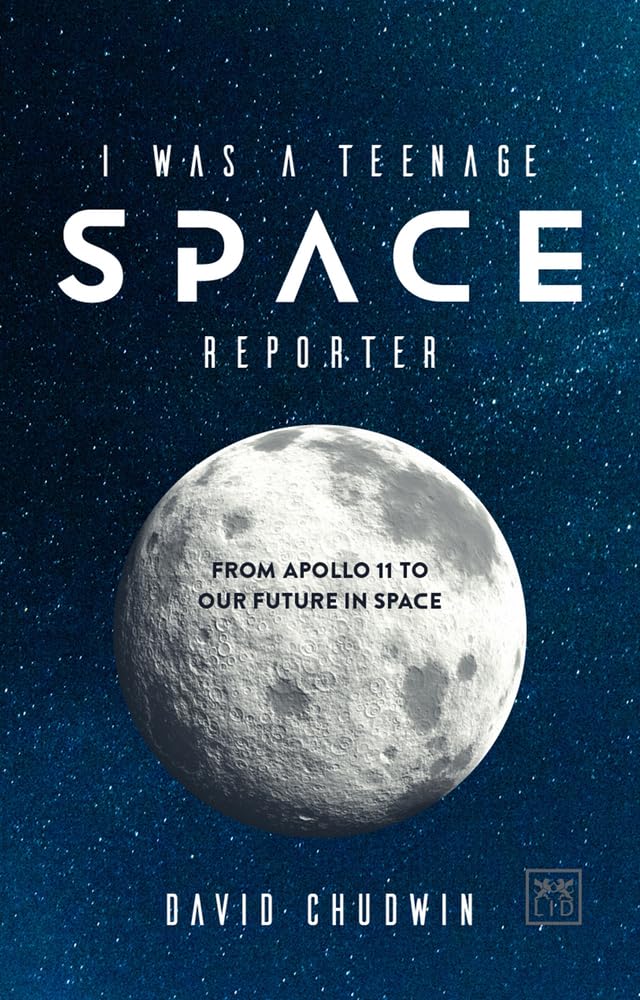
I Was a Teenage Space Reporter: From Apollo 11 to Our Future in Space
$12.95
by David Chudwin



“ That’ s one small step for (a) man, one giant leap for mankind,” were the words spoken by astronaut Neil Armstrong as he stepped off the Apollo 11. This was the first and most famous manned mission to land on the Moon. As a 19-year-old college journalist, author David Chudwin covered the launch from Florida in July 1969. Chudwin was the only journalist with official NASA press credentials representing the college press and had extraordinary access to the astronauts, rocket scientists, launch pads, rockets, and control centers. 2019 will be the 50th anniversary of Apollo 11 — a time to look back to celebrate that mission, and forward to our future in space. Divided into three parts, this book provides: the author’ s account of covering the first landing on the Moon in 1969; lessons learned from the Apollo program and their relevance to future space activities; and our future in space including new rockets, space stations, and trips back to the Moon and to Mars. David Chudwin MD decided to go into medicine instead of journalism, but his Apollo 11 experiences led to a lifelong interest in space exploration. Chudwin has written about Apollo 11 in a variety of media outlets and has spoken at schools and at space meetings, including Spacefest. Chudwin was the only teenager to be granted a press pass for the 1969 moon landing. I am a very lucky individual. As a 19-year-old college journalist, I covered the launch of the first Moon landing mission, Apollo 11, from Florida. I was one of the only teenagers to have official NASA press credentials for that historic event in July 1969, and the only journalist representing college newspapers. As a result, I had extraordinary access to the astronauts, rocket scientists, launch pads, rockets and control centers there. On 16 July 1969, at 9:32 a.m., I watched in person as Neil Armstrong, Mike Collins and Buzz Aldrin lifted off from NASA’s Kennedy Space Center on a massive Saturn V rocket on their way to the Moon. Four days later I reported from the NASA News Center there on humankind’s first steps on the Moon. Now that the 50th Anniversary of Apollo 11 approaches, it is an appropriate time to look both backwards at that mission, and forward to our future in space. For you and others not born yet, Neil Armstrong and Buzz Aldrin’s landing on the Moon on 20 July 1969 is almost ancient history; indeed, a 50th anniversary confirms that fact. In many ways the world was quite different then, with no mobile phones, personal computers, the internet, Facebook and other social media. By recounting Apollo 11 through the eyes of a teenager who was there, I hope that you experience the excitement, fears, planning and hard work that led to the first landing on another celestial body. It was not at all clear that the complicated plan requiring rendezvous of two spacecraft in lunar orbit would work. The astronauts themselves estimated they had only a fifty-fifty chance of success on the first try.