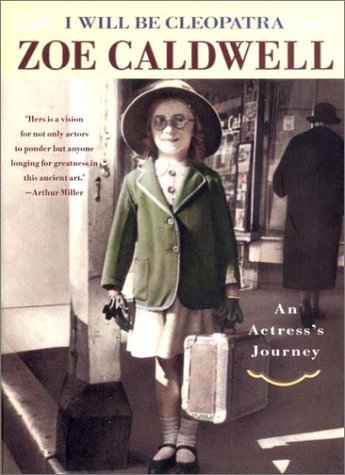



Echoing such classics as Eudora Welty's One Writer's Beginnings and Moss Hart's Act One , I Will Be Cleopatra is a riveting account of a determined, yet modest woman who became one of the leading classical actors of our time. To those whose only exposure to acting are the films of Hollywood, Zoe Caldwell remains a secret. To those of us, however, who have seen her on the stage―whether in London, Toronto, or New York―she is the essence of theater, her presence so transfixing that the memory of having seen her is emblazoned in the mind forever. The daughter of a plumber and a taxi dancer born in Australia at the height of the Great Depression, Caldwell first demonstrated her talents at the age of nine when she appeared on the stage as Slightly Soiled in Peter Pan. Hampered by a mild dyslexia, she felt that acting was the only way she could communicate, and by the age of fourteen she was appearing professionally in national radio soap operas. Caldwell spent the next ten years honing her skills as an actress, before she was sent to Stratford-upon-Avon in 1958, where she began a Shakespearean acting career that would culminate in her stunning portrayal of Cleopatra, the Bard's greatest female role. Caldwell's own uniquely charming and powerful voice―one that she brought to her roles in The Prime of Miss Jean Brodie and as Maria Callas in Master Class ―shines throughout this intimate memoir. Rather than emphasizing the stories of her adult triumphs, however, Caldwell deliberately focuses on the early influences and experiences that molded her as an actress: her enchanting first visits to the theater, sandwiched in between her parents, where she sat in "the gods," way up in the cheap seats; her early teachers and coaches who taught her not only how to use her diaphragm but also how to keep people "awake and in their seats"; and her journey―steerage class―to England at the age of twenty-five to perform at Stratford with many of the greatest actors of the twentieth century. As Caldwell reveals in these pages, acting is not a craft practiced in isolation. With an experienced eye, she describes her fellow performers, writers, and directors who have shaped her career: from Charles Laughton and Albert Finney to Edith Evans, Paul Robeson, and Laurence Olivier. She has performed the works of major playwrights from Shakespeare and Chekhov to Harold Pinter and Tennessee Williams, many of whom she knew personally. Her insights into the actor's craft reveal the completely undiluted and remarkably fine voice of an artist still impassioned about her craft and dedicated to its perpetuation in its purest form. I Will Be Cleopatra represents the literary culmination of a legendary theatrical career and a fascinating life. This highly entertaining autobiography presents the sometimes comical, sometimes touching memoirs of an Australian actress and winner of four Tony Awards, who was also one of the leading classical and Broadway actors of the 20th century. From her earliest memories as a child growing up in Melbourne to the culmination of her Shakespearean career as Cleopatra in 1967, Caldwell draws the reader into her world of the stage. "Actors need to observe," Caldwell writes, "for that is what they draw upon." She is unhesitatingly honest in both her praise and her criticism of her own and others' performances on and off the stage. Caldwell's witty descriptions and anecdotes of both ordinary people and all the greats with whom she worked from Paul Robeson, John Gielgud, and Laurence Olivier to Dame Judith Anderson, Dame Edith Evans, and Vivien Leigh give insight into the 20th century's "golden age of theater" as well as into the actress's dynamic and candid personality. Highly recommended for all theater and biography collections. Laura A. Ewald, Murray State Univ. Lib., KY Copyright 2001 Reed Business Information, Inc. A stage actor must know the instrument of voice: four-time Tony winner Caldwell says that "if they [the audience] know exactly what you're saying, they will follow you anywhere." Her voice is crystalline--wry, determined, candid, lucid, occasionally fierce--in this memoir delivered in part as lectures at New York Public Library. In telling us of her birth and upbringing in Australia, her work as a teen in radio, her following the craft to England, to Russia, to Canada, and then to the U.S., she introduces a great many ideas about theater and not a few sly stories about actors. She has been friends and colleagues for decades with Hume Cronyn and the late Jessica Tandy; she played Lady M to Sean Connery's Macbeth; she was named corespondent in Albert Finney's divorce. Some of these things tumble out like marbles, others are presented in a bezel like a jewel. The memoir ends in 1967, with her Broadway triumph in Antony and Cleopatra with Christopher Plummer. GraceAnne DeCandido Copyright © American Library Association. All rights reserved Hers is a vision for not only actors to ponder but a