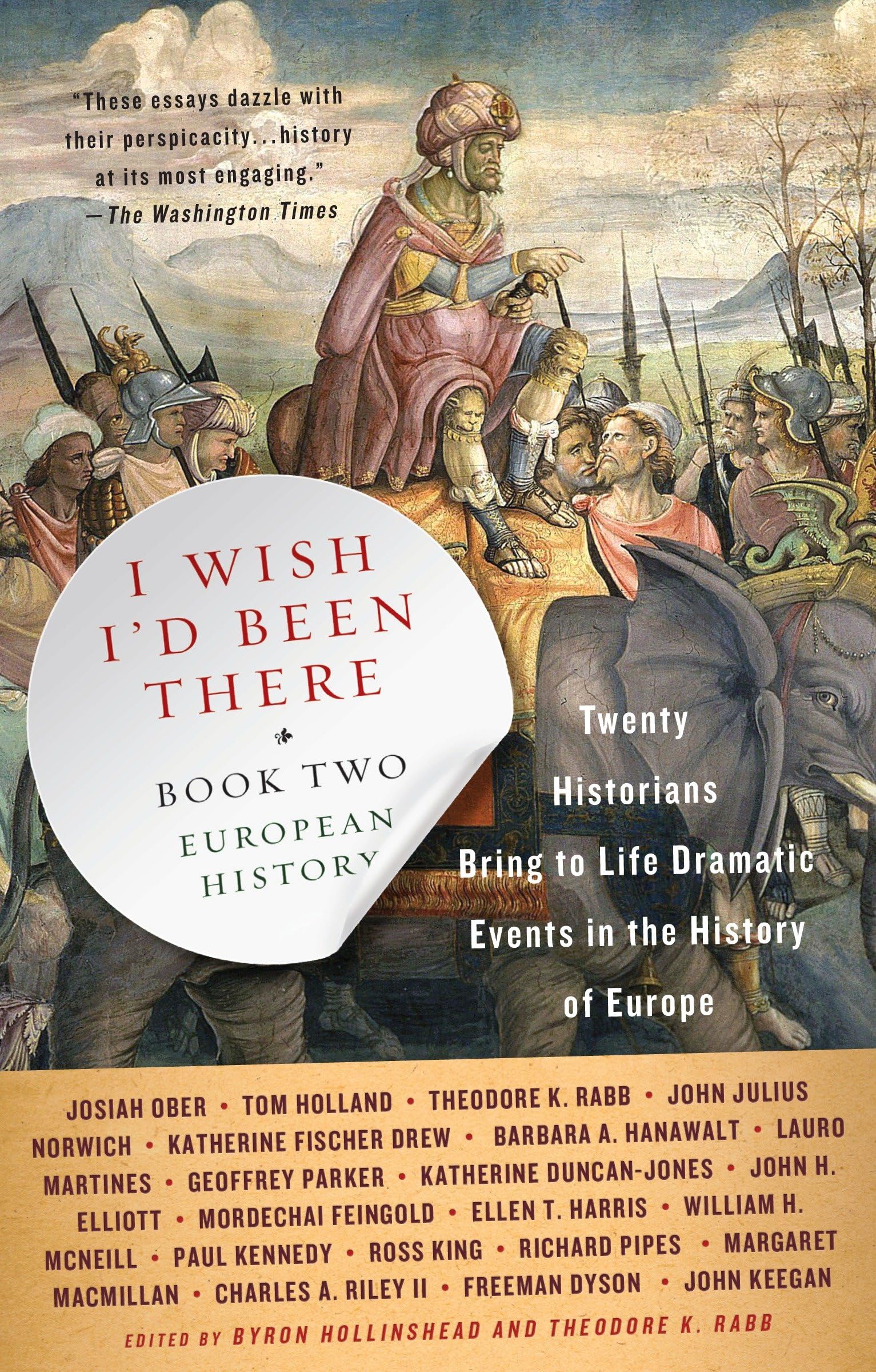



“What is the scene or incident in European history that you would like to have witnessed-and why?” With lively and detailed accounts of some of the most dramatic events in history, some of our finest historical writers now turn their attention to Europe in this companion volume to I Wish I'd Been There: Twenty Historians Bring to Life the Dramatic Events that Changed America. Guided by peerless scholars such as Paul Kennedy, John Keegan, Ross King, Freeman Dyson, and Katherine Duncan-Jones, readers will be transported to the signing of Magna Carta, the Versailles Conference, the German surrender in WWII on Luneburg Heath, and other key turning points in the drama of European history. These essays encompass two millenia and an entire continent, addressing issues of politics, law, religion, peace and war, science and the arts, and social change, all telescoped into finely observed narratives. The result is an historical pageant of characters and episodes that will attract and delight all readers of history. “These essays dazzle with their perspicacity.... History at its most engaging.”— The Washington Times “Rabb and Hollinshead have assembled a formidable array of scholars to engage in imaginary time travel.” — Financial Times “An absolutely sparkling collection: an ideal present for anyone with historical inclinations.” — Times Literary Supplement “This sound, quirky, and savory offering will kindle the imaginations of armchair historians.” — Publishers Weekly Byron Hollinshead is president of American Historical Publications, a producer of books in history for adults and for children. Previously, he was president of American Heritage Publishing Company and Oxford University Press, Inc. He was publisher of MHQ: The Quarterly Journal of Military History and Time Machine: American History for Kids , and edited I Wish I'd Been There (books one and two) . Theodore K. Rabb is a professor of history emeritus at Princeton University. He is the author of The Struggle for Stability in Early Modern Europe and The Last Days of the Renaissance , among other books. Rabb was the principal historical adviser and commentator for the Emmy-nominated PBS series Renaissance and wrote the series's companion book, Renaissance Lives . JOSIAH OBER At the Deathbed of Alexander the Great Josiah Ober is the Constantine Mitsotakis Professor in the School of Humanities and Sciences at Stanford University, where he holds appointments in Political Science, Classics, and Philosophy. After teaching at Montana State University, he joined the Classics Department at Princeton University in 1990, where he was the David Magie Professor of Classics from 1993 to 2006. Professor Ober has written extensively on military history, classical political thought, and ancient and modern democracy. He is the author of a number of books, including Mass and Elite in Democratic Athens, The Athenian Revolution, Political Dissent in Democratic Athens , and, most recently, Athenian Legacies: Essays on the Politics of Going On Together (2005). He is currently completing a new book on participatory democracy, knowledge organization, and innovation. He spends as much of his spare time as possible wading the streams near Bozeman, Montana, fly-fishing for trout. To start this volume, he takes us back to the last days of the greatest conqueror in history. *** At the Deathbed of Alexander the Great The last days of Alexander the Great have been obsessively studied since antiquity and much is known; the numerous Greek literary sources can be complemented by precious cuneiform texts and the evidence of archaeology. We know when and where he died: June 11, 323 b.c., between 4:00 and 5:00 p.m., on the banks of the Euphrates River in the fabled city of Babylon, in a palace built by the great and notorious Nebuchadnezzar a quarter millennium before. At the moment of his death, Alexander was surrounded by his lieutenants, soldiers, wives, and eunuchs; by Macedonians, Greeks, Persians, and Babylonians; along with petitioners, ambassadors, admirers, and gawkers from across three continents. The cause of death was fever. The symptoms began several days before, after a long night of heavy drinking. The fever abated briefly, then became increasingly severe. At the end Alexander could barely move and could not speak clearly, but he retained enough strength to press his signet ring into the hand of one of his generals. When asked to whom his spear-won realm should pass, the king, it was said, managed to whisper "to the strongest." Few ancient death scenes are as well documented, yet so much remains mysterious. Upon Alexander's demise, a rumor circulated that he had been poisoned. Fingers pointed to Antipater, the veteran commander who had been left in charge of Macedon when the twenty-year-old Alexander set out to conquer Asia. Antipater's son Cassander arrived in Babylon just a few days before the onset of the king's fever and had quarreled violently