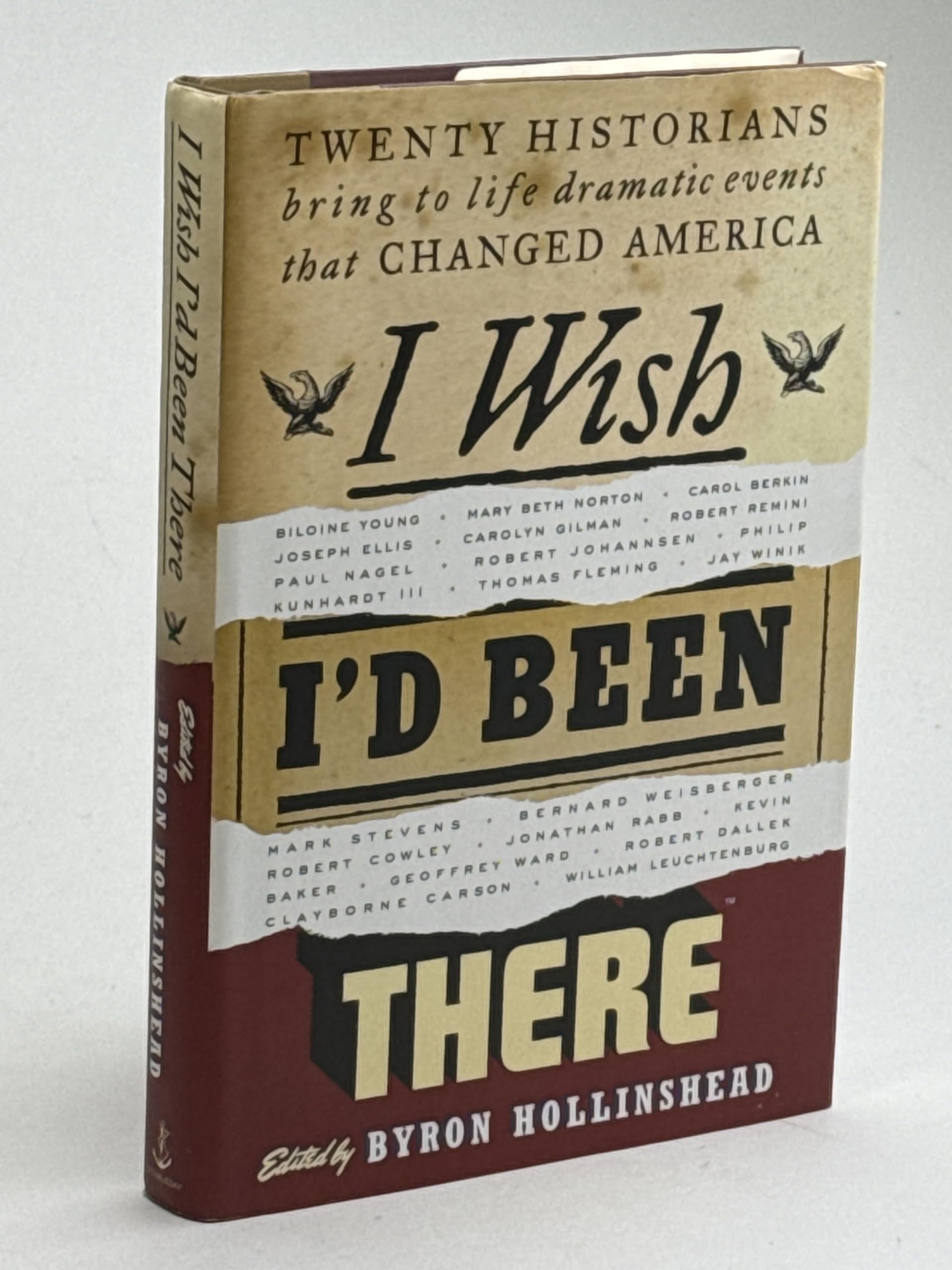
I Wish I'd Been There: Twenty Historians Bring to Life Dramatic Events That Changed America
$11.13
by Byron Hollinshead



Twenty distinguished American historians vividly reimagine twenty events of great drama and significance in our country’s past. “What is the scene or incident in American history that you would like to have witnessed—and why?” This is the thought-provoking question that editor Byron Hollinshead posed to twenty of our finest interpreters of American history with the invitation to write a personal essay answering it. The result is I Wish I’d Been There , a book that trains a lens on crucial moments of our past and brings them to vivid life. With these peerless scholars as their guides, readers will be transported to the Salem witch trials, the Lewis and Clark expedition, the raid on Harpers Ferry, the assassination of Abraham Lincoln, the Scopes “monkey trial,” the beginnings of the Vietnam War, the voting rights march to Selma, and other turning points of our national drama. Contributors include Mary Beth Norton, Joseph Ellis, Jay Winik, Carol Berkin, Kevin Baker, Robert Cowley, Carolyn Gilman, Geoffrey Ward, Robert Dallek, and William Leuchtenburg, among other luminaries of the historical profession. I Wish I’d Been There is a marvelous concept, wonderfully and imaginatively executed. The result is an American pageant of character and event that will attract and delight readers of history. Countless historians and lay thinkers have expressed their fantasy of being a "fly on the wall," able to view and listen in as a particular moment in history unfolded. Hollinshead has assembled an anthology of these participatory fantasies, written by 20 prominent historians. Through the imagined experiences of these historians, we can spend a day in -eleventh-century Cahokia, the Native American metropolis on the Great Plains; we can join Meriwether Lewis as he straddles the Continential Divide and puts to rest the dream of the Northwest Passage; we can sit in the sweltering courtroom as Bryan and Darrow joust over evolution. Although the various descriptions are well grounded in historical fact, they are inevitably filtered through the biases of the individual historians, and some will dispute their interpretations of reality. So this may not be strictly data-driven history, but it is provocative and should be a fun read for both historians and general readers. Jay Freeman Copyright © American Library Association. All rights reserved “Such vivid detail it’s as if they were present.” — New York Daily News “Fun. . . . Poses new and intriguing questions. . . . The essays are crammed with knowledge and are as thought-provoking as they are entertaining .” — Buffalo News “Provocative essays that both scholars and history buffs can enjoy.” — Deseret Morning News From the Trade Paperback edition. is president of American Historical Publications, a producer of books in history for adults and for children. Previously, he was president of American Heritage Publishing Company and Oxford University Press, Inc., and was publisher of MHQ: The Quarterly Journal of Military History . Hollinshead has been a consultant to several PBS documentaries in history, including, most recently, Freedom: A History of US , a sixteen part series from Kunhardt Productions. Biloine W. Young A Day in Cahokia–AD 1030 Biloine (Billie) Young lives in St. Paul, Minnesota, and is involved there in a number of cultural and civic activities. She is also the founder of Centro Colombo Americano, an educational and cultural center in Cali, Colombia. Among her published books are Cahokia: The Great Native American Metropolis ; Mexican Odyssey: Our Search for the People’s Art ; A Dream for Gilberto: An Immigrant Family’s Struggle to Become American ; and Three Hundred Years on the Upper Mississippi . In this essay Billie Young takes an imaginary journey to the Mississippi River metropolis of Cahokia in the summer of 1030. It is an unforgettable experience. *** A Day in Cahokia–AD 1030 One of the first discoveries made by the Spanish who came to the New World following Columbus was that the Americas were filled with people living in advanced civilizations. Cortez and his men were astounded, in 1519, at the sight of the Aztec Tenochtitlán, a city of 300,000 that was larger, cleaner, and more efficiently managed than any in Europe. The sight was so extraordinary that the superstitious soldiers thought they had been enchanted “on account of the great towers and pyramids and buildings rising from the water, and all built of masonry.” Houses, shaded with cotton awnings, were “well made of cut stone, cedar, and other fragrant woods, with great rooms and patios, all plastered and bright.” The Europeans would have been even more amazed if they had known that five hundred years earlier the Indians of North America had also established a metropolis–a planned urban center housing tens of thousands. Located on the American Bottom, where the Missouri, the Illinois, and the Kankakee rivers flow into the Mississippi, the Indian city we call C