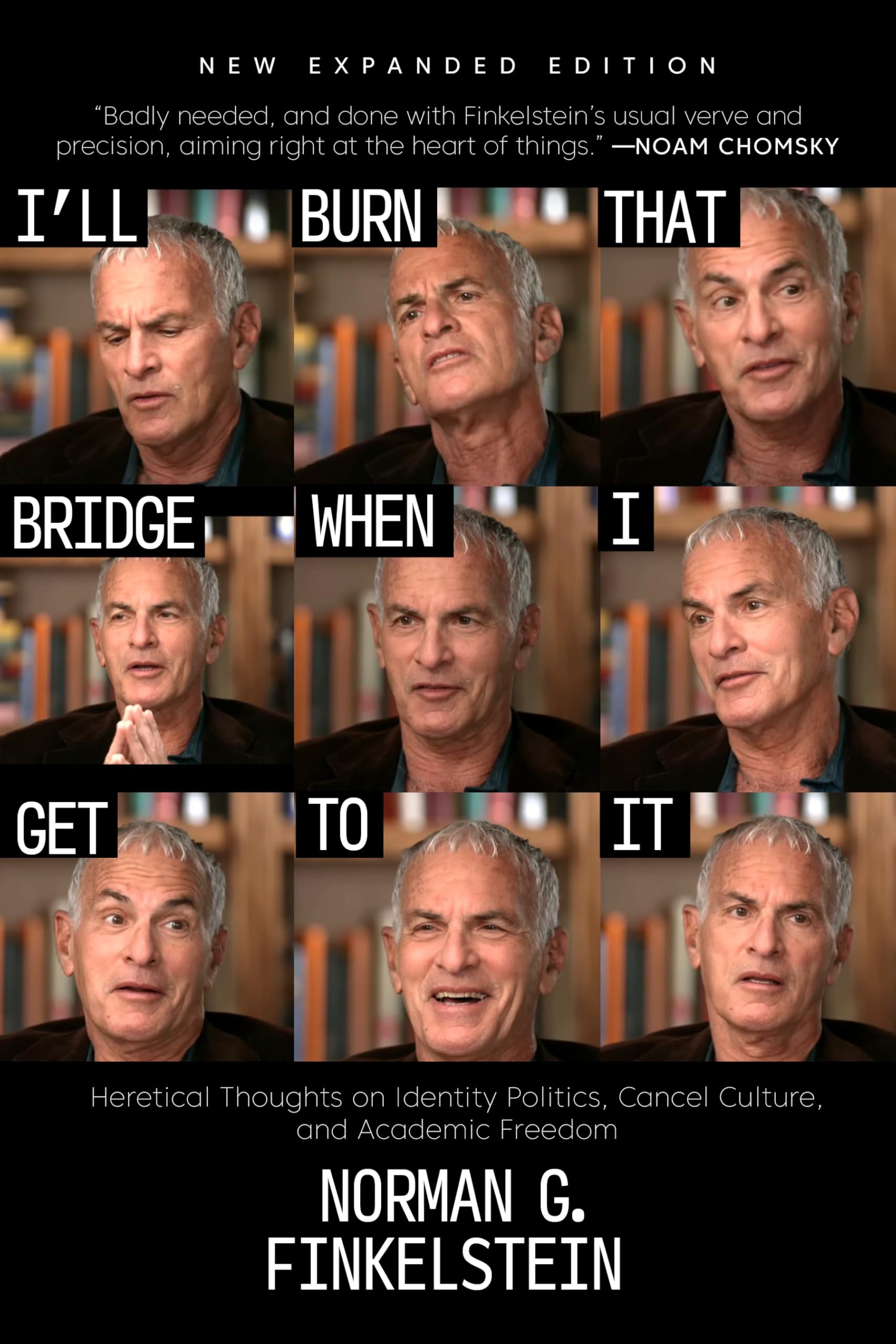
I'll Burn That Bridge When I Get to It: Heretical Thoughts on Identity Politics, Cancel Culture, and Academic Freedom
$23.92
by Norman G. Finkelstein



America’s most canceled intellectual presents a scorching defence of free thought and a devastating indictment of a left that has lost its way. Norman Finkelstein made his name debunking Israel’s apologists and exposing the cynical weaponization of Jewish history. In this work, Finkelstein trains that same forensic eye on identity politics writ large. After methodically parsing the canonical identity-politics texts, Finkelstein concludes that they’re lacking in intellectual substance. Instead, the real purpose of identity politics is to derail a class-based movement bent on radical change. Finkelstein shows how the cult surrounding Barack Obama used identity politics to burnish a status quo president’s radical sheen. When a truly progressive movement cohered around presidential candidate Bernie Sanders, these “woke” liberals mobilised identity politics to discredit him. Along the way, Finkelstein recalls his own life in radical politics and his close encounters with cancel culture, which left him unemployed and unemployable. He situates his personal story within broader debates on academic freedom and poignantly concludes that, although occasionally bitter, he harbors no regrets about the choices he made. “If I can’t laugh, I don’t want your revolution,” Finkelstein declares. Laced with his signature wit, readers of this book will get to laugh along with him. This revised edition of Finkelstein’s instant classic features a new chapter dissecting the Supreme Court's landmark decisions on affirmative action. In a bracingly original analysis, Finkelstein shows the stark limits of affirmative action discourse in the face of an economic system that is fundamentally rigged. “Badly needed, and done with Finkelstein’s usual verve and precision.” —Noam Chomsky “There is no one like him today … [an] incredible warrior for truth and justice.” —Alice Walker “Like his magisterial work on Gaza, this book is both brilliant and brave.” —Cornel West “Norman reaches into the bushes, grabs less rigorous analyses, and shakes them until the chaff shows. I may not always agree, but I require his view for a full accounting.” —Debra Winger “Given his personal experiences of the cancel culture, he certainly deserves to be listened to on this too, whether he is expressing himself with vitriol or presenting more nuanced views, along with the supporting evidence, on academic freedom.” — Morning Star Norman G. Finkelstein received his doctorate from the Department of Politics at Princeton University. For many years he taught political theory and the Israel-Palestine conflict. He is the author of a number of books, among them Gaza: An Inquest Into Its Martyrdom; Method and Madness: The Hidden Story of Israel's Assaults on Gaza; Knowing Too Much: Why the American Jewish Romance with Israel is Coming to an End; What Gandhi Says: About Nonviolence, Resistance and Courage; “This Time We Went Too Far”: Truth and Consequences of the Gaza Invasion; Beyond Chutzpah: On the Misuse of Anti-Semitism and the Abuse of History; and The Holocaust Industry: Reflections on the Exploitation of Jewish Suffering . Identity politics is as old as the White Cliffs of Dover and the Black Hills of Kentucky. Woke politics is political correctness 2.0. Cancel culture is the civic form of McCarthyism. Still, something has changed. It’s the enhanced salience of wokeness on the social landscape. Until recently, these cultural fads played out on the margins of society. They were pretty much confined to the college campus and the political left. Even on campus their influence can be exaggerated. No doubt, they affected the tenor of university life as multiculturalism and thought-policing became fixtures. The results could be bizarre. At Brooklyn College (City University of New York), where I taught from 1988 to 1992, the Multicultural Action Committee wouldn’t allow my Mother to speak about her experiences during the Nazi holocaust as her remarks might “hurt the feelings” of Jewish students. (Although firm in her belief in the necessity for a Jewish place of refuge, she had few kind words to spare for Israel.) At DePaul University, where I taught from 2001 to 2007, it seemed as if every other month a new poster went up announcing a symposium on The Black Body. Leaving aside the creepy voyeurism, it wouldn’t have hurt if the university offered a few minority scholarships. The student body was whiter than. . . the White Cliffs of Dover. Flaky degree programs sprung up to propitiate the Gods of p.c. But the hard core of the higher education curriculum was left mostly unscathed. Postmodernism contaminated English Literature, Comparative Literature, Foreign Languages and Anthropology, but History proved immune to the contagion, while Economics and Political Science moved in the opposite direction as they became, for better or worse (probably worse), increasingly quantitative. Although lower-tier philosophy departments reduced course offerings to Nietzsche, Heidegg