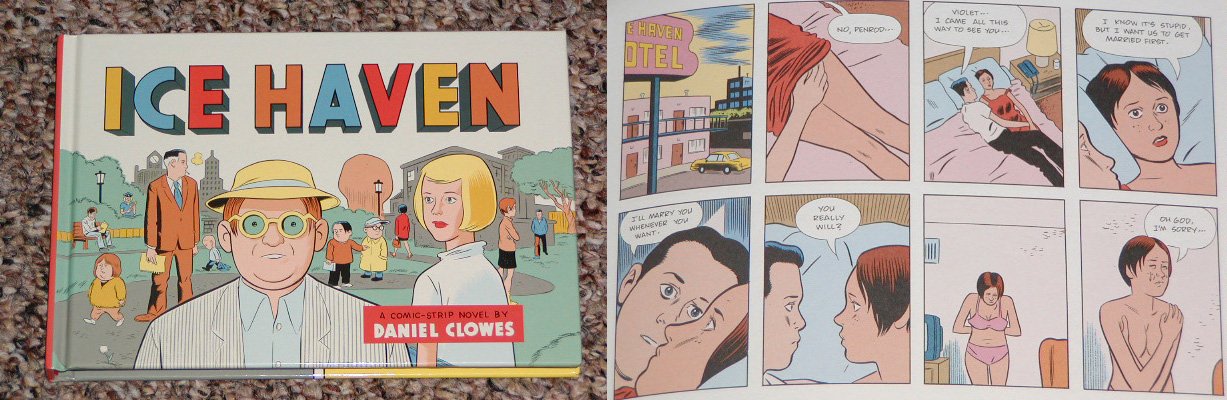



At long last: Daniel Clowes is back at Pantheon, with a brilliant new graphic novel already hailed by Time as “another of his hilariously slightly off-center worlds that have a vague sense of dread about them. Kind of like where you live.” Welcome to Ice Haven! “It’s not as cold here as it sounds,” declares Random Wilder, our reluctant guide to this sleepy Midwestern town. He’s also its would-be poet laureate. Would-be, that is, were it not for the "Florid banalities” of his archrival, Ida Wentz, published ad nauseam in the Ice Haven Daily Progress. Among Wilder’s other fellow Ice Havians are the lovelorn Violet Van der Plazt and Vida Wentz; the detective team of Mr. and Mrs. Ames; the adorable interracial moppets Carmichael and Paula; disaffected stationery salesgirl Julie Patheticstein; the Blue Bunny, newly sprung from prison and the bitterest rabbit in town; and poor little David Goldberg, missing for more than a week now… While Dan Clowes has gotten a nod from the mainstream — an Oscar nomination for the screen adaptation of Ghost World - his work remains wonderfully idiosyncratic and imaginative. The lives of the men and women of Ice Haven are woven into a multi-layered tale that, while it owes a debt to Our Town , is ultimately based on and inspired by… Leopold and Loeb. No kidding. Only Daniel Clowes could do it and, luckily for us, he has. Grade 10 Up–Previously published in the independent comic-book series Eight Ball, this is a darkly comic romp through the small Midwestern town of Ice Haven. The basic story is pretty straightforward: a sad, quiet little boy named David Goldberg vanishes. But instead of delivering a pulp-inspired detective story, Clowes uses the child's tale mostly as a backdrop. His real interest is in the lives of the bizarre, yet all-too-real townsfolk. They include a lovesick teen, an irritable private detective, a poet, and a schoolyard bully. Although the characters are types, the author/illustrator embellishes them enough to make them unique and memorable. Through vignettes that jump perspective every few pages, readers witness their lives and individual reactions to David's disappearance. As the point of view shifts, so does the artwork. In showing how the event affects the boy's classmates, the panels take on a style inspired by Charles Schultz's Peanuts , but Clowes moves into satire with a bleakly funny schoolyard of kids talking quite openly about sex, drugs, and violence. Other vignettes pull from the motifs of detective strips, teen romances, and The Flintstones . While well-read comics fans will get most of the jokes, some references may frustrate or confuse readers. Overall, though, there is plenty here to enjoy. –Matthew L. Moffett, Northern Virginia Community College, Annandale Copyright © Reed Business Information, a division of Reed Elsevier Inc. All rights reserved. Graphic novelist Clowess Ghost World illustrated his talent for creating alienated misfits; here, hes just as twisted. Ice Haven , based on the simple premise of the disappearance of a strange little boy (inspired, in turn, by the true story of child murderers Nathan Leopold and Richard Loeb), is actually quite complex. The more than 30 short strips form a portrait of a dull suburban town, and the blocky, dull-colored drawings mirror the themes: alienation, loneliness, entrapment. "Its not as cold here as it sounds," says Random Wilder. But, as readers will soon find out in this artful graphic novel-cum-crime-thriller, hes very, very wrong. Copyright © 2004 Phillips & Nelson Media, Inc. *Starred Review* Already highly regarded in alternative-comics circles for such impressive works as Ghost World (1997), Clowes takes his game to another, higher level in Ice Haven , surely one of the most accomplished graphic novels in recent memory. It is a tour-de-force made up of 29 interconnecting stories rendered in styles varying from mock documentary to pseudo- Peanuts , all depicting life in the town of Ice Haven, which is gripped by anxiety over a missing child. Clowes deftly brings an astonishing depth of characterization to a sizable cast that includes embittered poet Random Wilder; his amateur archrival, the grandmotherly Mrs. Ida Wentz; the husband-and-wife detective team investigating the child's disappearance; and Carmichael, a youngster obsessed by Leopold and Loeb. Although the work has a masterful formal complexity, the story itself is straightforward, and despite the emotional chilliness suggested by the town's name, Clowes exhibits a genuine, if submerged, sympathy for even the most misbegotten members of his cast. Ice Haven is relatively short for an ostensible novel--it's a reformatted version of a story that first appeared as a single issue of Clowes' comic book Eightball --but it possesses a depth that few other graphic novels achieve, regardless of their length. Gordon Flagg Copyright © American Library Association. All rights reserved “ Don’t be surprised