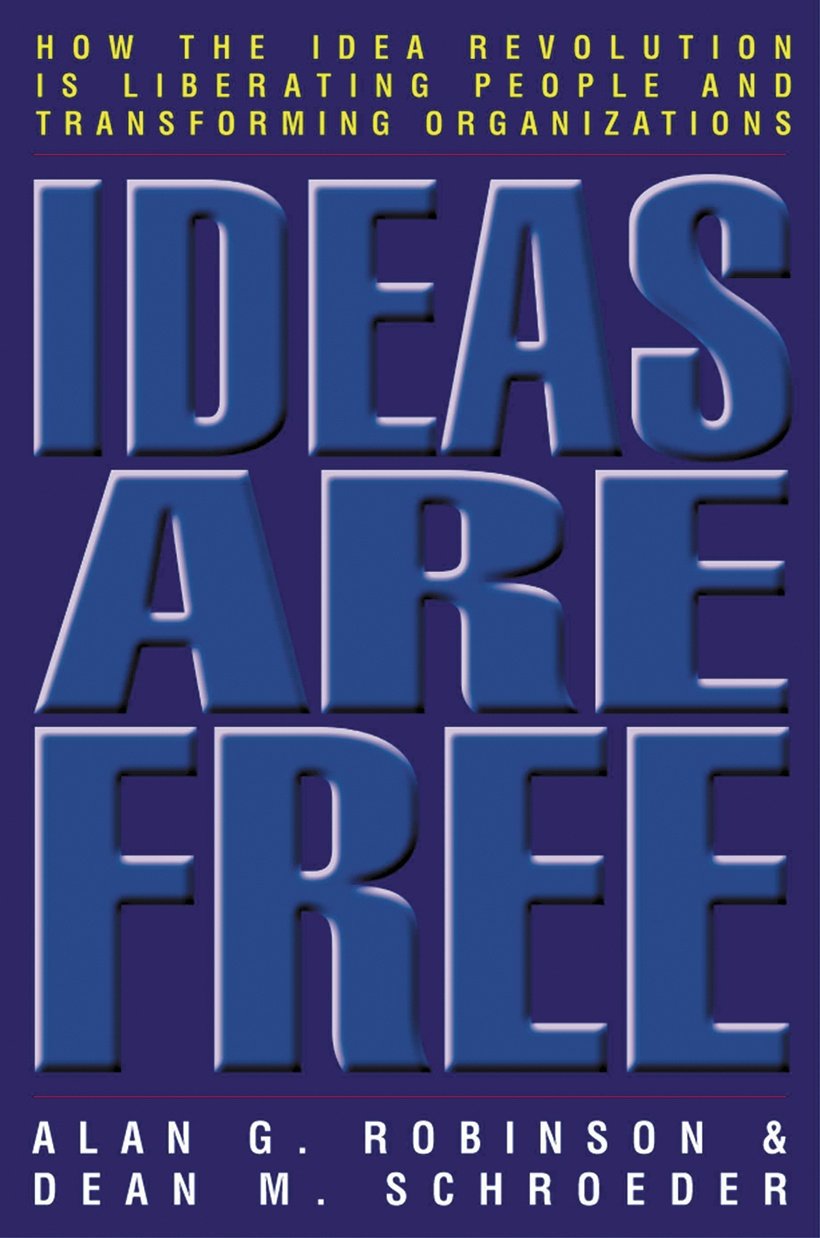
Ideas Are Free: How the Idea Revolution Is Liberating People and Transforming Organizations
$21.36
by Alan G. Robinson



A worker in one of Europe’s largest wireless communication companies stumbled across an error in his company’s billing software, fixed it, and saved the company some $26 million per year. A secretary at Grapevine Canyon Ranch proposed a simple change to the company's website that brought the site to the top of search engine listings. A guard at the Massachusetts Department of Correction saved the prison system $56,000 a year by suggesting the use of digital cameras instead of film to process new inmates. From simple ideas for saving time, effort, and money, to entirely new ways of doing business, front-line employees see a great many opportunities in their day-to-day work that their managers don’t. Drawing on extensive research and experience in more than 300 organizations around the world—and including numerous illustrative examples—Alan Robinson and Dean Schroeder show precisely how to take advantage of the virtually free, perpetually renewable resource of employee ideas. Ideas Are Free shows managers how to tap all the ideas their employees have and gain significant advantage over their competitors. Ever since Frederick Taylor advocated that it was management's job to "think" and the worker's job to "do," this perspective has been the basis for the policies, structures, and operating practices of most business organizations. Although this division between thinking and doing may have worked 100 years ago, it is severely limiting in today's environment, where it is the front-line worker who is in the best position to notice problems and suggest ideas. In example after example, the authors show how companies that encourage and implement the ideas of the entire workforce are the ones that come up with the most innovative and successful strategies. Contrary to past thinking on the subject, they make it clear that monetary rewards are not the best way to elicit ideas, and that emphasis on small ideas can be a more effective strategy than shooting for a "home run." The methods described show how to create an environment that encourages ideas, help employees develop knowledge and improve their problem-solving skills, and properly manage the ideas that are generated, including their larger implications. David Siegfried Copyright © American Library Association. All rights reserved " Ideas Are Free is a refreshingly insightful book that managers at all levels should read”. —Donald V. Fites, former CEO, Caterpillar, Inc. “ Ideas Are Free [is] a clear and concise prescription for turning an organization into an idea machine. … it will inspire any manager who believes, as I do, that only the innovative thrive!” —Jeff Taylor, Founder and Chief Monster, Monster.com “ Ideas Are Free shows how a good idea has no bounds and how pursuing such ideas is the essence of everyone's job today. Robinson and Schroeder outline a workable plan for tapping into this unlimited resource and harnessing its potential. Believe it: Small ideas can yield big results!” —Bob Nelson, Ph.D., bestselling author of 1001 Ways to Reward Employees and 1001 Ways to Take Initiative at Work Alan G. Robinson is coauthor of the bestseller Corporate Creativity and teaches at the Isenberg School of Management at the University of Massachusetts. Dean M. Schroeder is currently the Herbert and Agnes Schulz Professor at the College of Business Administration at Valparaiso University. THE IDEA REVOLUTION What will future generations say about the way we practice management today? What will they consider our most conspicuous failure? We believe they will accuse us of having squandered one of the most significant resources available to us: employee ideas. Every day, all over the world, millions of working people see problems and opportunities that their managers do not. With little chance to do anything about them, they are forced to watch helplessly as their organizations waste money, disappoint and lose customers, and miss opportunity after opportunity that to them are all too apparent. The result is performance far lower than it should be and employees who do not respect or trust management and who are not fully engaged with their work. At the same time, their managers are under constant pressure to do more with less. But with so much of their time consumed by “firefighting” and trying to meet short-term demands, they have little or no time to think about how to build their organizations’ capabilities. They are chronically short of the resources they need to keep performance at current levels, much less improve it. They wonder how to motivate their employees, who don’t seem as involved in their work as they should be. In short, a great many managers today find their work stressful and unfulfilling. Because there seems to be no alternative, both managers and employees become jaded, and they accept the situation as the way things have to be. But a quiet revolution is under way—an idea revolution—led by managers and supervi