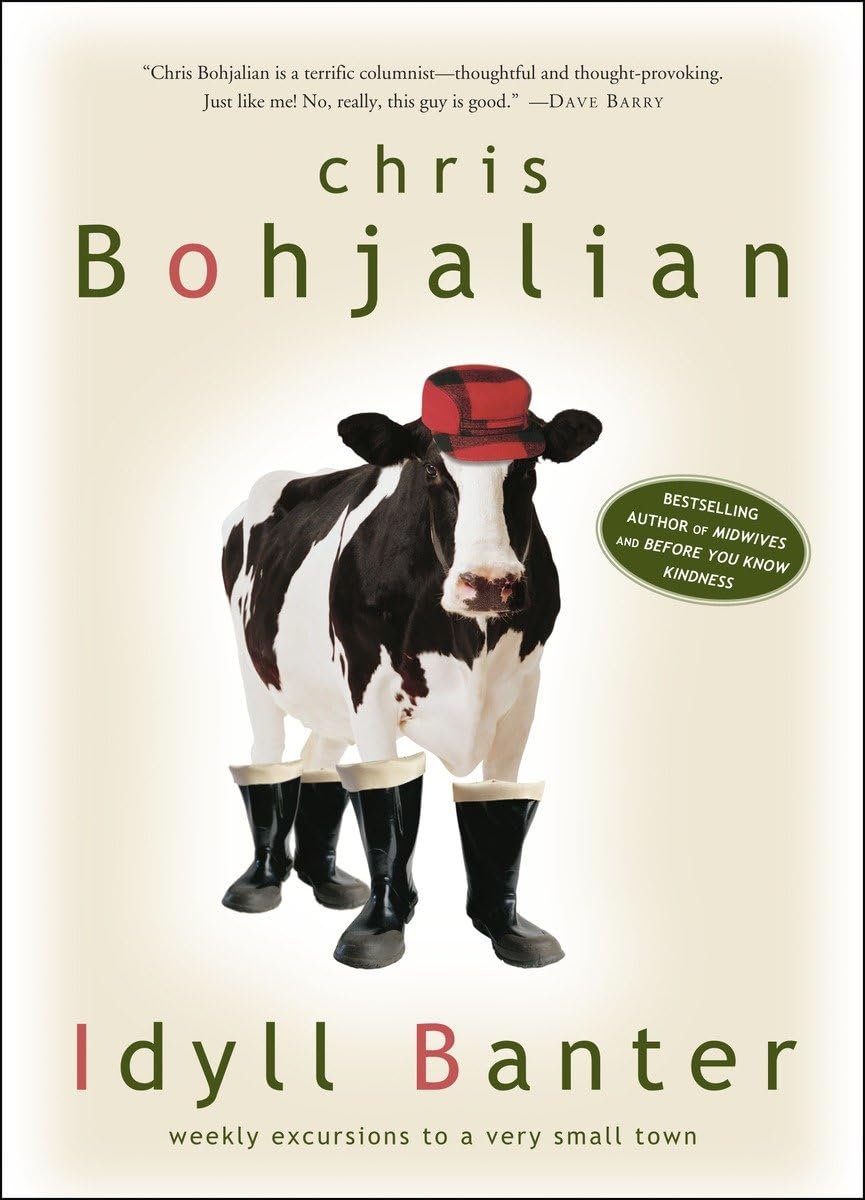



Years ago, Chris Bohjalian and his wife traded their Brooklyn co-op for a century-old Victorian house in Lincoln, Vermont (population 975). Bohjalian, a bestselling novelist, began chronicling life in that gloriously quirky little village with a wide variety of magazine essays and his newspaper column, “Idyll Banter.” These pieces, written over the course of twelve years, are honest, funny, and deeply affecting reflections on the unique idiosyncrasies of small-town life (annual outhouse races) and the universal experiences (our hunger for neighborliness) that unite us all. “Chris Bohjalian is a terrific columnist—thoughtful and thought-provoking. Just like me! No, really, this guy is good.” —Dave Barry “[Bohjalian] is writing about one of the most important issues in America today—how do we retain our sense of community. . . . Gentle . . . sensitive . . .heart-warming.” — Ft. Lauderdale Sun-Sentinel “These essays carry a community connection and a humble grace. When words read this easily, you know they also carry a lot of work. Bohjalian is a reliable guide, moving from pastures to town steeple to the edge of the playground.” — Boston Globe “Whether you’re aching to escape the urban grind or yearning to have your small-town experience reflected back at you, you’ll do well to pick up Idyll Banter .” — Elle Years ago, Chris Bohjalian and his wife traded their Brooklyn co-op for a century-old Victorian house in Lincoln, Vermont (population 975). Bohjalian, a bestselling novelist, began chronicling life in that gloriously quirky little village with a wide variety of magazine essays and his newspaper column, "Idyll Banter." These pieces, written over the course of twelve years, are honest, funny, and deeply affecting reflections on the unique idiosyncrasies of small-town life (annual outhouse races) and the universal experiences (our hunger for neighborliness) that unite us all. Chris Bohjalian is the award-winning author of nine novels, including Before You Know Kindness , The Buffalo Soldier , Trans-Sister Radio , The Law of Similars , and Midwives . Now That the Cows Are Gone The sun wouldn't rise for two more hours, but by 5:00 in the morning Tom Densmore was in the barn milking cows. When the trucks arrived shortly before 8:00-two the length of tractor trailers and a third perhaps half that long-he had finished milking the animals, but he hadn't begun to disassemble the feed carts or milking machines. That would have to wait until the afternoon. It took Densmore and the truckers three hours to march his sixty-head herd up the metal ramps into the trucks, about what the thirty-four-year-old farmer had expected. By 11:30, the trucks were beginning their slow descent on the steep road that had led them up to the Vermont hill farm, winding past miles of new-growth forest, and then through the center of town, with its immaculate white church, general store, and two dozen village houses with sharply pitched roofs. The animals arrived at the auction barn, about three hours away, in midafternoon. It took auctioneer Herb Gray less than ninety minutes to dispose of the herd, selling the milking cows one by one and some of the calves in small groups. Most of the cows brought Densmore $800 to $1,100 each, while the calves went for $200 to $700 apiece-not enough to pull him completely out of debt. Densmore's mother, sister, and one of his brothers stood by him as his cows were scattered to farms across Vermont and New Hampshire. Nita, Nola, and Nicki-alliteration that signaled the cows were from the same family-were separated, as were three of Densmore's best producers: Kim, Amy, and Fayne. Every year they gamely produced well over 16,000 pounds of milk each. Densmore's sixty-head herd was small even by Vermont standards, but it represented the last dairy farm in Lincoln, and the auction last December formally marked the end of an era. Lincoln, a village thirty miles southeast of Burlington, boasted forty-six active dairy farms as recently as 1945. Today there are none. There may be an occasional cluster of cows or beef cattle visible on the hillsides that roll throughout Lincoln, but there will be no more silver trucks from the Eastern Milk Producers Cooperative winding their way through town or trying to negotiate the narrow roads that link the homes in the hills. Like many of Vermont's small rural towns, Lincoln has changed. In 1950, there were 11,019 dairy farms in Vermont. Today there are barely 2,300. The farms that remain are bigger-an average Vermont dairy farm has seventy-three milking cows, up from fifty-five as recently as 1978-and the cows produce more milk: roughly 15,500 pounds per cow per year these days, versus 11,500 pounds fifteen years ago. Some of the farms disappeared simply because the farmers grew too old to milk fifty or sixty cows twice a day, and their children chose more lucrative occupations: carpentry or real estate or manufacturing jobs in Connecticut and Massachusetts.