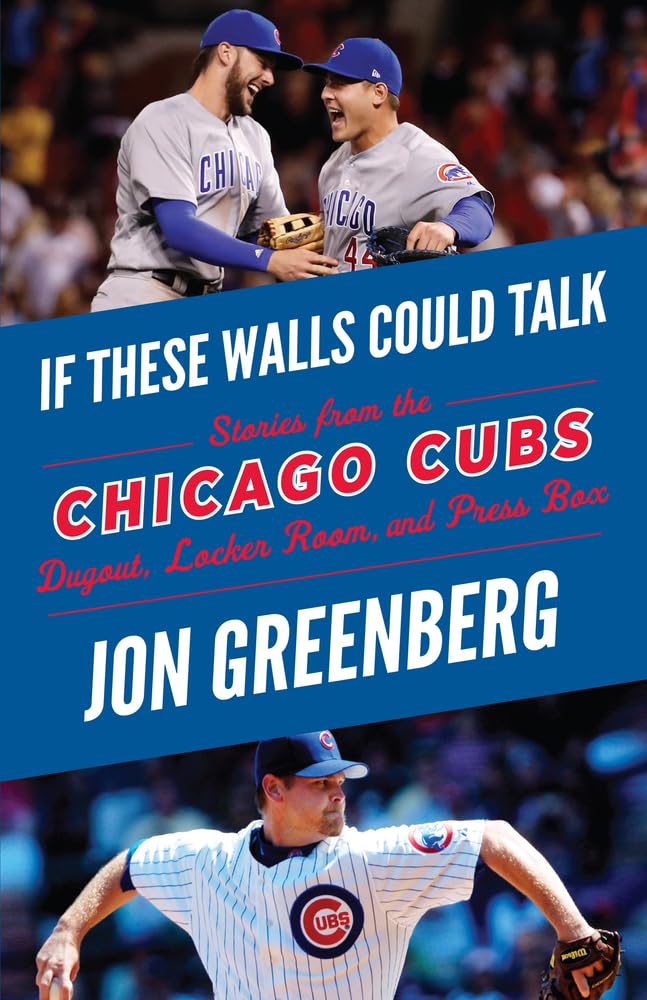
If These Walls Could Talk: Chicago Cubs: Stories from the Chicago Cubs Dugout, Locker Room, and Press Box
$7.80
by Jon Greenberg



The Chicago Cubs are one of the most historic teams in Major League Baseball, and their World Series championship in 2016 will forever remain one of baseball's iconic triumphs. In If These Walls Could Talk: Chicago Cubs , Jon Greenberg of The Athletic Chicago provides insight into the team's inner sanctum as only he can. Readers will gain the perspective of players, coaches, and personnel from this modern era in moments of greatness as well as defeat, making for a keepsake no fan will want to miss. Jon Greenberg is the lead Cubs columnist and founding editor-in-chief of The Athletic Chicago . He previously covered Chicago sports for ESPN Chicago and wrote nationally for ESPN.com. This is his first book. If These Walls Could Talk: Chicago Cubs Stories from the Chicago Cubs Dugout, Locker Room, and Press Box By Jonathan Greenberg Triumph Books LLC Copyright © 2019 Jon Greenberg All rights reserved. ISBN: 978-1-62937-654-7 Contents Introduction: A Conversation on the Concourse, 1. Chasing Ghosts, 2. One Last Run at the Brass Ring, 3. The Hangover, 4. A Fan Buys the Cubs, 5. Theocracy, 6. The Future is Now, 7. A Season in the Sun, 8. Fall Classics, 9. The Hangover II, 10. Big Business at Wrigley Field, 11. Enigmatic '18, CHAPTER 1 Chasing Ghosts When the Cubs finally did it, when they won the World Series on a warm night in Cleveland in 2016, Jim Hendry was in his living room in Park Ridge, Illinois, 21 miles northwest of Wrigley Field. Like a lot of Chicagoans, he was rooting hard for the Cubs to win. He was cheering for front office executive Randy Bush, a friend of many decades who he hired back in 2005. He was rooting for Theo Epstein, Hendry's replacement, a different kind of baseball executive, but one who Hendry always liked. And Jim Hendry was happy for Joe Maddon, who Hendry knew would've gotten absolutely roasted if the Cubs had lost Game 7. He was rooting for Ryan Dempster, clubbies Tom "Otis" Hellman and Danny Mueller, Javy Báez, Matt Szczur, and Willson Contreras. Jim Hendry was rooting for Cubs fans everywhere. After all, he still remembers the pain of 2003. Hendry got a ring from the Cubs and he appreciated it. The Cubs held a little ceremony for him the following season in their office complex, a large building he could only dream about during his days in the cramped confines at Clark and Addison. He brought his son John, now a college pitcher, with him. It was a moment he had always dreamed about, though Hendry imagined he'd be the one passing out the rings. So it goes. That was the famous line by Kurt Vonnegut, who spent some time in Chicago, and while Hendry doesn't seem like a Vonnegut guy, he lives his life by that mantra. He doesn't dwell on the past. In his first season as GM, Hendry was five outs from the World Series. The Cubs could never get back to that peak. "We were good in '04," Hendry said. "We were good in '07 and '08. Even when the things changed and it was up for sale and it was getting so at the end you probably couldn't have won, it wasn't like I ever looked at it like, 'You know, we didn't have as much as they have now, or we had a small staff.' I mean, that's not the world I'm in. "And so I was happy for them because I grew to appreciate the [Rickettses] very well, even though I had to go. And Theo and I have been friends since he first started in Boston. And Randy Bush and I, that's about a 40-year relationship there." The Hendry era, from 2003 through 2011, was full of ups and downs, but it also represented a sea change for the franchise, which was finally trying to be competitive on an annual basis. After the 2003 season ended in myth and shame — that has been well-documented enough over the years — the Cubs didn't cower. That off-season, the Cubs reloaded with Greg Maddux and Derrek Lee. But first, Hendry had to get over Games 6 and 7, Moises Alou, Steve Bartman, Alex Gonzalez, and Mark Prior. "I think it took me a couple weeks to … you never really get over it, get over it," he said. "But it took me a couple weeks. I had to finally slap myself and say, 'Okay. Yeah. That's enough.'" On November 26, Hendry got down to the business of remaking his team, first taking advantage of the financial straits of the team that had dealt the Cubs their heartbreak by trading a young first baseman in Hee-Seop Choi to Florida for the 28-year-old Lee. "We loved Choi at the time and the only negative about it at the time was that [Choi] was left handed," Hendry said. "We lacked left-handed power and he was our first guy in the system we thought was going to be 'the Dude.' But I was a big Derrek Lee fan. And he was only 28. And he played great against us with the Marlins. And I had a history with his father [Leon Lee], who worked for me. At the time we made the trade he was our Pacific Rim guy." Not only that, he was the guy who recommended signing Choi, who hailed from South Korea. "So I knew a lot about Derrek," Hendry said. "Growing up I