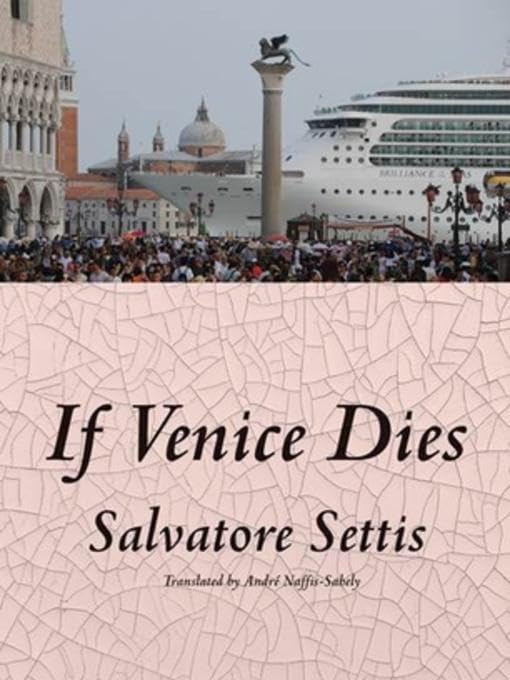



"Anyone interested in learning what is really going on in Venice should read this book.”— Donna Leon, author of My Venice and Other Essays and Death at La Fenice What is Venice worth? To whom does this urban treasure belong? This eloquent book by internationally renowned art historian Salvatore Settis urgently poses these questions, igniting a new debate about the Queen of the Adriatic and cultural patrimony at large. Venetians are increasingly abandoning their hometown—there's now only one resident for every 140 visitors—and Venice's fragile fate has become emblematic of the future of historic cities everywhere as it capitulates to tourists and those who profit from them. In If Venice Dies , a fiery blend of history and cultural analysis, Settis argues that "hit-and-run" visitors are turning landmark urban settings into shopping malls and theme parks. This is a passionate plea to secure the soul of Venice, written with consummate authority, wide-ranging erudition, and élan. Salvatore Settis is an archaeologist and art historian and former director of the Getty Research Institute of Los Angeles and the Scuola Normale Superiore of Pisa. He is chairman of the Louvre Museum's Scientific Council., Settis, often considered the conscience of Italy for his role in spotlighting its neglect of national heritage, is the author of several books on art history. “A chilling account of the slow agony of Venice as illustrative of a global consumerist epidemic. Richly documented and imbued with deep angst about this supreme urban creation." —Philippe de Montebello, former director of the Metropolitan Museum of Art "Anyone interested in learning what is really going on in Venice should read this book.” —Donna Leon, author of My Venice and Other Essays and Death at La Fenice "An impassioned plea that every lover of Venice, urban planner, architect, and cultural historian should read."— Kirkus (Starred review) "Settis shows how the tragedy of Venice could happen to any city which has a past. It's a powerful polemic." —Richard Sennett, author of The Fall of Public Man and Flesh and Stone: The Body and the City in Western Civilization , and Professor of Sociology, New York University and the London School of Economics "Venice is indeed unique but it stands for all cities in this eloquent, furious blast against the commodification of our planet and the relentless destruction of human communities by the mentality of markets."— Roger Crowley, author of City of Fortune: How Venice Ruled the Seas "This book valiantly shows why Venice—crossroads of civilization, art and commerce, eternal place of love—cannot be allowed to perish."— Diane von Furstenberg, Vice Chairman, Venetian Heritage Council "An elegant indictment of the challenges Venice faces from today’s rapacious economic environment. Settis offers an ethical prescription for re-imagining and resuscitating the historical uniqueness of Venice and Venetian life." —Eric Denker, coauthor of No Vulgar Hotel: The Desire and Pursuit of Venice and Senior Lecturer, National Gallery of Art “A lament for the day-by-day destruction of great beauty … full of anger and disappointment at what the author sees as the moral bankruptcy of Italy today.”— The Art Newspape r “The vision of Settis is particularly gloomy and pessimistic, but there is still hope.”— Corriere della Sera “Salvatore Settis wants to curb the sellout of cities … Balancing sharp intellect and moral indignation, lucid writing and impassioned argument, his polemic makes for captivating reading.”— Frankfurter Allgemeine Zeitung "Settis's analysis extends to all cities. Only active citizenship can save them from the greed of real estate speculators." —Desmond O'Grady, former European editor of The Transatlantic Review and author of The Road Taken "With his book, Settis has clarified what conservationism and the protection of our cultural heritage should mean." — Il Manifesto Salvatore Settis is an archaeologist and art historian who has directed the Getty Research Institute of Los Angeles and the Scuola Normale Superiore of Pisa. He is chairman of the Louvre Museum's Scientific Council. Considered the conscience of Italy for his role in spotlighting its neglect of the national cultural heritage, Settis’s name has been mentioned frequently for the post of minister of culture and Italian president. He is the author of several books on art history as well as a regular contributor to major Italian newspapers and magazines. Chapter IX - Replicating Venice Locked in its lagoon, Venice has nevertheless managed to inspire the world. The sudden collapse of St. Mark’s Campanile in 1902 and the swift move toward its reconstruction as it was, where it was,” completed in 1912, triggered the construction of a wave of replicasof varying dimensionsduring the early 1900s, especially in the United States. Thus, one can see Venetian bell towers in the train stations of Seattle (1904, 242-feet-tall) an