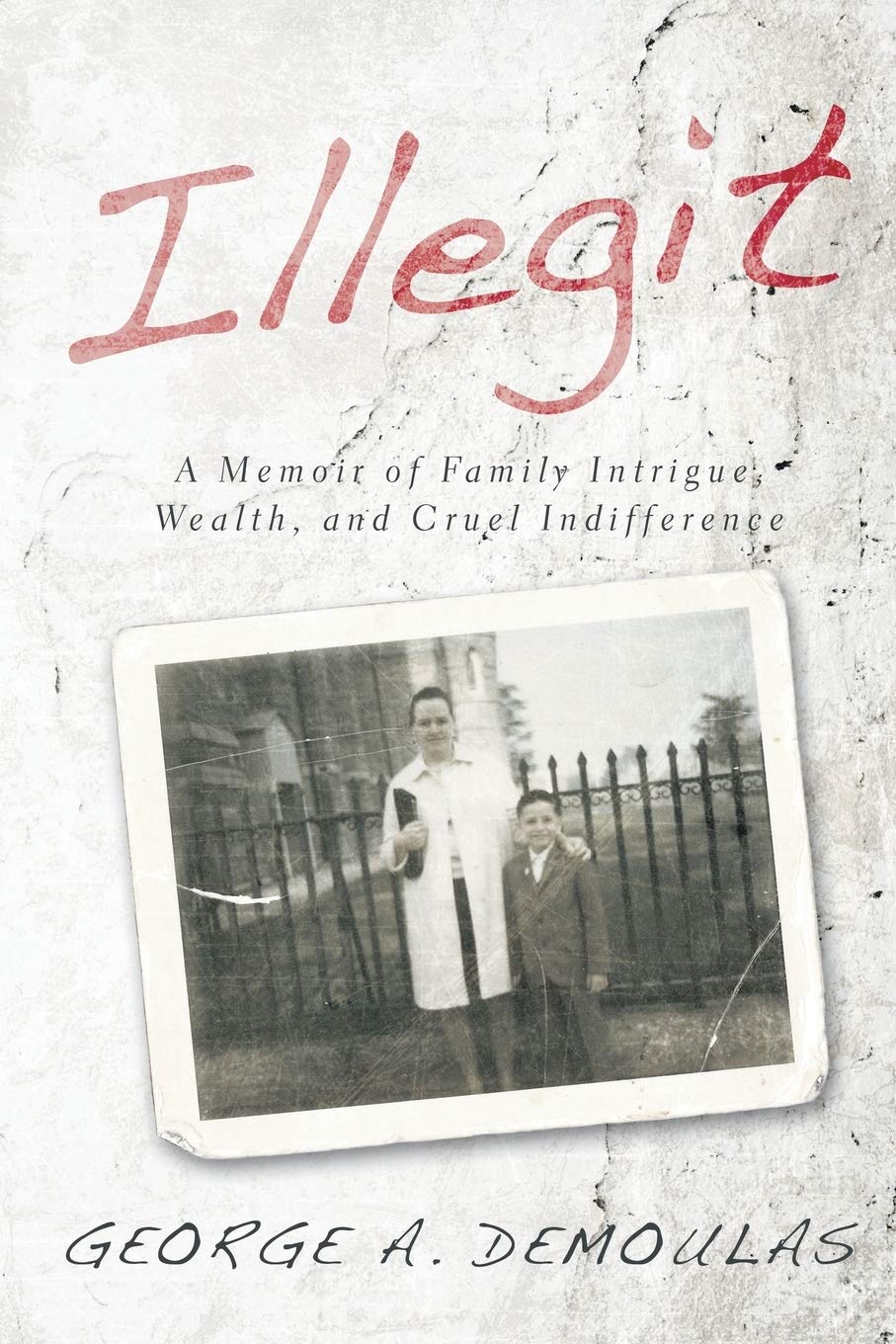
Illegit: A Memoir of Family Intrigue, Wealth, and Cruel Indifference
$14.95
by George A. DeMoulas



Finding My Identity My story of how DNA proved my legacy My life story - The journey that led me to prove my legacy through DNA analysis. Everyone has a story. It takes courage to tell it. By writing this book I hope I can help one of many survive what I lived by telling my own experiences. I hope to help others realize they do have an identity and they need to be responsible for it. Illegit A Memoir of Family Intrigue, Wealth, and Cruel Indifference By George A. Demoulas AuthorHouse Copyright © 2014 George A. DeMoulas All rights reserved. ISBN: 978-1-4969-3331-7 CHAPTER 1 All stories start at the beginning. It is like that for families as well. Families don't just appear in a flash. There is a continuum that reaches back through time to long before the newest members of the family are born. So it is with my story. It all began in Greece with my paternal grandfather, Athanasias Demoulas. He was born in 1883 in a small village in the shadows of the Meteora and the Pindus Mountains, which are located in the central part of the country. The region is renowned for its ancient monasteries and has been described as "the perfect place for Zeus to store his thunderbolts." When he was twenty-three, Athanasias immigrated to America, landing on Ellis Island in the shadows of the Statue of Liberty on St. Patrick's Day in 1906. At the time of my grandfather's passage to America, his homeland and its neighbors were embroiled in the endemic rivalry that still persists in the Balkans. Serbs, Slavs, Bosnians, Albanians, and Bulgarians all were involved in the ongoing battles, and Greek guerrillas were on a rampage in the mountains of Macedonia. Although I do not know for certain what prompted my grandfather to leave Meteora, his family, and his childhood sweetheart, who was to become my grandmother, it seems evident the sociopolitical turmoil and the harsh economic conditions in his homeland played a role in his decision. Soon after arriving in New York, Athanasias made his way to Lowell, Massachusetts, following in the footsteps of thousands of immigrants, many Greeks among them. Lowell was then known as Spindle City because of the dozens of textile mills that extended for miles along the edge of the Merrimac River. The Greek, French, Irish, and French-Canadian immigrants who toiled in those mills congregated in a section of Lowell called the Acre, which stretched from Lowell City Hall along Market Street toward the river. My grandfather soon found work in a tannery as a shoemaker and, within three years, had saved enough money to send for the girl he had left behind in Meteora. Tall and thin and eleven years his junior, my grandmother was Efrosine Souleiman. Shortly after her arrival in Lowell, she and Athanasias were married. At some point along the path to assimilation, my grandfather began to refer to himself as Athas, a name far easier for people to pronounce than Athanasias. Later still, he went by Arthur, a name eventually passed on to two of his grandsons. My mother also gave it to me as my middle name. As I look back on this part of my family history, information I learned only after years of searching public records and gleaning what I could from my mother, I find myself feeling sad sometimes. The story of my grandfather is rich in the stuff of the American dream. I am part of that story, yet it is as if my siblings and I never existed. In that sense, we lived in a world devoid of the grounding most of us depend on for the rudiments of our self-identities. It's a strange and sad place to be when you're adrift and ignored. My grandfather worked hard in the tannery for years, but his health began to suffer. The working conditions in the factory were awful, and his doctor advised Arthur to leave his job. In 1917, at the age of thirty-four and eleven years after he had arrived in Lowell, my grandfather opened Demoulas Market on Dummer Street in the Acre and began selling meat, produce, and sundries to his fellow émigrés from Greece and other parts of the world. Above the awning on the front of the shop hung a sign advertising "Lamb, Sausages & Pork." Arthur and Efrosine did their own slaughtering, and several times each week, my grandfather drove his battered old Ford truck to the railroad yards to pick up live sheep and pigs. They kept chickens in wooden cages on the sidewalk outside the shop. After selecting a chicken, customers brought it inside to be weighed and then carried it off, alive and squawking, wrapped up in sheets of newspaper. In time, my grandmother became renowned for her roasted pork sandwiches, a specialty favored by the workers who passed by the shop on their way to the mills. In keeping with the custom among many merchants in immigrant cities, Arthur allowed his customers to buy on credit, and he delivered their purchases free of charge. It was a different time, a different world. I don't want to romanticize those times too much, but it always strikes me that life must have been