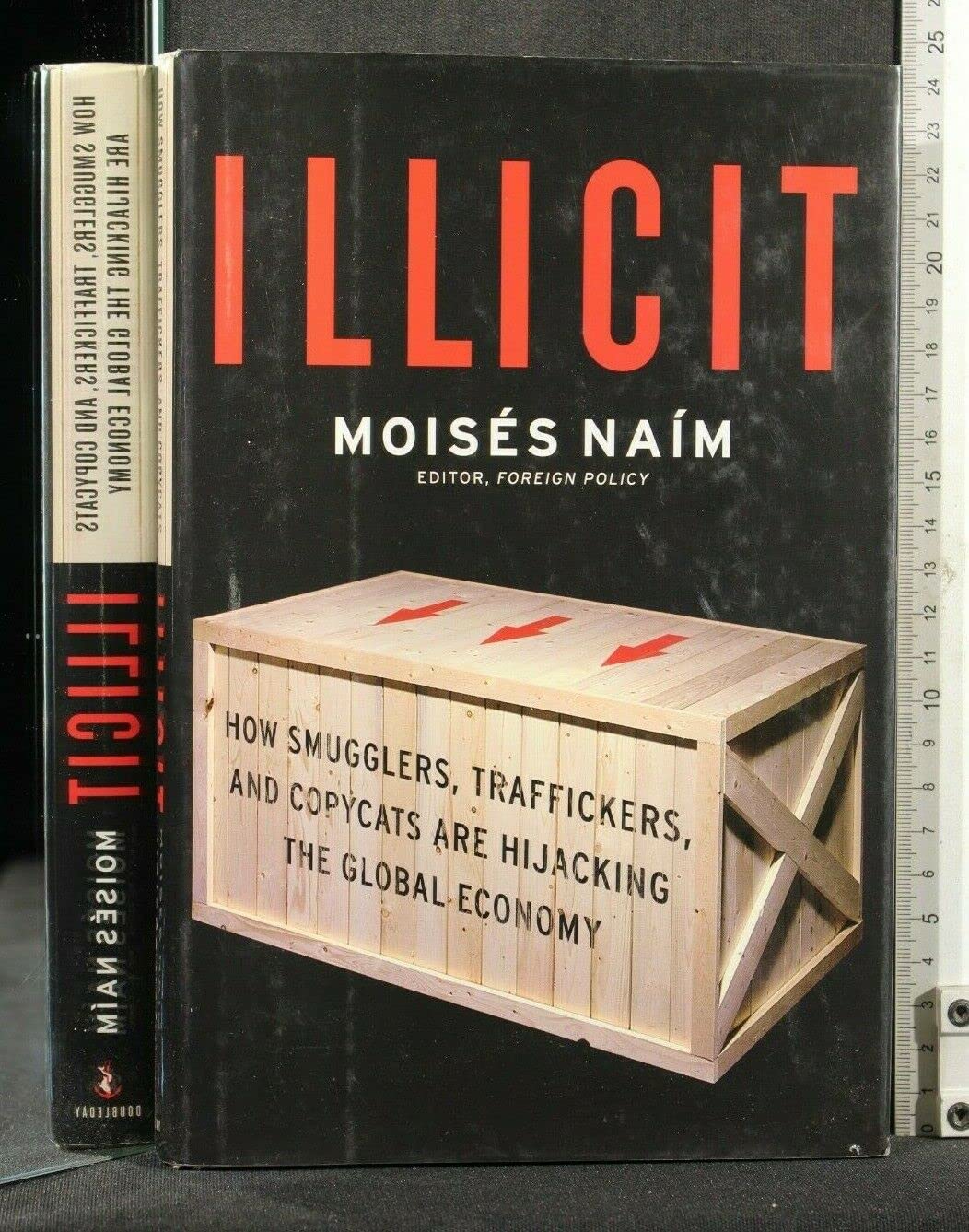
Illicit: How Smugglers, Traffickers and Copycats are Hijacking the Global Economy
$19.87
by Moisés Naím



Pick up a newspaper anywhere, any day, and you will find reports of illegal migrants, drug busts, smuggled weapons, and laundered money or counterfeit goods. Illicit trades are booming and so are the traffickers’ revenues—and their political influence. Hamstrung bureaucracies in rich and poor countries alike are losing the battles against these agile, well-financed, politically powerful, and ever-shifting networks of determined individuals. Religious and political zeal drive terrorists, but it turns out that simple profit is no less a motivator for political upheaval and international instability. Black-market networks are stealthily transforming global politics and economics. Filled with fast-paced, vivid examples that are as real as they are surprising, Illicit shows how we got to this dangerous point—and stresses the interconnections between these illegal enterprises, how they endlessly recombine to breed new lines of business, distort the economy of entire countries and industries, enable terrorists and even take over governments. From pirated movies to weapons of mass destruction, from human organs to endangered species, drugs or stolen art, Illicit reveals the inner workings of these amazingly efficient international organizations and shows why it is so hard—and so necessary—to contain them. Illicit offers a fresh, ingenious and compelling vision of this untold story of globalization. It provides a powerful new lens with which to assess how today’s world really works and where it may be headed. Illicit will surely ignite urgent debate at the highest levels—and change the way you think about the world. Illicit activities are exploding worldwide. The onslaught of globalization has unleashed a tidal wave of bad stuff--everything from arms trafficking, human smuggling, and money laundering to music bootlegging. Here is the dark side of globalization: the mushrooming underground economy. Moisés Naím explores this murky world in his book Illicit . Naím is the editor of the relaunched magazine Foreign Policy and a former executive director of the World Bank and Minister of Trade and Industry of Venezuela. In Illicit , he unties the connections between the Colombian cocaine dealer, the New York banker steering money to offshore tax havens, the Albanian forcing women into prostitution, and the Chinese market stall-holder selling counterfeit DVDs. Naím reports that legitimate global trade has doubled since 1990 from $5 to $10 trillion. Meanwhile, money laundering has gone up tenfold, exceeding $1 trillion a year. Smuggling and money laundering have always existed, but Naím shows how they have increased at a staggering pace in the wake of globalization, despite new government controls since 9/11. The main culprits are the collapse of the Iron Curtain and state deregulation. As the reach of organized crime has expanded, governments have failed to keep up. Naím illustrates the problems with stories about A.Q. Khan, the father of Pakistan's atomic bomb who sold nuclear technology to North Korea and Libya; Walter C. Anderson, an American who was accused of hiding $450 million in offshore accounts to evade taxes; and Vladimir Montesinos, the Peruvian intelligence czar who is on trial for trafficking drugs and arms. The book, while a little dry, will be interesting to policy buffs and aspiring crooks alike. --Alex Roslin Naim explores the massive trade in illegal goods and services that has ballooned in recent years along. The black-market trade in drugs, counterfeit goods, and the trafficking in human slaves is nothing new, but the digital age has opened up whole new avenues of exchange. Copies of software, CDs, and DVDs are as perfect as the original. Money laundering takes place through complex international electronic transfers that are difficult to trace to their source. Illicit wares are also a favorite source of funding for terrorist organizations, which use the proceeds to buy arms and influence. Naim points to the U.S. war on drugs as an example of how governments are wholly ineffective in stopping illegal trade. Nongovernmental organizations (NGOs) that have a stake in the outcome, such as the Business Software Alliance and the Motion Picture Alliance, may stand a better chance of gaining international cooperation than government bureaucracies. Naim also focuses on demand-side reduction and decriminalization as options to the forceful tactics of government law enforcement. David Siegfried Copyright © American Library Association. All rights reserved Moisés Naím is the editor of the influential magazine Foreign Policy , published by the Carnegie Endowment for International Peace. Under his leadership, Foreign Policy has gained wide recognition for its cutting-edge articles, winning the 2003 National Magazine Award for General Excellence. Naím holds an M.S. and a Ph.D. from MIT and was the Minister of Industry and Trade in Venezuela, as well as an Executive Director of the World Bank. His