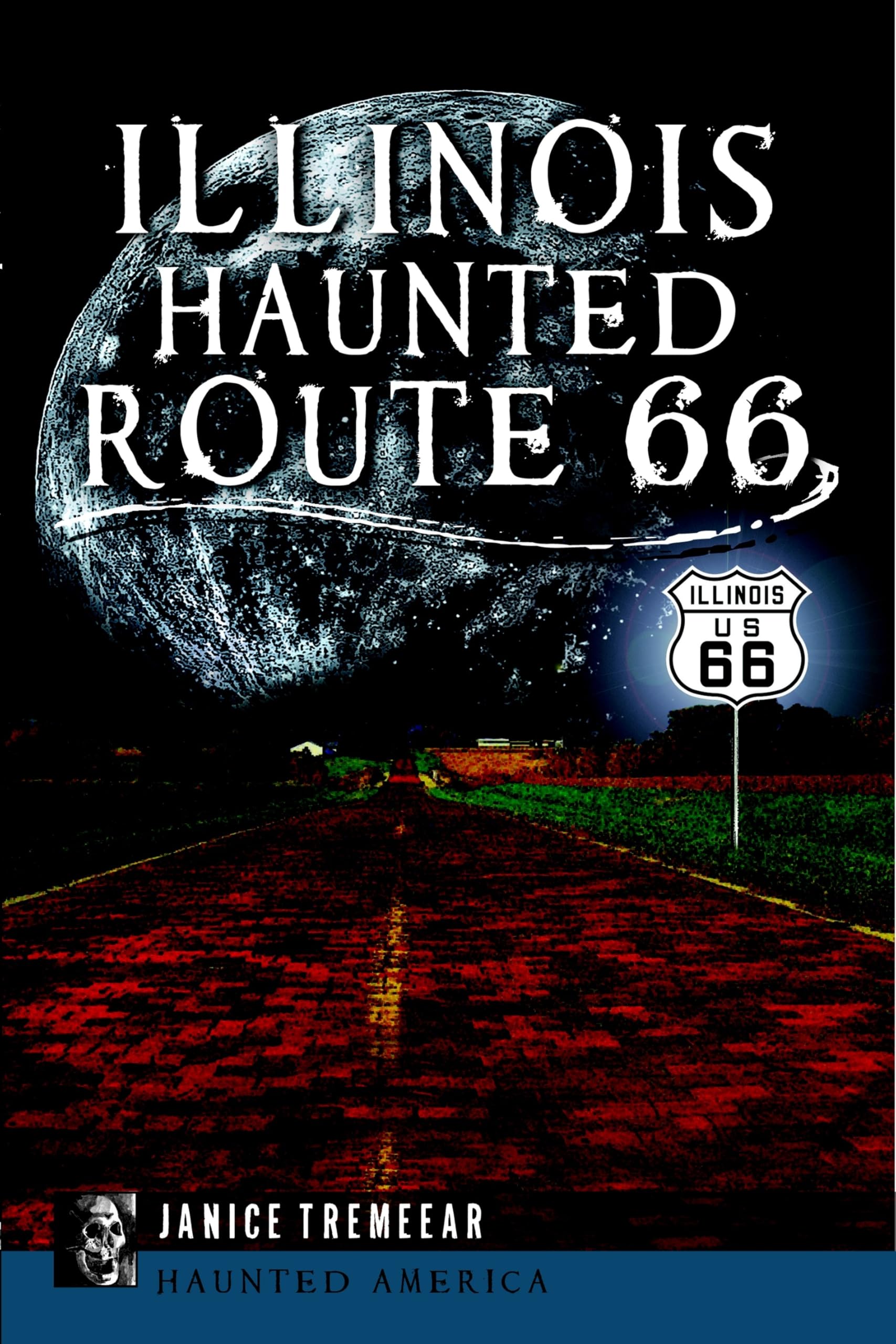



Route 66 is no longer the main thoroughfare between Chicago and St. Louis, but if local lore is to be believed, ghostly traffic along the Mother Road continues unabated. Janice Tremeear chases down accounts of a man executed for witchcraft, the demon baby of Hull House and the secrets of H.H. Holmes's Murder Castle. Native American legends place the piasa bird in the skies above the highway's southern stretch with the same insistence that characterize contemporary UFO sightings in the north. In between, spirits such as Resurrection Mary join the throng of hapless souls wandering the roadside of the Prairie State's most famous byway. Born in St. Louis, Janice has lived most of her life in Missouri. She is a second-generation dowser. In tune with the paranormal from an early age, she now directs her interest and research into investigating the unknown with her team Route 66 Paranormal Alliance. She has three grown children and four grandchildren. She currently lives in Springfield, Missouri. Illinois Haunted Route 66 Ghosts from Chicago to St. Louis By Janice Tremeear The History Press Copyright © 2013 Janice Tremeear All rights reserved. ISBN: 978-1-62619-252-2 Contents Acknowledgements, Introduction, 1. Illinois and Route 66: From the Beginning, 2. Chicago, 3. Joliet, 4. Watseka, 5. Bloomington, 6. Springfield, 7. New Salem, 8. Cahokia, Bibliography, About the Author, CHAPTER 1 Illinois and Route 66 From The Beginning Get Your Kicks on Route 66," the famous song written by Bobby Troup, brings to mind the freewheeling, fun attitude of vacationing families seeking adventure and new sights as they traveled along the "Middle Road" or the more oft-turned phrase, "Mother Road of North America," as coined by John Steinbeck. The call for adventure lured with promises of spicy sights and racy tales of roadside dives. Called the "most magical road in all the world" with its roadside giants, campsites, mini museums, mom-and-pop businesses, motor courts and eateries topped with miles upon miles of glowing neon, Route 66 was a lighted pathway enticing the weary, delighting the wide-eyed seekers of the wonder of the open road. Cozy Dog Drive-in, the historic eatery in Springfield, Illinois, is the home to the original hot dog on a stick. Established in 1949, the drive-in served as one of the enticing oddities people loved. Some believe Route 66 embodies a part of the "dragon lines," a very powerful energy grid located at specific longitude and latitude lines, known as ley lines, which create sacred geometric grid patterns on the globe where many ancient sites and spirit roads exist, such as the Mayan and the Egyptian pyramids. In between Chicago and Los Angeles runs the shattered spine of America, the broken ley line of Route 66, with the main break appearing in Kansas. A growing population during the 1920s and a growing number of automobiles forced highway officials to admit to the impracticality of disjointed trails. Legislation for public highways first appeared in 1916. Congress enacted an even more comprehensive version of the act in 1925 and executed its plan for national highway construction. Cyrus Avery, a Tulsa, Oklahoma resident, teamed with highway proponent John Woodruff of Springfield, Missouri, to lobby for the creation of a diagonal roadway running from Chicago to Los Angeles. The American Association of State Highway and Transportation Officials (AASHTO) named the road Route 60 and then changed it to Route 62. Avery "strenuously objected" to the switch, sending an impassioned letter to AASHTO executive secretary William Markham that read, "You are making a joke of the interstate highway." On April 30, 1926, the route became Route 66. Avery gained fame as the "Father of Route 66," the birthplace of which was located in Springfield, Missouri. Illinois begins the great roadside culture with the 2,448-mile-long asphalt python starting in the downtown Chicago loop at the "slabbed" Pontiac Trail, SBI 4. Like the tip of the Yellow Brick Road in The Wizard of Oz, the section of Route 66 constructed during 1926 to 1930 is the most scenic part in Illinois, slanting through a densely populated, developed state with a fairly level alignment thanks to the scraping of Ice Age glaciers — unlike the twists, switchbacks, cuts and roller-coaster terrain it takes in Missouri, west of St. Louis. As early as the mid-1920s, the Prairie State boasted that its segment of the Old Road was mud-free and slab all the way. "Muffler Men" were gentle giants bordering the road in front of tourist shops, service stations or restaurants. Once common in the heyday of Route 66, only a few of them survive. The most iconic one, "Tall Paul," holding a giant hotdog, is located in Atlanta, Illinois. It was moved (it originally stood in Cicero, Illinois) and beautifully restored by the Route 66 Association. Route 66 soon became the road of choice for Capone and other Chicago gangsters in the pursuit o