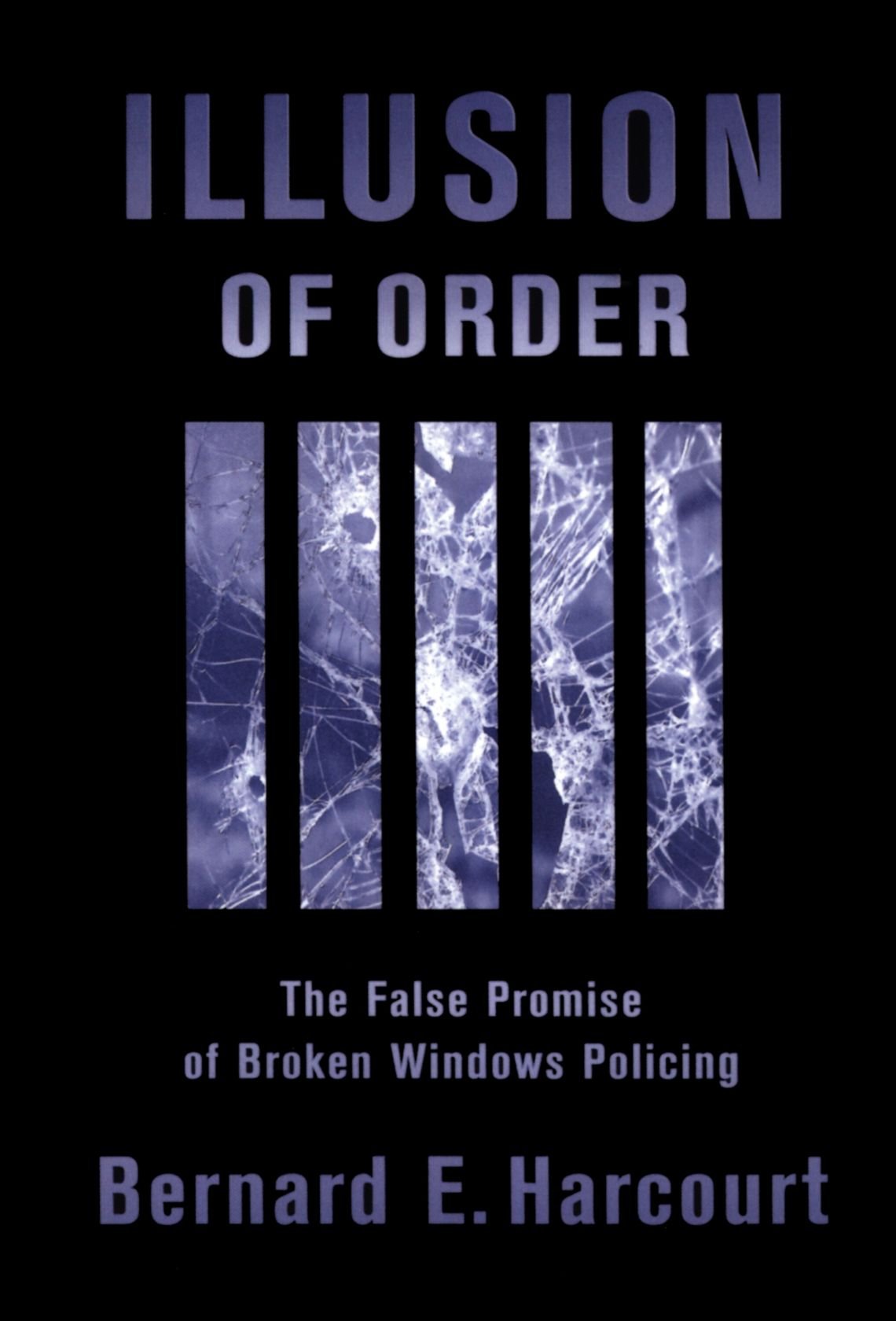
Illusion of Order: The False Promise of Broken Windows Policing
$44.00
by Bernard E. Harcourt



This is the first book to challenge the "broken-windows" theory of crime, which argues that permitting minor misdemeanors, such as loitering and vagrancy, to go unpunished only encourages more serious crime. The theory has revolutionized policing in the United States and abroad, with its emphasis on policies that crack down on disorderly conduct and aggressively enforce misdemeanor laws. The problem, argues Bernard Harcourt, is that although the broken-windows theory has been around for nearly thirty years, it has never been empirically verified. Indeed, existing data suggest that it is false. Conceptually, it rests on unexamined categories of "law abiders" and "disorderly people" and of "order" and "disorder," which have no intrinsic reality, independent of the techniques of punishment that we implement in our society. How did the new order-maintenance approach to criminal justice--a theory without solid empirical support, a theory that is conceptually flawed and results in aggressive detentions of tens of thousands of our fellow citizens--come to be one of the leading criminal justice theories embraced by progressive reformers, policymakers, and academics throughout the world? This book explores the reasons why. It also presents a new, more thoughtful vision of criminal justice. “This is an excellent, timely, and thought-provoking book, absolutely critical to the continuing debate on the "broken windows" theory. Harcourt's book will be a welcome intervention in this ongoing public debate. As an academic matter, Harcourt takes on the social norms school, and effectively exposes its absence of empirical support. This, too, is a tremendously important contribution to the literature. Like "broken windows'" in policing, "social norms" theory has been accepted all too uncritically in academia, and the questions Harcourt raises are the right ones.” ― David Cole, Georgetown University Law Center “"Broken windows," "order-maintenance," "quality-of-life policing": these ideas are fast becoming the conventional wisdom of contemporary crime control. In this, the first book-length critique of these policies and the ideas that underpin them, Bernard Harcourt goes straight to the heart of the matter. Harcourt asks, "Do these policies work?" and "How do we know?" and he addresses these questions with due attention to empirical evidence and methodological detail. But he also poses a more profound question. "How do these ways of policing disorder shape our citizens, our civic culture, and our social relations?" His book is a timely reminder that in policing the "disorderliness" of others, we also define the civic order in which we, ourselves, must live.” ― David Garland, New York University “This book makes a valuable contribution for taking on the sacred cow of the "broken windows" theory. Harcourt makes a convincing case that the New York miracle is not a confirmation of the "broken windows" hypothesis, but reflects the substantial increase in the number of police in New York and the number of arrests, plus the effect of the declining crack cocaine trade. He argues that New York City's quality-of-life initiative has probably contributed to the decline in crime not from a reduction in litter, fixing broken windows, or beautifying neighborhoods, but rather through the enhanced power of surveillance offered by a policy of aggressive misdemeanor arrests. These mechanisms have little to do with fixing broken windows and much more to do with arresting window breakers.” ― John Donohue III, Stanford University “Harcourt presents a 'wake-up' call to all those who blindly accept the 'broken windows' approach to policing. Highly recommended for all criminology and social science collections.” ― Tim Delaney , Library Journal “[In] his new book, Illusion of Order , Bernard Harcourt argues that the 'broken windows' theory underlying New York's policing strategy doesn't deserve much praise...He suggests that no studies establish a link between neighborhood disorder and crime victimization...Offering a critique grounded equally in public policy and political theory, the book veers widely, from the writings of Michel Foucault and John Stuart Mill to a highly technical analysis of previous statistical studies. [Harcourt's] arguments offer a measured counterbalance to the gung-ho advocates of 'broken windows' policing and a welcome warning about the limits of simplistic social policy.” ― Seth Stern , Christian Science Monitor “Legal theorist Bernard Harcourt has written an important, engaging, and provocative work on criminal justice. He criticizes the idea, associated with James Q. Wilson, William Bratton, and Rudolph Giuliani, that determined efforts to punish petty crimes (breaking windows, loitering, squeegeeing windshields) will reduce the rate of serious crimes.” ― Joshua Cohen , Boston Review “A 1982 article by James Q. Wilson and George Kelling introduced the concept of a "broken windows" approach to combating cri