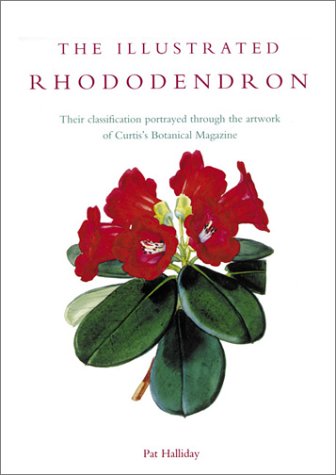
Illustrated Rhododendron: Their Classification Portrayed Through the Artwork of Curtis's Botanical Magazine
$43.97
by Pat Halliday



Halliday, a staff member at the Royal Botanic Garden in Kew from 1947-1990, demonstrates the classification of this complex genus using reproductions of beautiful hand-colored engravings from William Curtis' Botanical Magazine (founded in 1787). Each of the 121 plates is accompanied by an account of that species' history, introduction into cultivation, distribution, habitat, and classification. Annotation c. Book News, Inc., Portland, OR (booknews.com) William Curtis's venerable Botanical Magazine , founded in 1787, is one of the oldest regular publications with color illustrations still in existence. In The Illustrated Rhododendron , Pat Halliday lays out the complicated classification of the genus according to the system approved by the Royal Botanic Garden, Edinburgh, taking as her inspiration the finely detailed drawings that appeared in the Botanical Magazine over the last two centuries. Though of course not all of the 850 or so species native to the Northern Hemisphere are pictured or discussed, every subgenus, section, and series is represented, the species chosen for inclusion based on the quality and condition of the illustration available, the importance of the species historically, the popularity of the species, and Halliday's personal interest in it. "This is primarily a book of 'pretty pictures,'" Halliday writes, but that is a modest appraisal. Halliday's accounts of the selected species' discovery and cultivation, as well as her meticulous descriptions of the plants, range, and habitats, will captivate rhododendron enthusiasts. And on the contrary, the illustrations were given short shrift in the book's production--the paper is simply too transparent to support dense text on one side and a delicate illustration on the other. Ultimately, this is a book on the classification of the Rhododendron genus, with some very pretty pictures thrown in. --Liana Fredley Plant exploration and a devotion to gardening are part of Great Britain's formidable horticultural tradition, as is William Curtis' Botanical Magazine , appearing first in 1787 and in production continuously since that time. From among thousands of illustrations published in that periodical, Halliday culled lovely botanical portraits and commissioned new drawings for this compilation of more than 100 blooming rhododendrons. Scientifically, Halliday aims to fully represent the classification of the Rhododendron genus. To that end, the text offers engrossing historical background, meticulous descriptions, cultural advice, and practical growing information for each species shown, accompanied by depictions of beautiful inflorescences, textural leaf forms, and a range of plants from dwarfs to towering shrubs. Artistically, Halliday's effort achieves the luminescence of a multifaceted gem: the book is bright with images of beguiling flowers adorning an array of rare and familiar rhododendrons. The result is a volume that will elicit the curiosity of backyard gardeners while satisfying the demands of connoisseurs. Alice Joyce Copyright © American Library Association. All rights reserved Anyone who loves the history of garden plants will find this book entrancing. -- Verlyn Klinkenborg, The New York Times Book Review, December 2, 2001 Gardeners and growers will want to have this book, but it will also interest those who enjoy fine botanical illustration. -- Choice, Vol. 39 No. 04, December 2001 Highly recommended, essential reading for gardeners and horticulturalists with an interest in the species. -- The Bookwatch, October 2001 [This book] is an exquisite collection of botanical art on the genus Rhododendron. . . . Rhododendron enthusiasts will surely appreciate. -- Mark Brand, HortScience, Vol. 36 No. 7, December 2001 Pat Halliday was on the staff in the Herbarium at the Royal Botanic Garden, Kew, from 1947 to 1990. She has been involved in the study of rhododendrons for many years and carried out all the identification work for Kew. She continues to lend out her identification services today. Used Book in Good Condition