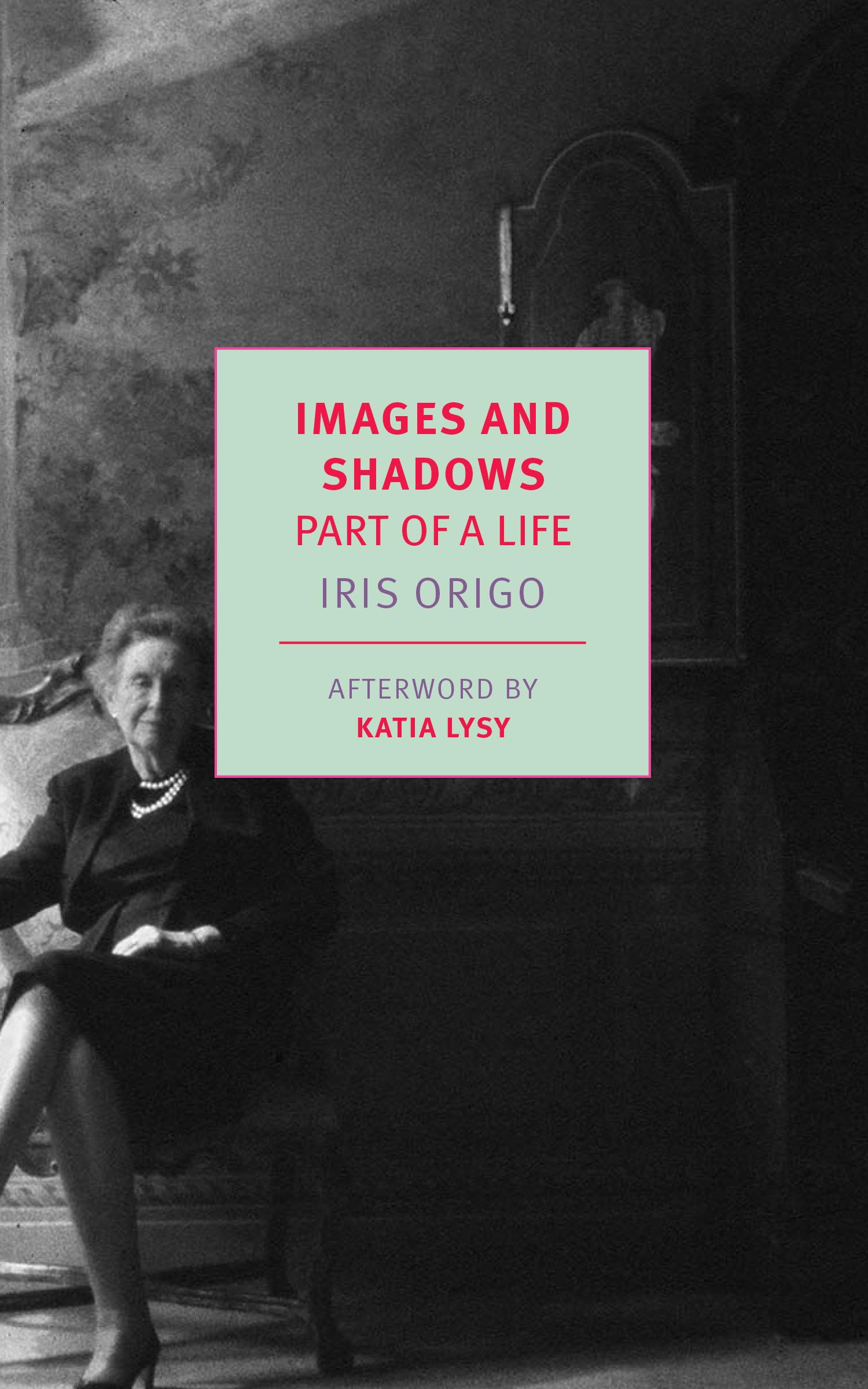



An extraordinary memoir by Iris Origo, who chronicled political life in A Chill in the Air and War in Val d'Orcia , and now turns inward to describe her own family, the work of writing, and the transcience of memory. Images and Shadows , Iris Origo’s autobiographical account of her early life, is as perceptive and humane and beautifully written as her celebrated memoir War in Val d’Orcia . Origo’s father came from an old and moneyed American family, her mother was the daughter of an Irish peer, and Iris grew up in the most privileged of circumstances. Her father died of tuberculosis when he was only thirty, and her mother moved to Fiesole, Italy, where she and Iris developed a close friendship with the great connoisseur and art historian Bernard Berenson. Later, Origo and her Italian husband transformed a desolate and deforested Tuscan property into a flourishing estate, and it was there that she discovered her true calling as a writer. In Images and Shadows , Origo paints portraits of her shy, loving father and her headstrong mother, and describes beloved places, the books that formed her sensibility, and how she grew up and made her way in the world. She reflects on the pleasures and challenges of writing and evokes the persistence and fragility of memory. Images and Shadows is an autobiography that is as thoughtful as it is profoundly touching. “An elegiac autobiography . . . illuminating.” — The Daily Telegraph “ Images and Shadows , written with all the lucidity and lightness of touch for which she was widely admired, is extremely enjoyable. It is an engrossing picture of an earlier age, clever, full of acute literary asides, and with a kind of philosophizing that seems to belong to a time when writers did not have to make excuses when they reflected on the principles of morality and religion that governed their lives.” —Caroline Moorehead, The Spectator “[Origo’s] autobiography is distinguished by its beautiful prose style, its moral and psychological intelligence, and its vivid social history. . . . Among her distinctions is the fact that her personal writings are the works of a biographer and historian by temperament, training and practice. This . . . is of course what makes her personal writing so penetrating and valuable. But Iris combines this habit of mind with the techniques and ironic distance of a novelist of manners, which is what makes her observations so thoroughly readable.”— Beth Gutcheon, The Hudson Review “Origo’s natural elegance leads her to understate her toughness, passion and her bravery—not least in assisting anti-Fascist partisans during World War II—qualities that nonetheless saturate this eminently civilized book.” —A.O. Scott, The New York Times “A masterly biographer here recounts her own story. All her work has delighted me, and in this autobiography she is at her best.” —Raymond Mortimer “This is a small classic of autobiography in which Iris Origo recreates the lost mad world of Bernard Berenson and the Anglo-American artistic coterie in Florence. She is marvellous at nuances of place and personality, writing with a subtle mingling of candour and affection that lingers in the mind. Her courageous account of wartime struggles at La Foce in Tuscany where she lived after her marriage is one of the most moving memoirs of the Second World War I have ever read.” —Fiona MacCarthy “A true cosmopolite of vast energy and stunning intelligence . . . Origo was the rare person of privilege who used her position for the real betterment of the world.” —Nicholas Fox Weber, The New York Times Iris Origo (1902–1988) was a British-born biographer and writer. She lived in Italy and devoted much of her life to the improvement of the Tuscan estate at La Foce, which she purchased with her husband in the 1920s. During the Second World War, she sheltered refugee children and assisted many escaped Allied prisoners of war and partisans in defiance of Italy’s fascist regime and Nazi occupation forces. She is the author of A Chill in the Air: An Italian War Diary, 1939–1940 and War in Val d’Orcia: An Italian War Diary, 1943–1944 (both NYRB Classics); Leopardi: A Study in Solitude ; and The Merchant of Prato , among others.