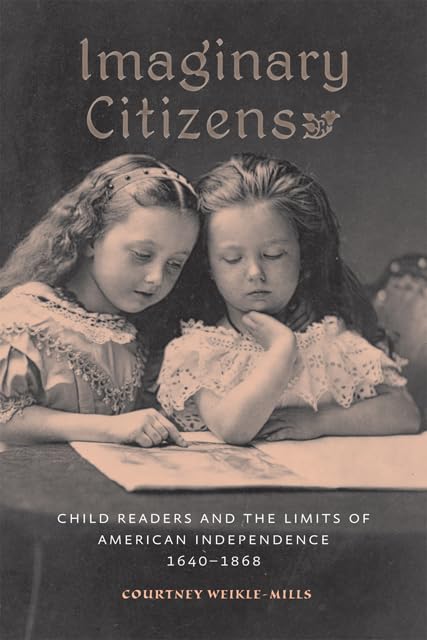
Imaginary Citizens: Child Readers and the Limits of American Independence, 1640–1868
$57.00
by Courtney Weikle-Mills



How did Ichabod Crane and other characters from children’s literature shape the ideal of American citizenship? 2015 Honor Book Award, Children's Literature Association From the colonial period to the end of the Civil War, children’s books taught young Americans how to be good citizens and gave them the freedom, autonomy, and possibility to imagine themselves as such, despite the actual limitations of the law concerning child citizenship. Imaginary Citizens argues that the origin and evolution of the concept of citizenship in the United States centrally involved struggles over the meaning and boundaries of childhood. Children were thought of as more than witnesses to American history and governance―they were representatives of “the people” in general. Early on, the parent-child relationship was used as an analogy for the relationship between England and America, and later, the president was equated to a father and the people to his children. There was a backlash, however. In order to contest the patriarchal idea that all individuals owed childlike submission to their rulers, Americans looked to new theories of human development that limited political responsibility to those with a mature ability to reason. Yet Americans also based their concept of citizenship on the idea that all people are free and accountable at every age. Courtney Weikle-Mills discusses such characters as Goody Two-Shoes, Ichabod Crane, and Tom Sawyer in terms of how they reflect these conflicting ideals. This tightly argued and convincing book reflects the extraordinary ambiguity that has almost always surfaced in thinking and writing for and about children, and it shows the extent to which the study of history and literature can inform each other. ―James Marten, Journal of American History Well researched and engaging, filled with both factual information and insightful analysis. ―Chris Nesmith, Children's Literature Association Quarterly This book is impressive for its breadth of scholarship, and it should stimulate discussion among its intended audience of academics and advanced undergraduates about children and childhood as metaphors for how citizenship was, and can be, defined. ―Gail Schmunk Murray, New England Quarterly Weikle-Mills provides a fascinating new way to look at American conceptions of citizenship... Historians of childhood will find this book useful, as will anyone who wants to understand the changing position of children and the concept of responsible citizenship. ―Nancy Hathaway Steenburg, American Historical Review The main strengths of Imaginary Citizens are its clarity of expression, explicit definition of terms, and easy interaction with multiple fields, including children's literature, early American literary, religious and political studies. ― The Year's Work in English Studies Weikle-Mills's rich investigation of connections between child readers and political empowerment significantly contributes to both the study of children's literature and the study of American social and political history. ―Thomas Fair, Rocky Mountain Review of Language and Literature This book is an original and compelling contribution to the history of children’s literature, early American literary studies, religious studies, and politics. Weikle-Mills clarifies children’s historical relationship to citizenship and shows the way in which childhood helped to define the very terms of citizenship, especially as the nation moved away from a patriarchal model of subjecthood to a democratic society. ―Julia L. Mickenberg, University of Texas at Austin This book is an original and compelling contribution to the history of children’s literature, early American literary studies, religious studies, and politics. Weikle-Mills clarifies children’s historical relationship to citizenship and shows the way in which childhood helped to define the very terms of citizenship, especially as the nation moved away from a patriarchal model of subjecthood to a democratic society. -- Julia L. Mickenberg How did Ichabod Crane and other characters from children’s literature shape the ideal of American citizenship? Courtney Weikle-Mills is the director of the Children’s Literature program and an associate professor at the University of Pittsburgh. She is the author of Imaginary Citizens: Child Readers and the Limits of American Independence, 1640-1868 . Used Book in Good Condition