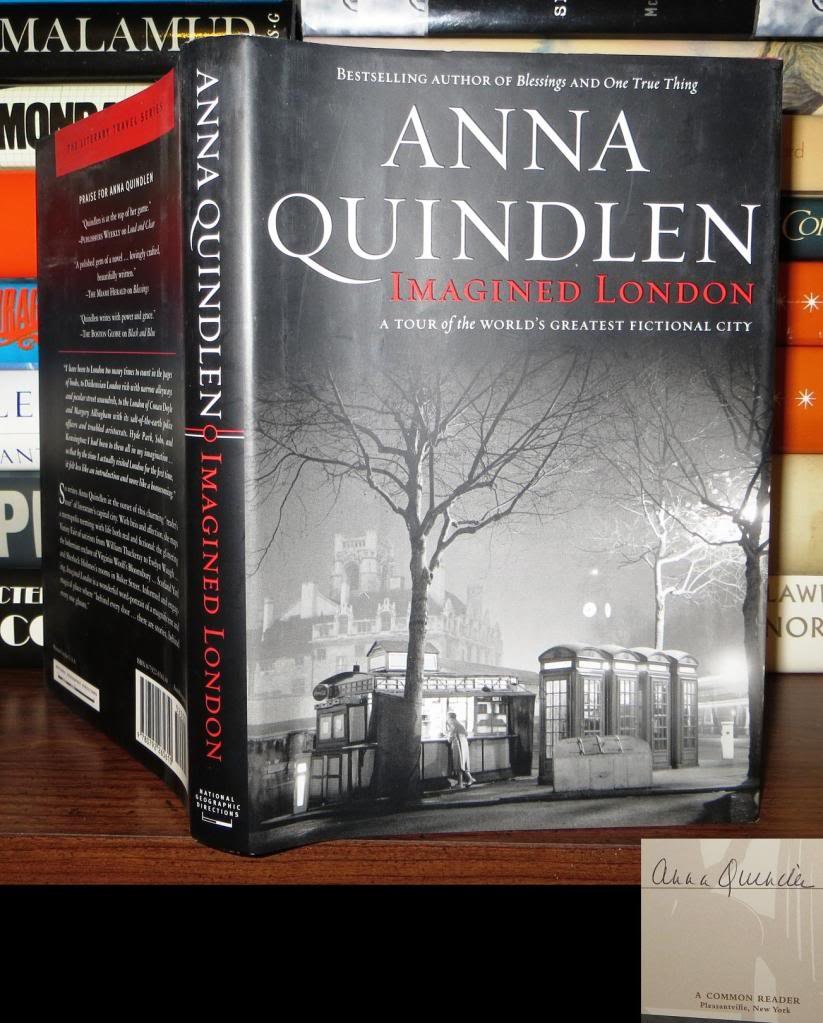
Imagined London: A Tour of the World's Greatest Fictional City (Directions)
$19.87
by Anna Quindlen



Anna Quindlen first visited London from a chair in her suburban Philadelphia home. "'The city streets were filled with fog and the cobbled pavers were slightly slick with moisture, so that the man and woman struggling down the street slid on its surface. It was just after the war, and some of the buildings were empty holes left over from the blitz.' The book describing this was by Patricia Wentworth, one of a series of mystery novels she wrote that wind up always, inevitably, in the capital, at the cozy flat of the essential English spinster."Quindlen has been to London countless times since, in the pages of books. From Dickensian London, rich with narrow alleyways and jocular street vendors, to the London of Conan Doyle and Margery Allingham, with its salt-of-the-earth police officers and crowded train stations. She visited Victoria Station, Hyde Park, Soho, and Kensington in her imagination long before ever setting foot in the city. By the time Quindlen actually visited London in 1995, it was less like an introduction and more like a homecoming. Here, she thought, is where Evelyn Waugh's bright young things danced until dawn. Here is where foolish Lydia Bennett eloped with the dastardly Wickham. Here is where Oliver Twist sought his fortune, and where Adam Dalgliesh has his private flat. New York, Paris, and Dublin are vividly portrayed in fiction, but London has always been the star, both because of the primacy of English literature and the specificity of the city's descriptions. In Imagined London, Quindlen walks through the city, moving within blocks from the great books of the 18th century to the detective stories of the 20th to the new modernist tradition of the 21st. Her book is about traveling and reading in a city in fact and a city in fiction and where and how the two cities intersect. Best-selling novelist and Newsweek columnist Quindlen has always been an "indefatigable" reader, and British novels set in London, "indisputably the capital of literature," have been a particular passion. Quindlen acquired a vivid impression of the city from absorbing Dickens, Eliot, Galsworthy, Doyle, Woolf, and Lessing, writers for whom London was as much a living character as their indelible protagonists. But she admits she was reluctant to travel there and obliterate the imagined with the actual. Finally, a book tour sends her to this fabled place, and she does revel in London's evocative complexity as she undertakes pilgrimages to literary landmarks. Deftly contrasting "the London frozen in the amber of great fiction" with today's city, Quindlen discerns the key lesson of English literature: the "unvarying nature both of social problems and personal dramas." The continuity that links, for instance, characters and predicaments in Monica Ali's Brick Lane (2003) to those in Dickens' works. A consistently enlightening and enjoyable writer, Quindlen presents a smart, bookish, wry, and stimulating portrait of the most literary of cities. Donna Seaman Copyright © American Library Association. All rights reserved Anna Quindlen is a columnist for Newsweek.