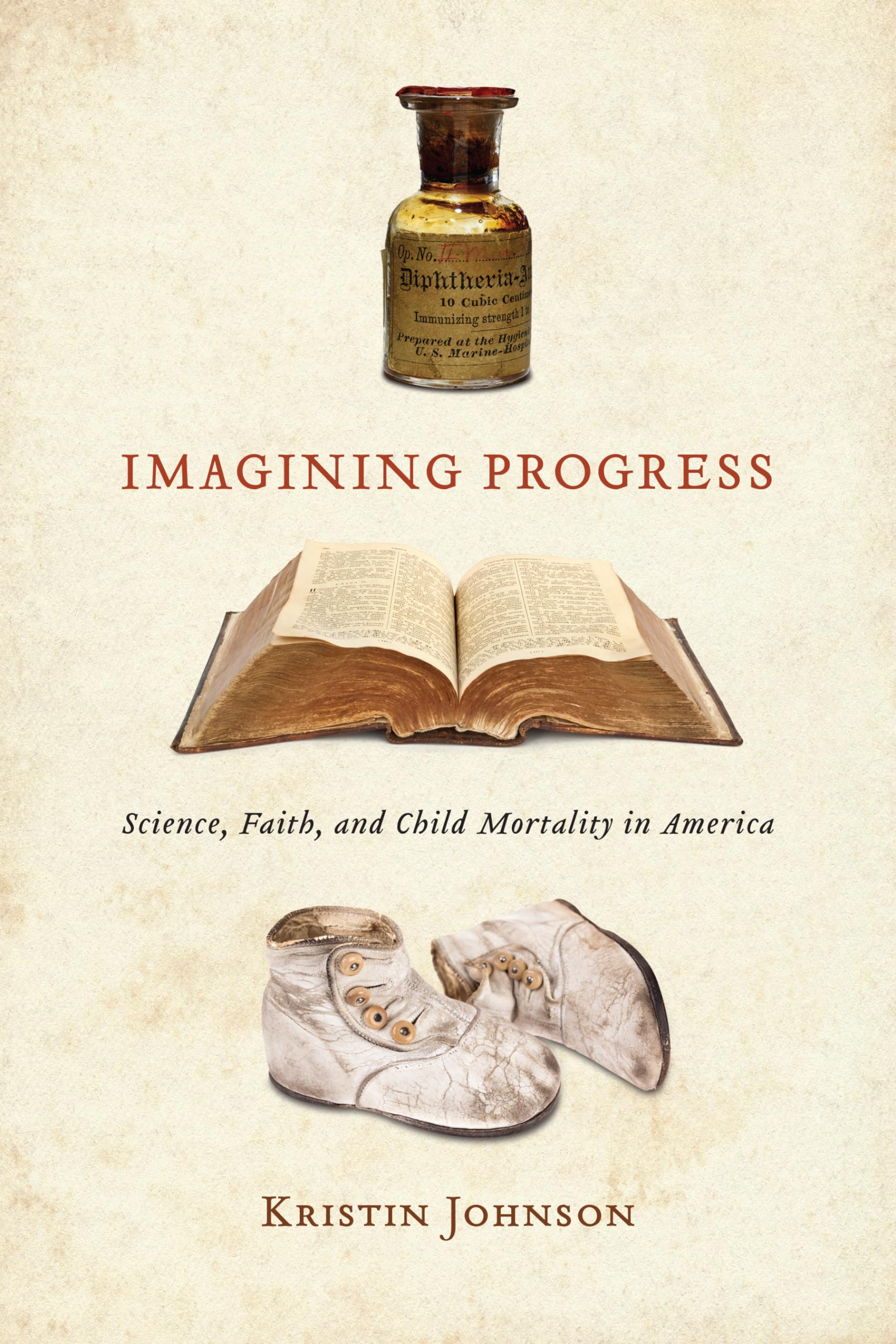
Imagining Progress: Science, Faith, and Child Mortality in America
$34.95
by Kristin Johnson



Explores the intellectual history of Americans’ divergent assumptions about God, nature, and science Offering fascinating examples from the works of diverse writers and thinkers such as Benjamin Franklin, Frederick Douglass, Mark Twain, W. E. B. Du Bois, Elizabeth Cady Stanton, and Harriet Shelton Dover, Kristin Johnson traces the history of Americans’ complicated faith in science and the various triumphs and tragedies that faith has inspired. Imagining Progress reveals many of the complex factors involved in the polarized state of contemporary American attitudes toward science, scientists, public health, medicine, and science policy. Humankind has always wrestled with the existence of suffering, how to respond to suffering, whom to care for, and in what ways. For two centuries, many American ministers, physicians, and scientists believed that an omnipotent and omniscient God created the world such that people might relieve suffering through ingenuity and learning. Others responded to the new worldview introduced by the scientific revolution as a threat to the divine order. In Imagining Progress , Johnson traces the history of Americans’ evolving relationship with science and religion at “one of its most dramatic places”—the bedsides of dying children. It’s here, in the crucible of parental despair, that she illuminates diverging assumptions about God, nature, and history. From Cotton Mather’s campaign for smallpox inoculation to battles over teaching evolution in the 1920s, Johnson adroitly weaves an interdisciplinary history of medicine, science, theology, and activism. She follows a wide cast of characters from across theological, scientific, and political spectrums. What emerges is a kaleidoscopic portrait of diverse, often contradictory hopes and anxieties inspired by new theories of nature and human existence. Johnson also discerns a problematic pattern of invoking science both to ameliorate the suffering of some children while ignoring the suffering of others. " Imagining Progress is a tour de force in the history of ideas regarding how Americans explained and responded to childhood illness and mortality from 17th-century Colonial days to the 1920s. . . . The book does a tremendous service to anyone interested in pursuing these matters further, in that it provides comprehensive endnotes and an extensive bibliography." — CHOICE "What makes this book so powerful is its simultaneous sweep and intimacy. Johnson shows how competing arguments about of the laws of God, nature, and progress that evolved from the 1690s to the 1920s were tightly interwoven with individual parents’ needs to make sense of the all-too-common deaths of their children. In the interaction of these stories, we learn how fathers and mothers channeled their deepest personal losses into belief, hope, and action toward a less deadly future—for at least some of America’s children." —Lynn K. Nyhart is professor emerita of History at the University of Wisconsin – Madison. “A fascinating study that places child loss at the center of American intellectual debates over God, nature, and science. Between the colonial era and the Scopes Trial, Americans with diverging views of God and nature struggled to understand and respond to child mortality and suffering. Imagining Progress puts both the triumph of medicine and the tragedy of eugenics in a new light.” —Molly Ladd-Taylor, author of Mother-Work: Women, Child Welfare, and the State “ Imagining Progress is deeply researched, nuanced in its interpretations, and beautifully written, and it illuminates facets of the American present as well as past. A true joy to read, scholars and general readers alike will profit from its many thought-provoking insights.” —Diane B. Paul, Professor Emerita in Political Science at UMass Boston and Associate in the Department of Organismic and Evolutionary Biology at Harvard University “In this highly original and important book, Kristin Johnson seamlessly and skillfully weaves together diverse lines of inquiry: history of science, history of medicine, history of racism, and history of religion. Her study of pastoral counsel and medical empathy in the deaths of children recalls Drew Faust’s The Republic of Suffering .” —Edward B. Davis, Professor Emeritus of the History of Science, Messiah University “The author’s approach to the material is original. . . clearly a new and interesting perspective on the relations of faith, medicine, and culture in American history. . . The broad range of time, choice of characters, and interdisciplinary approach makes this a potentially significant contribution to the field.” —Charles D. Kay, PhD, Professor Emeritus, Wofford College “Kristin Johnson draws on rich scholarship about complex, important issues to tell a compelling story. Focusing on childhood death, she brings together many threads of American history. How have individuals from the 18th century to the 1920s faced death of their child