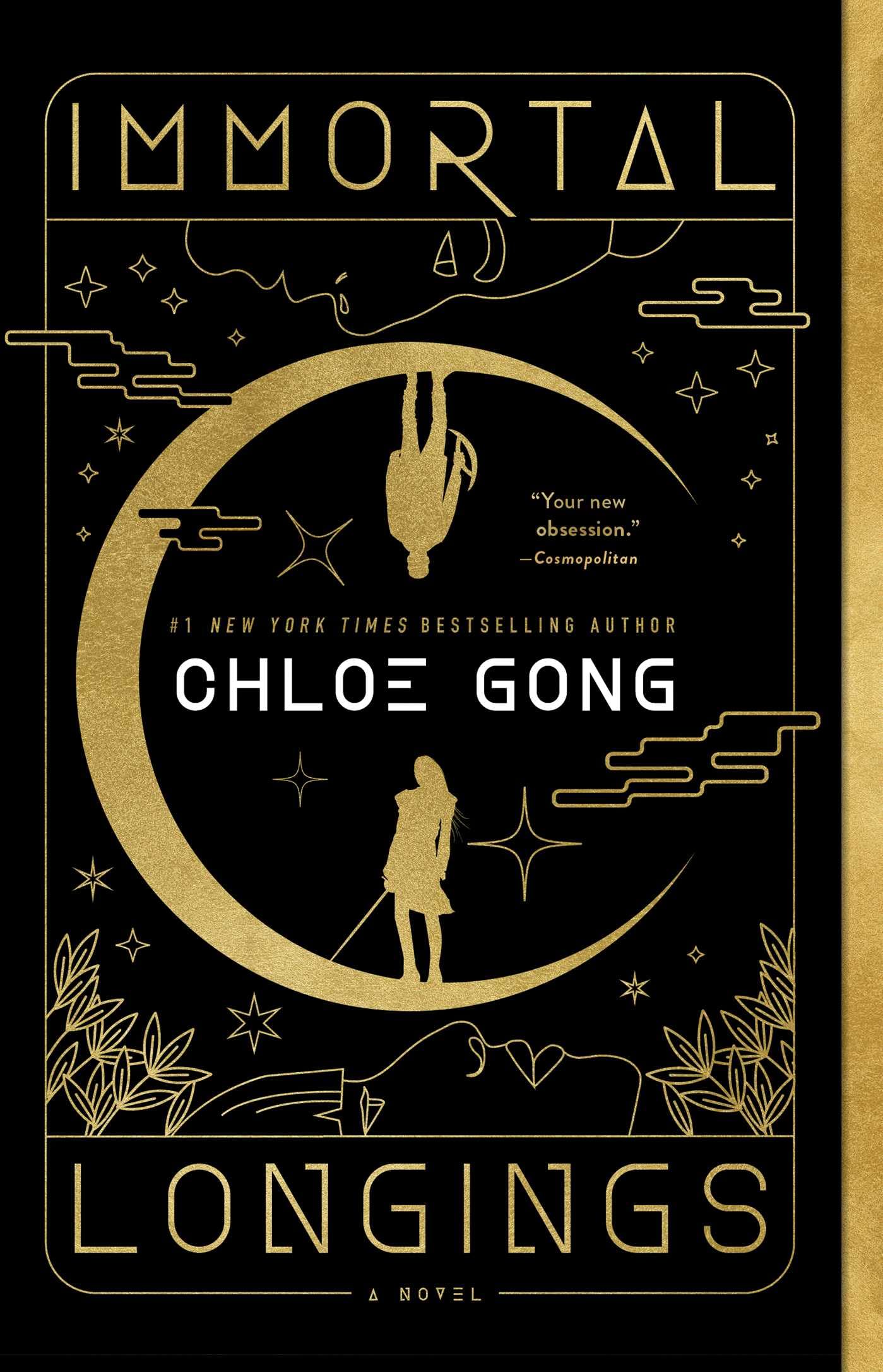



A NEW YORK TIMES AND USA TODAY BESTSELLER Chloe Gong’s adult epic fantasy debut, inspired by Shakespeare’s Antony and Cleopatra , is a “smart, imaginative, and brutal” (Wesley Chu, New York Times bestselling author of The War Arts Saga) collision of power plays, spilled blood, and romance amidst a set of deadly games. Every year, thousands in the kingdom of Talin flock to its capital twin cities, San-Er, where the palace hosts a set of games. For those confident enough in their ability to jump between bodies, competitors across San-Er fight to the death to win unimaginable riches. Princess Calla Tuoleimi lurks in hiding. Five years ago, a massacre killed her parents and left the palace of Er empty…and she was the one who did it. Before King Kasa’s forces in San can catch her, she plans to finish the job and bring down the monarchy. Her reclusive uncle always greets the victor of the games, so if she wins, she finally gets her opportunity to kill him. Enter Anton Makusa, an exiled aristocrat. His childhood love has lain in a coma since they were both ousted from the palace, and he’s deep in debt trying to keep her alive. Thankfully, he’s one of the best jumpers in the kingdom, flitting from body to body at will. His last chance at saving her is entering the games and winning. Calla finds both an unexpected alliance with Anton and help from King Kasa’s adopted son, August, who wants to mend Talin’s ills. But the three of them have very different goals, even as Calla and Anton’s partnership spirals into something all-consuming. Before the games close, Calla must decide what she’s playing for—her lover or her kingdom. Chloe Gong is the #1 New York Times bestselling author of the critically acclaimed Secret Shanghai novels, as well as the Flesh and False Gods trilogy. Her books have been published in over twenty countries and have been featured in the New York Times , People , Cosmopolitan , and more. She was named one of Forbes ’s 30 Under 30 for 2024. Chloe graduated from the University of Pennsylvania with a degree in English and international relations. Born in Shanghai and raised in Auckland, New Zealand, she is now located in New York City, pretending to be a real adult. Chapter 1 CHAPTER 1 A living thing, when faced with a break or injury, is compelled to heal itself. A cut will clot with blood, trapping in a person’s qi. A bone will smooth over, knitting new threads at every split. And San-Er’s buildings, when an inconvenience is identified, will rush to mend the sore, pinpointing every fracture and hurling remedies with vigor. From the top of the palace, all that can be seen are the stacked structures composing the twin cities, interlocked and dependent upon one another, some attached to a neighbor from the ground level and others connected only at the highest floors. Everyone in the kingdom of Talin wants to be in its capital—in these two cities masquerading as one—and so San-Er must grow denser and higher to accommodate, covering up its offenses and stenches with utter incoherence. August Shenzhi tightens his grip on the balcony railing, tearing his gaze away from the horizon of rooftops. His attention should be with the marketplace below, which bustles at high volume inside the coliseum walls. Three generations ago, the Palace of Union was built beside San’s massive coliseum—or perhaps it’s more apt to say it was built into the coliseum, the north side of the elevated palace enmeshed with the coliseum’s south wall, its turrets and balconies pulling apart stone and slotting itself right in to close the gap. Every window on the north side has a perfect view of the market, but none better than this balcony. Back when he still made public appearances, King Kasa stood here to make his speeches. The market would be cleared out, and his subjects would come to gather in the only plot of open space inside San-Er, cheering for their monarch. There’s nowhere quite like the coliseum. San-Er itself is only a small protrusion of land at the edge of the kingdom, its border with rural Talin marked by a towering wall, the rest of its perimeter hemmed in by sea. Yet despite its size, San-Er functions as a world of its own—half a million inhabitants crammed into each square mile, again and again. The needle-thin alleys between every building sag, the earthen ground always muddy because it is sweating with overexertion. Prostitutes and temple priests share the same doorway; drug addicts and schoolteachers nap under the same awning. It makes sense that the only space protected from builders and squatters is the coliseum, under the vigilant eye of royalty and untouched by the desperate expansion pressing in on its walls. They could raze the coliseum and build ten—perhaps twenty—new streets on the land cleared, squeeze in hundreds more apartment complexes, but the palace won’t allow it, and what the palace says goes. “Give me leave to strangle your uncle, August. I’m tired to death of hi