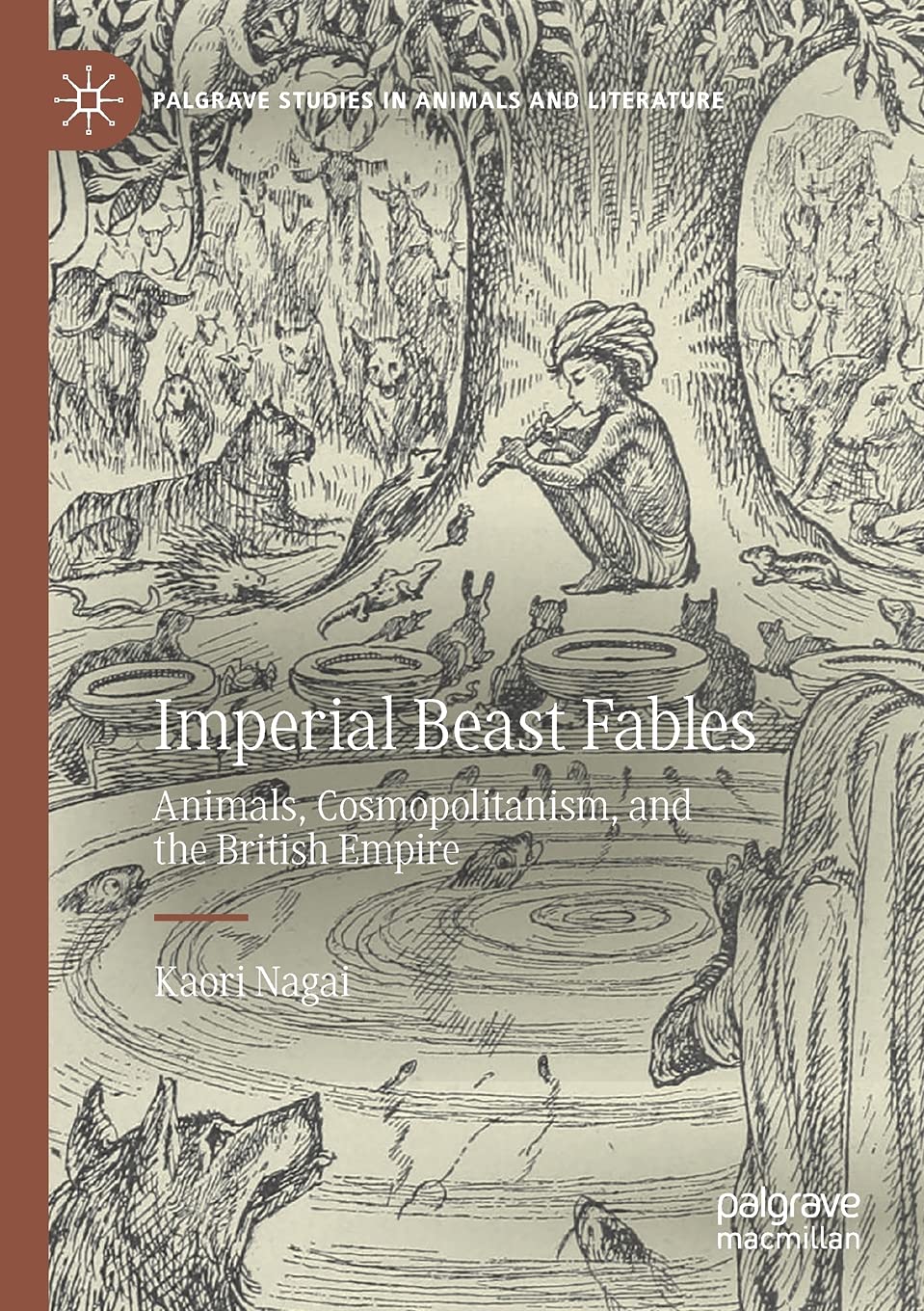
Imperial Beast Fables: Animals, Cosmopolitanism, and the British Empire (Palgrave Studies in Animals and Literature)
$82.01
by Kaori Nagai



This book coins the term ‘imperial beast fable’ to explore modern forms of human-animal relationships and their origins in the British Empire. Taking as a starting point the long nineteenth-century fascination with non-European beast fables, it examines literary reworkings of these fables, such as Rudyard Kipling’s Jungle Books , in relation to the global politics of race, language, and species. The imperial beast fable figures variably as a key site where the nature and origins of mankind are hotly debated; an emerging space of conservation in which humans enclose animals to manage and control them; a cage in which an animal narrator talks to change its human jailors; and a vision of animal cosmopolitanism, in which a close kinship between humans and other animals is dreamt of. Written at the intersection of animal studies and postcolonial studies, this book proposes that the beast fable embodies the ideologies and values of the British Empire, while also covertly critiquingthem. It therefore finds in the beast fable the possibility that the multitudinous animals it gives voice to might challenge the imperial networks which threaten their existence, both in the nineteenth century and today. “I would recommend this book to students or teachers interested in finding accessible ways to consider the British empire and its texts beyond the confines of strictly British canon.” (Taylin Nelson, Marginalia, marginalia.blogs.rice.edu, July 29, 2025) “Imperial Beast Fables constitute impressively erudite yet readable additions to work at the intersection of Victorian literatures and history, genre studies, animal studies, and postcolonial critique. Scholars … will find their provocations impossible to bypass.” (Parama Roy, Victorian Studies, Vol. 65 (1), 2022) “This innovative and interdisciplinary volume revises conventional understandings of the animal fable in the context of the British Empire and its politics of race, nation, and species. Combining postcolonial approaches with recent advances in human-animal studies, it shows how animal fables by Chandler Harris, Kipling, Chesterton, and others are intricately linked with issues of cross-cultural identity and language that both unite and separate humans and non-humans. It is a much-needed and timely volume.” ( Jopi Nyman , Professor of English, University of Eastern Finland) “In a time of mass extinctions, talking with animals has never been more urgently necessary. What would animals say if we knew how to listen? The beast fable has been dismissed as an allegorical screen for human concerns. Yet what if this genre, in which animals speak, were offering an instance of a possible hearing of a subaltern animal encountering? Buried within imperial histories lie other stories―indigenous, folkloric, animalcentric―that provincialize the European and the Human. Kaori Nagai unleashes the radical possibilities of beast fables for animals.” ( Donna Landry , Professor of English and American Literature, University of Kent, UK, and author of Noble Brutes: How Eastern Horses Transformed English Culture (2008)) This book coins the term ‘imperial beast fable’ to explore modern forms of human-animal relationships and their origins in the British Empire. Taking as a starting point the long nineteenth-century fascination with non-European beast fables, it examines literary reworkings of these fables, such as Rudyard Kipling’s Jungle Books , in relation to the global politics of race, language, and species. The imperial beast fable figures variably as a key site where the nature and origins of mankind are hotly debated; an emerging space of conservation in which humans enclose animals to manage and control them; a cage in which an animal narrator talks to change its human jailors; and a vision of animal cosmopolitanism, in which a close kinship between humans and other animals is dreamt of. Written at the intersection of animal studies and postcolonial studies, this book proposes that the beast fable embodies the ideologies and values of the British Empire, while also covertly critiquingthem. It therefore finds in the beast fable the possibility that the multitudinous animals it gives voice to might challenge the imperial networks which threaten their existence, both in the nineteenth century and today. Kaori Nagai is Lecturer in Victorian Literature at the University of Kent, UK. She is the author of Empire of Analogies: Kipling, India and Ireland (2006). She has edited Rudyard Kipling’s Plain Tales from the Hills and The Jungle Books for Penguin Classics, and is the co-editor of Kipling and Beyond (2010), and Cosmopolitan Animals (2015).