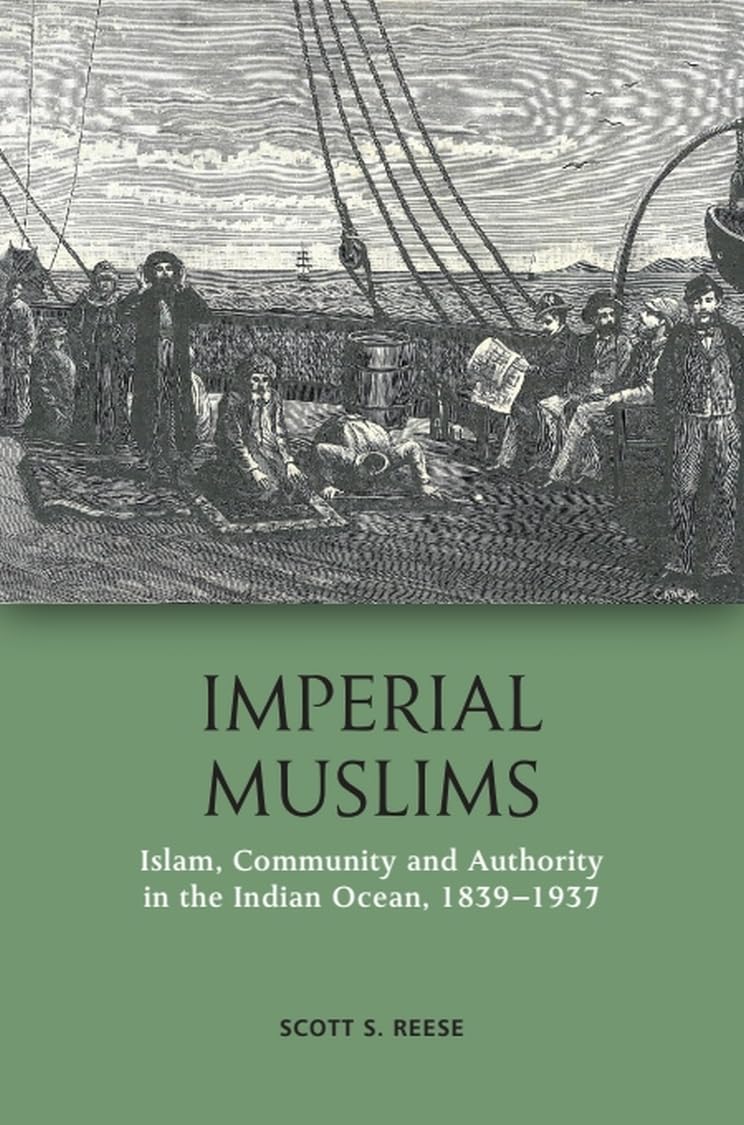
Imperial Muslims: Islam, Community and Authority in the Indian Ocean, 1839-1937
$19.50
by Scott S. Reese



The webs, nodes and networks created by Britain’s Indian Ocean Empire during the nineteenth and twentieth centuries are here explored in the context of their personal and social impact. Using the British Settlement of Aden as its focus, the book examines the development of a local community within the spaces created by imperial rule. It explores how individuals from widely disparate backgrounds brought together by the networks of empire created a cohesive community utilizing the one commonality at their disposal: their faith. Specifically, it examines how religious institutions and spiritual ideas served as parameters for the creation of community and the kinds of symbolic and cultural capital an individual needed to attain communal membership and influence within the confines of imperial rule. In Imperial Muslims , the author’s ingenious use of British archival sources and Arabic contemporary publications make 19th and early 20th century Aden come alive in front of the readers’ eyes. His assertion that at the turn of the century Britain ruled over forty percent of the global Muslim population is enough to explain why Aden is an important case study in providing a window into the social and spiritual life of a Muslim community within the British Empire.' -- THANOS PETOURIS ― BYS newsletter In Imperial Muslims , the author’s ingenious use of British archival sources and Arabic contemporary publications make 19th and early 20th century Aden come alive in front of the readers’ eyes. His assertion that at the turn of the century Britain ruled over forty percent of the global Muslim population is enough to explain why Aden is an important case study in providing a window into the social and spiritual life of a Muslim community within the British Empire. -- THANOS PETOURIS ― BYS newsletter Imperial Muslims is an important contribution to the growing literature on the formation of Muslim identities under colonial rule. In absorbing detail, Reese vividly creates a portrait of the complex intersections of religion, ethnicity, and trade in British-ruled Aden, in a rich study that will be highly appreciated in the fields of history and religious studies. ― Carl W. Ernst, The University of North Carolina at Chapel Hill In Imperial Muslims we have a tremendously valuable and highly readable contribution, one that has filled a serious gap in our reading of modern Indian Ocean history, and that has also added significant depth to our understanding of Muslim religious life under colonial rule. This is a book that will find a wide readership in Middle Eastern and Islamic history, colonial history, and especially the history of the Indian Ocean. It is beautifully written, deeply textured, and eminently accessible... Moreover, it is organized in a way that allows for a classroom instructor to assign individual chapters as well as the whole book. -- Fahad Ahmad Bishara, University of Virginia ― Die Welt des Islams A complex and compelling...Reese’s insightful exposition has the possibility of stimulating new discussions of issues of concern to those of us working on configurations of Muslim community and modernizing transformations much further afield. -- R. Michael Feener, Oxford Centre for Islamic Studies ― Journal of Islamic Studies A community that was the offspring of empire, the Muslims of Aden gave voice to the competing religious currents at the confluence of Africa and Asia. By depicting a ‘multiverse’ shaped by rival cosmologies, legal pluralism, and the metaphysical unseen as well as the visible flows of finance, Scott Reese succeeds splendidly in revealing a microcosm of the Indian Ocean’s heterogeneous umma . ― Nile Green (UCLA), author of Bombay Islam: The Religious Economy of the West Indian Ocean A transregional history of Muslim community in the British Empire A transregional history of Muslim community in the British EmpireThe webs, nodes and networks created by Britain’s Indian Ocean Empire during the nineteenth and twentieth centuries are here explored in the context of their personal and social impact. Using the British Settlement of Aden as its focus, the book examines the development of a local community within the spaces created by imperial rule. It explores how individuals from widely disparate backgrounds brought together by the networks of empire created a cohesive community utilizing the one commonality at their disposal: their faith. Specifically, it examines how religious institutions and spiritual ideas served as parameters for the creation of community and the kinds of symbolic and cultural capital an individual needed to attain communal membership and influence within the confines of imperial rule.Key FeaturesExplores the social consequences of Britain's creation of an Indian Ocean empire that brought millions of Muslim subjects under a single political umbrella for the first time in the modern eraThe case of Aden allows an examination of a community that was created by the