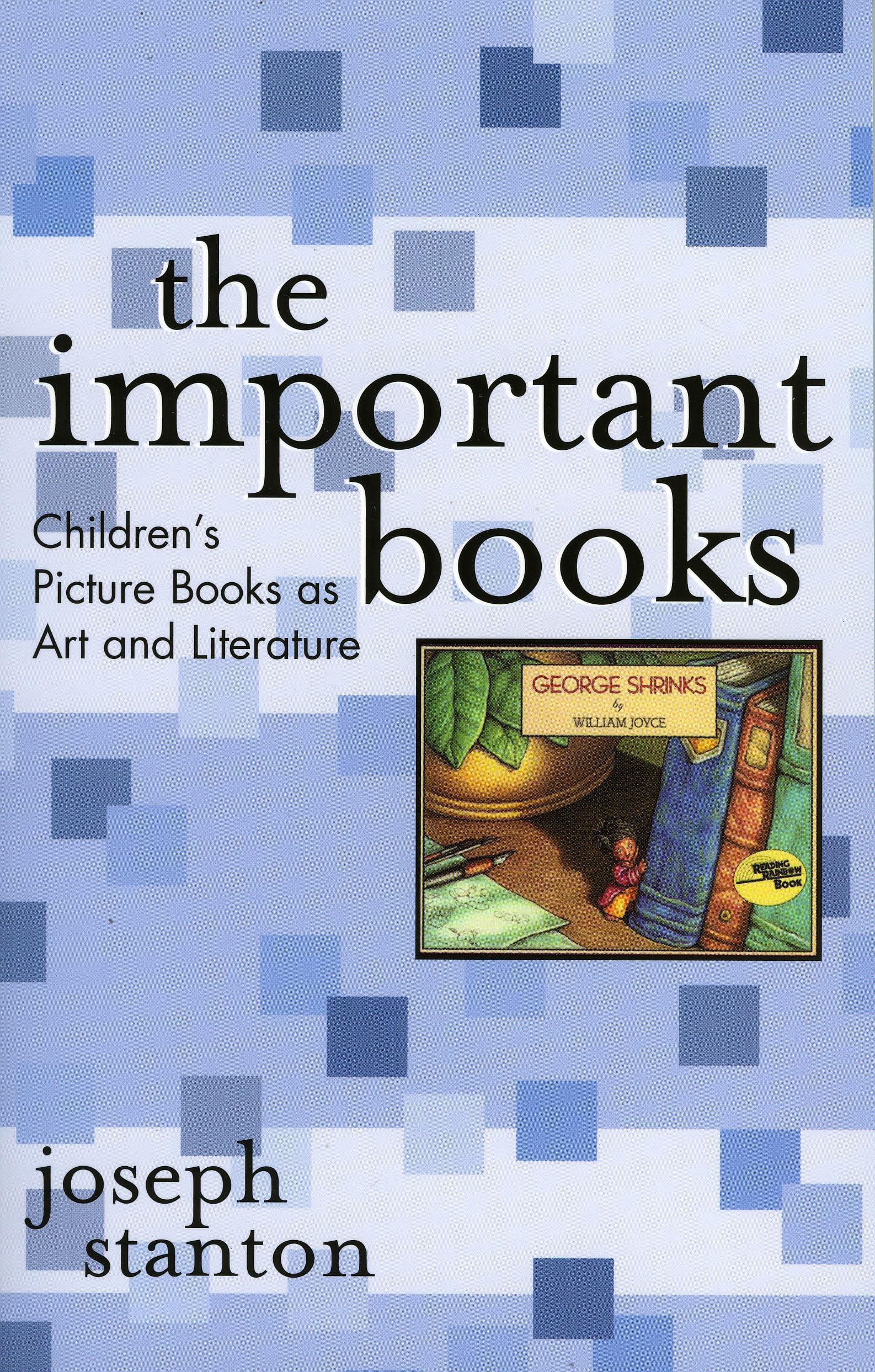
Important Books, The: Children's Picture Books as Art and Literature
$56.00
by Joseph Stanton



The children's picture book is an important form of literary-visual art. In this volume, Joseph Stanton disposes of some of the assumptions that have tended to obscure this genre's achievements. While focusing on those books that are distinguished by some degree of originality in both word and image, the author points out that the importance of picture books is not primarily pedagogical—they are not intended to serve as "dumbed down" versions of young adult or adult novels—and the audience for these great books is not solely children. Because the children's picture book is designed to provide the context for an intimate transaction involving the imaginations of both parent and child, there is a social value to the form that lends a special poignancy to the pleasure it provides. The Important Books takes a look at some of the most significant and talked about authors, illustrators, and titles in the genre, including Maurice Sendak, Margaret Wise Brown, William Joyce, and Chris Van Allsburg. Stanton's six scholarly articles discuss picture books as literary and visual art. The author suggests that the truly fine ones appeal to both children and adults for very specific, and often different, reasons. In one article, Stanton makes connections between Donald Hall's Ox-Cart Man 's shared patterns and Le Duc de Berry's Les Tres Riches Heures , and poetic texts by Dickenson, Whitman, and other works by Hall. In another article, he explores the numerous kinds of Surrealist connections in Chris Van Allsburg's work. Noting William Joyce's dashing heroes and eccentric families, he points out some wellsprings of the artist's work rooted in theater, TV, old movies, and popular culture. The author's free-ranging ability to discuss both text and pictures illuminates the genre's underpinnings. The book also includes discussion of Maurice Sendak's New York City picture books, the roles of straight man and clown in the easy chapter books by Arnold Lobel, and comfort against the vast dark in Margaret Wise Brown's work. Susan Hepler, formerly at Burgundy Farm Country Day School, Alexandria, VA Copyright © Reed Business Information, a division of Reed Elsevier Inc. All rights reserved. Although one might expect to find lists of "best" books in this slim volume, in fact it consists of six critical essays on distinguished children's picture books and their authors. These books are viewed as works of art, and as such, Stanton asserts that the pictures do not function primarily as pedagogical tools, that words and pictures "reverberate in each other's company in surprising ways," and that the books appeal to adults as well as to children. Some of the authors whose works are discussed are Margaret Wise Brown, William Joyce, Arnold Lobel, Maurice Sendak, and Chris Van Allsberg. An example of thorough scholarship, replete with accurate references and essential explanatory notes, this study should benefit teachers, librarians, and students of children's literature. Sharon E. Cohen Copyright © American Library Association. All rights reserved “Although one might expect to find lists of 'best' books in this slim volume, in fact it consists of six critical essays on distinguished children's picture books and their authors. These books are viewed as works of art, and as such, Stanton asserts that the pictures do not function primarily as pedagogical tools, that words and pictures 'reverberate in each other's company in surprising ways,' and that the books appeal to adults as well as to children. Some of the authors whose works are discussed are Margaret Wise Brown, William Joyce, Arnold Lobel, Maurice Sendak, and Chris Van Allsberg. An example of thorough scholarship, replete with accurate references and essential explanatory notes, this study should benefit teachers, librarians, and students of children's literature.” ― Booklist “This brief but thoughtful book contains essays about the following picture book authors: Margaret Wise Brown, Arnold Lobel, Barbara Cooney, Maurice Sendak, William Joyce, and Chris Van Allsburg.” ― Children's Literature Association Quarterly “The author's free-ranging ability to discuss both text and pictures illuminates the genre's underpinnings.” ― School Library Journal “Thoughtful and illuminating...Stanton's collection of essays is solidly reasoned and cogently argued. I also found it a good explanation as to why children's picture books hold so much fascination for adults.” ― Green Man Review “In the six insightful essays comprising this collection, Endicott contributor Joseph Stanton looks at the field of children's picture book and argues convincingly that the best examples of the form can, and should, be valued as works of fine art and literature.” ― Endicott Scuttlebutt “Stanton reminds us of the influence of our first encounters with children's books and also their influence on the other half of their audience, namely the parents, teachers, librarians and other grown-ups who select the