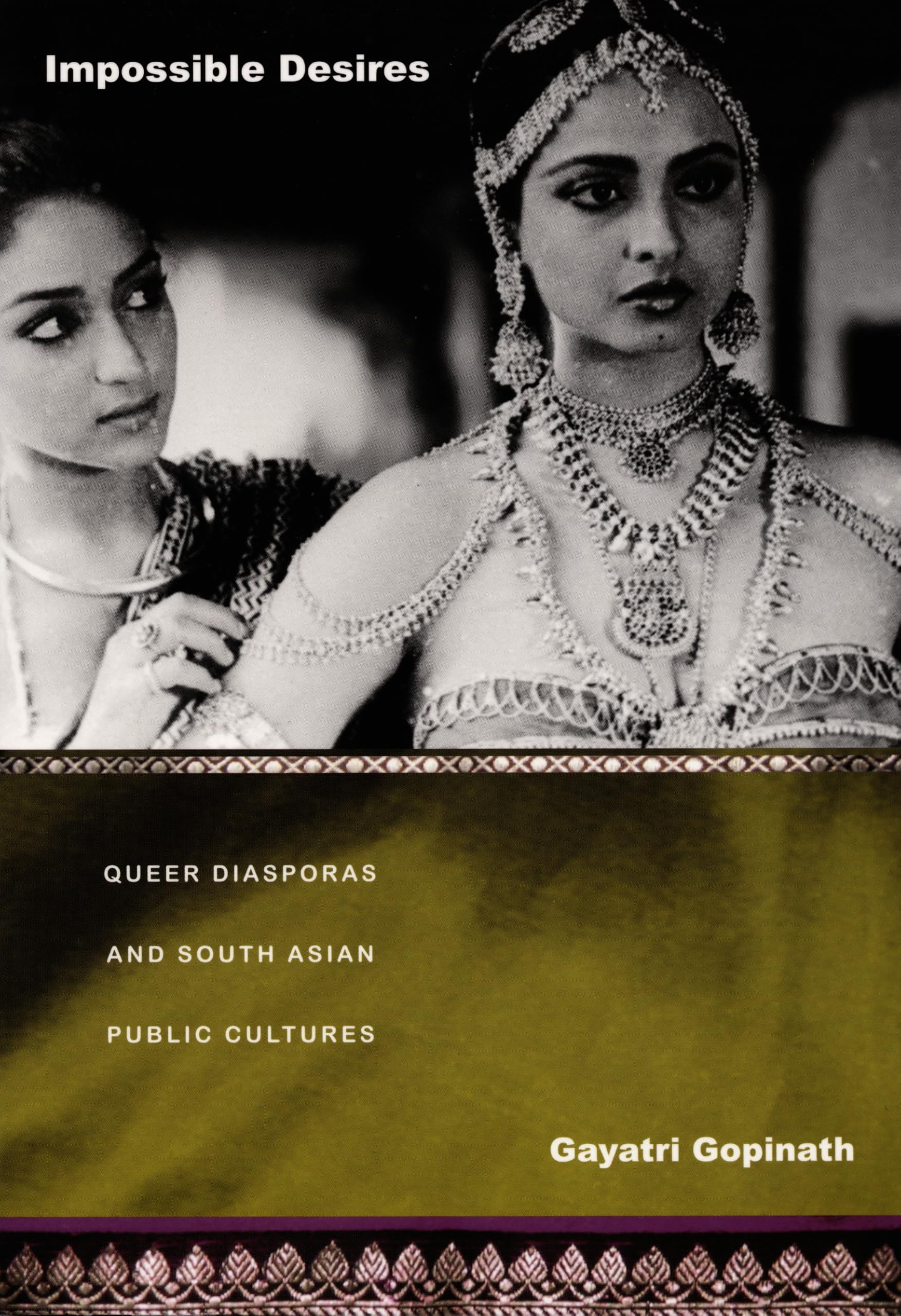
Impossible Desires: Queer Diasporas and South Asian Public Cultures (Perverse Modernities: A Series Edited by Jack Halberstam and Lisa Lowe)
$27.95
by Gayatri Gopinath



By bringing queer theory to bear on ideas of diaspora, Gayatri Gopinath produces both a more compelling queer theory and a more nuanced understanding of diaspora. Focusing on queer female diasporic subjectivity, Gopinath develops a theory of diaspora apart from the logic of blood, authenticity, and patrilineal descent that she argues invariably forms the core of conventional formulations. She examines South Asian diasporic literature, film, and music in order to suggest alternative ways of conceptualizing community and collectivity across disparate geographic locations. Her agile readings challenge nationalist ideologies by bringing to light that which has been rendered illegible or impossible within diaspora: the impure, inauthentic, and nonreproductive. Gopinath juxtaposes diverse texts to indicate the range of oppositional practices, subjectivities, and visions of collectivity that fall outside not only mainstream narratives of diaspora, colonialism, and nationalism but also most projects of liberal feminism and gay and lesbian politics and theory. She considers British Asian music of the 1990s alongside alternative media and cultural practices. Among the fictional works she discusses are V. S. Naipaul’s classic novel A House for Mr. Biswas , Ismat Chughtai’s short story “The Quilt,” Monica Ali’s Brick Lane , Shyam Selvadurai’s Funny Boy , and Shani Mootoo’s Cereus Blooms at Night . Analyzing films including Deepa Mehta’s controversial Fire and Mira Nair’s Monsoon Wedding , she pays particular attention to how South Asian diasporic feminist filmmakers have reworked Bollywood’s strategies of queer representation and to what is lost or gained in this process of translation. Gopinath’s readings are dazzling, and her theoretical framework transformative and far-reaching. “Boldly spanning Hindi film, British Asian music, Urdu literature, diasporic postcolonial literature and film, U.S. queer activism, and feminist politics, Gayatri Gopinath argues that queer desire becomes central to the ways in which national and diasporic histories are told when the erotics of power is acknowledged. Impossible Desires is a deft demonstration of both queer theory’s dominant ethnocentrism and diaspora and postcolonial studies’ heteronormativity and androcentrism.”—Ranjana Khanna, author of Dark Continents: Psychoanalysis and Colonialism “Gayatri Gopinath’s innovative book marks a new stage in queer and diasporic studies. Incisive, expansive, and nuanced, Gopinath’s analysis will surely be invoked by academics in the future. A landmark piece of scholarship!”—Martin F. Manalansan IV, author of Global Divas: Filipino Gay Men in the Diaspora “[T]his smart and well-written book signals a sea change in the field. . . . Impossible Desires stands as a pathbreaking work, addressing persistent exclusions in both feminist and queer literatures on South Asian public culture and significantly reworking current conceptualizations of diaspora.” -- Lawrence Cohen ― Journal of Asian Studies "Boldly spanning Hindi film, British Asian music, Urdu literature, diasporic postcolonial literature and film, U.S. queer activism, and feminist politics, Gayatri Gopinath argues that queer desire becomes central to the ways in which national and diasporic histories are told when the erotics of power is acknowledged. "Impossible Desires" is a deft demonstration of both queer theory's dominant ethnocentrism and diaspora and postcolonial studies' heteronormativity and androcentrism."--Ranjana Khanna, author of "Dark Continents: Psychoanalysis and Colonialism" Gayatri Gopinath is Assistant Professor of Women and Gender Studies at the University of California, Davis. IMPOSSIBLE DESIRES Queer Diasporas and South Asian Public Cultures By Gayatri Gopinath Duke University Press Copyright © 2005 Duke University Press All right reserved. ISBN: 978-0-8223-3513-9 Contents Acknowledgments..........................................................................................................ix1 Impossible Desires: An Introduction....................................................................................12 Communities of Sound: Queering South Asian Popular Music in the Diaspora...............................................293 Surviving Naipaul: Housing Masculinity in A House for Mr. Biswas, Surviving Sabu, and East Is East.....................634 Bollywood/Hollywood: Queer Cinematic Representation and the Perils of Translation......................................935 Local Sites/Global Contexts: The Transnational Trajectories of Fire and "The Quilt"....................................1316 Nostalgia, Desire, Diaspora: Funny Boy and Cereus Blooms at Night......................................................1617 Epilogue: Queer Homes in Diaspora......................................................................................187Notes...........................................................................................