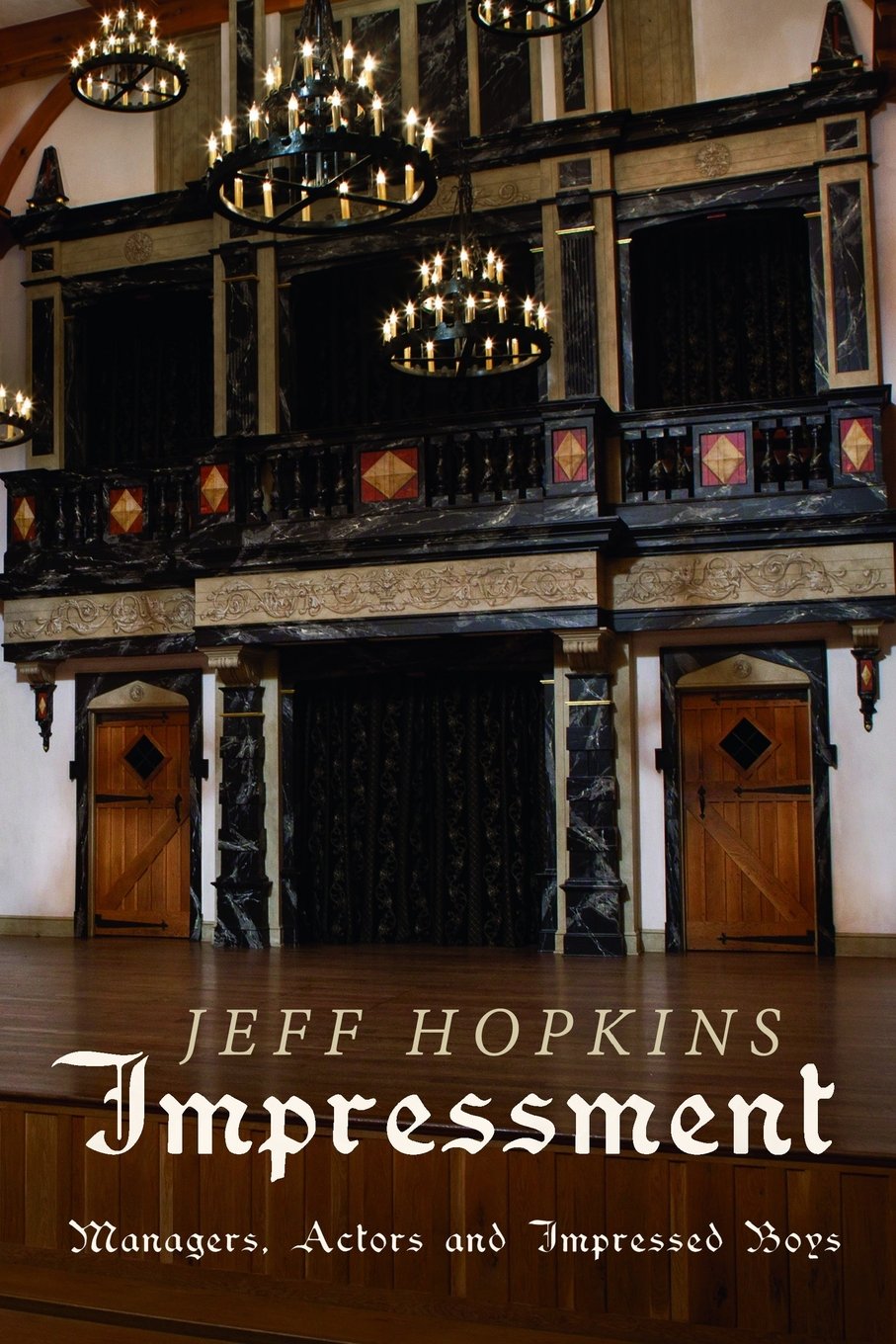



In 1597 Queen Elizabeth I signed a Royal warrant giving theatre managers Henry Evans, Nathaniel Giles and their deputy, James Robinson authority to ‘impress’ boys to be actors in the second Blackfriars Theatre. In reality it was kidnapping against which there were no laws in Elizabethan England. As a result two of the greatest boy players of the age, Nathan Field and Salomon Pavy, suffered ‘impressment’. The setting up of the new indoor theatre ushers a cavalcade of characters into the former Dominican Priory. It takes two more decades for all the mysteries of the ill-fated Blackfriars Theatre to be solved. It is a theatrical traverse through the final years of Elizabeth’s reign and the first part of the 17th century. The history is fascinating, and the tale, which proves both comic and tragic, will seem far more strange than fiction ever could be. 'Impressment' is the result of searching for a story that could be set in a theatre. As the drama master at an all boys' private school for many years I wanted to write something about creating and staging plays and musicals using all boy casts. These were, of course, the things with which I was most familiar. However, I was not keen to write autobiographically or dabble in the memoir genre. I had been reading a great deal about Edward De Vere, the 17th Earl of Oxford, as the possible writer of the works of William Shakespeare and had become fascinated by the late Elizabethan theatre scene. That is when I stumbled across the history of the second Blackfriars Theatre and the unusual troika of theatre managers Henry Evans, Nathaniel Giles and James Robinson. They were almost a story in themselves, but with the two great boy actors of the age, namely Nathaniel Field and Salomon Pavy, added to the mix it was a rich area in which to explore. Finally, came Queen Elizabeth the First's Royal warrant that allowed the process of impressment of boys to be actors and I was excited about the prospects of the story. After I had written the manuscript I estimated that about a third of the book was in fact historically accurate. I did have to manipulate the history a little for dramatic effect, but there is a lot that can be relied upon. Then came the fictional characters and Charlie Sharpe entered the story as a minor character and blossomed (or took me over) and became quite a significant player in the second half of the novel. The drama lessons and the design, rehearsal and staging of the completely fictitious play based on the myth of 'Jupiter and Ganymede' allowed me to play drama master again in the persona of theatre manager, Nathaniel Giles. I was attracted to a line in the historical record about the mysterious death of Salomon Pavy (aged thirteen years) and wove a murder mystery into the narrative, but left it open ended even though clear accusations are made, however the resolution is not all that clear. Certainly there was no historical record of the case being solved or the perpetrators brought to account. When I discovered there was a replica of the Blackfriars Theatre in Virginia in the United States I was thrilled to see the pictures. The cover of the book is an interior shot of the American Shakespeare Center's Blackfriars Playhouse. The reading and research was absorbing and the writing just playful fun. Jeff Hopkins (1950) is a retired schoolteacher. He lives in Western Australia with his two Labrador dogs, Jack and Sam. As the drama master at a private boys' school he wrote eleven original musical plays andproduced and directed them at the school. In 1992 he researched and wrote a family history, Life's Race Well Run and after retiring in 2006 he has written nine novels: Artifice (2015), Gnarl (2015), Impressment: Managers, Actors and Impressed Boys (2015), The Spiv: The Robbie Sparrow Story (2015), Benedict Lovelace and the Travelling Show (2016), Reflections (2016), Rocking Horse Rider (2016), The Hydrographer: The Clyde Steadman Story (2016) and Lord Gnarl (2017). Jeff previously maintained he wrote entirely for pleasure, and to fillin the long summer months between football seasons. Recently he has admitted that he set himself the task of writing in a number of different genres as part of a three year programme to learn about creative writing and self publishing. He said it was like an undergraduate degree course for which there was a strict budget and work schedule. It has since become clear that the whole experiment was oneof the most interesting and absorbing things he had done in his life. He continues to write.