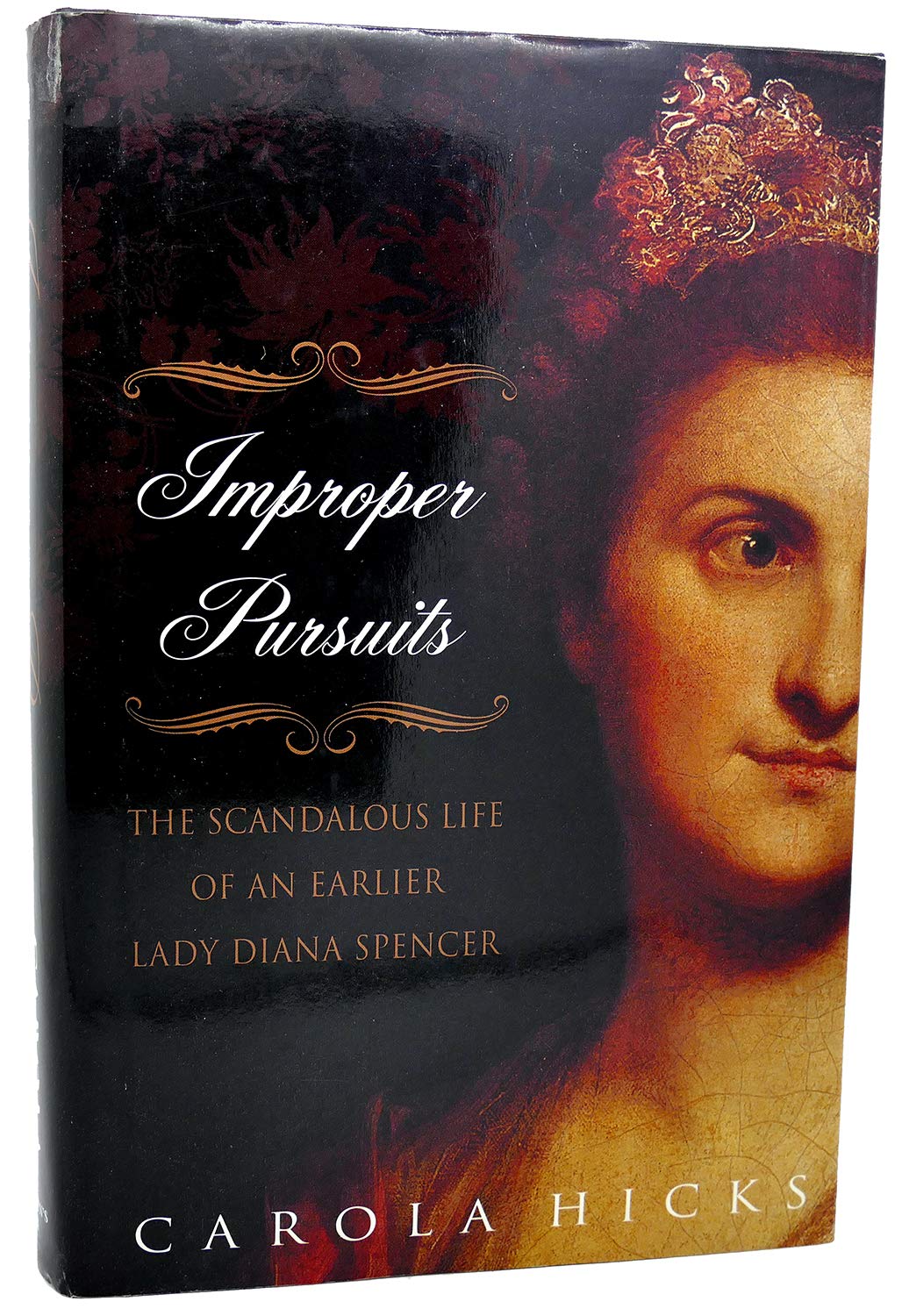
Improper Pursuits: The Scandalous Life of an Earlier Lady Diana Spencer
$12.58
by Carola Hicks



With these words to Boswell, Samuel Johnson dismissed Lady Di Beauclerk, the wife of one of his closest friends, a woman of the highest rank, the daughter of a duke, who had forsaken her reputation, her place in society, her children, and her role as lady-in-waiting to the Queen for love. Born Lady Diana Spencer in 1735, the eldest child of the third Duke of Marlborough, she was expected rigidly to follow a traditional path through life: educated in the fashion considered suitable for a girl, and married to a man of the appropriate rank for a duke's daughter. But finding herself in a desperately unhappy marriage to Viscount Bolingbroke, Lady Di overturned convention. She left her husband, maintained a secret relationship with her lover, Topham Beauclerk, hid the birth of an illegitimate child, and eventually helped to support herself by painting. Lady Di Beauclerk was a highly gifted artist who was able to use her scandalous reputation as an adulteress, aristocratic woman to further her career as a painter and designer. She painted portraits, illustrated plays and books, provided designs for Wedgwood's innovative pottery, and decorated rooms with murals. Championed by her close friend Horace Walpole, whose letters illuminate all aspects of her life, she was able to establish herself as an admired artist at a time when women struggled to forge careers. Carola Hicks provides an enthralling account of eighteenth-century society, in which Lady Di encountered many of the most eminent artistic, literary, and political figures of the day. Improper Pursuits is an absorbing study of a singular life. Hicks is an art historian at Cambridge University whose earlier works focus on church architecture, stained glass, and medieval art motifs. For her first biography, she quite naturally turns her attention to an 18th-century artist who shares direct lineage and a name with the late Lady Diana Spencer. Like Lady Di, the former Lady Diana, born in 1735, was something of a truant. She divorced her husband, gave birth to an illegitimate child, and then married her lover. She was also an artist and was discussed in letters by her friend Horace Walpole. This book is perfectly well researched, as one would expect from such a fine historian, but it is also slightly dense and academic. Unfortunately for Hicks, the personal names in the Spencer line repeat themselves, as do those of their social milieu; this becomes infuriatingly convoluted to the uninitiated. Further, one has to wonder whether writing a biography of the earlier Lady Diana Spencer is not just a matter of "cashing in." This book will have limited popular appeal, perhaps only to devotees of British aristocracy and their more colorful rascals. Gail Benjafield, St. Catharines P.L., Ont. Copyright 2002 Cahners Business Information, Inc. Hicks recounts the remarkable life of the original Lady Diana Spencer. Born into a noble family in 1735, Lady Diana, the eldest daughter of the duke of Marlborough, was raised to be an ideal patrician matriarch. Disenchanted with her rigidly stratified life, she defied eighteenth-century convention. Physically and spiritually exhausted by her marriage to the unfaithful, profligate, and emotionally unstable Viscount Bolingbroke, Lady Diana courageously charted her own course, living a life shaped by her own standards rather than those of British society. Taking a lover, bearing an illegitimate child, and eventually divorcing her worthless husband, she established herself as one of the most notorious aristocrats of her time. Ironically, her infamy allowed her to further push the boundaries of polite society, enabling her to earn her own living by selling her artwork. Feminist historians and royal watchers will have no trouble drawing parallels between the two Lady Dianas, soul mates separated by centuries but united in spirit. Margaret Flanagan Copyright © American Library Association. All rights reserved Carola Hicks studied Archaeology and History of Art at Edinburgh University and completed a Ph.D. on medieval art and iconography. Having taken up a research fellowship at Lucy Cavendish College, Cambridge, she went on to write her first book, Animals in Early Medieval Art . She later became Curator of the Stained Glass Museum at Ely Cathedral, where she wrote Discovering Stained Glass . She now teaches art history to adult and undergraduate students at the University of Cambridge and is Director of Studies in History of Art at Newnham College as well as a fellow of the Society of Antiquaries of London. She has two children and lives in Cambridge and London.