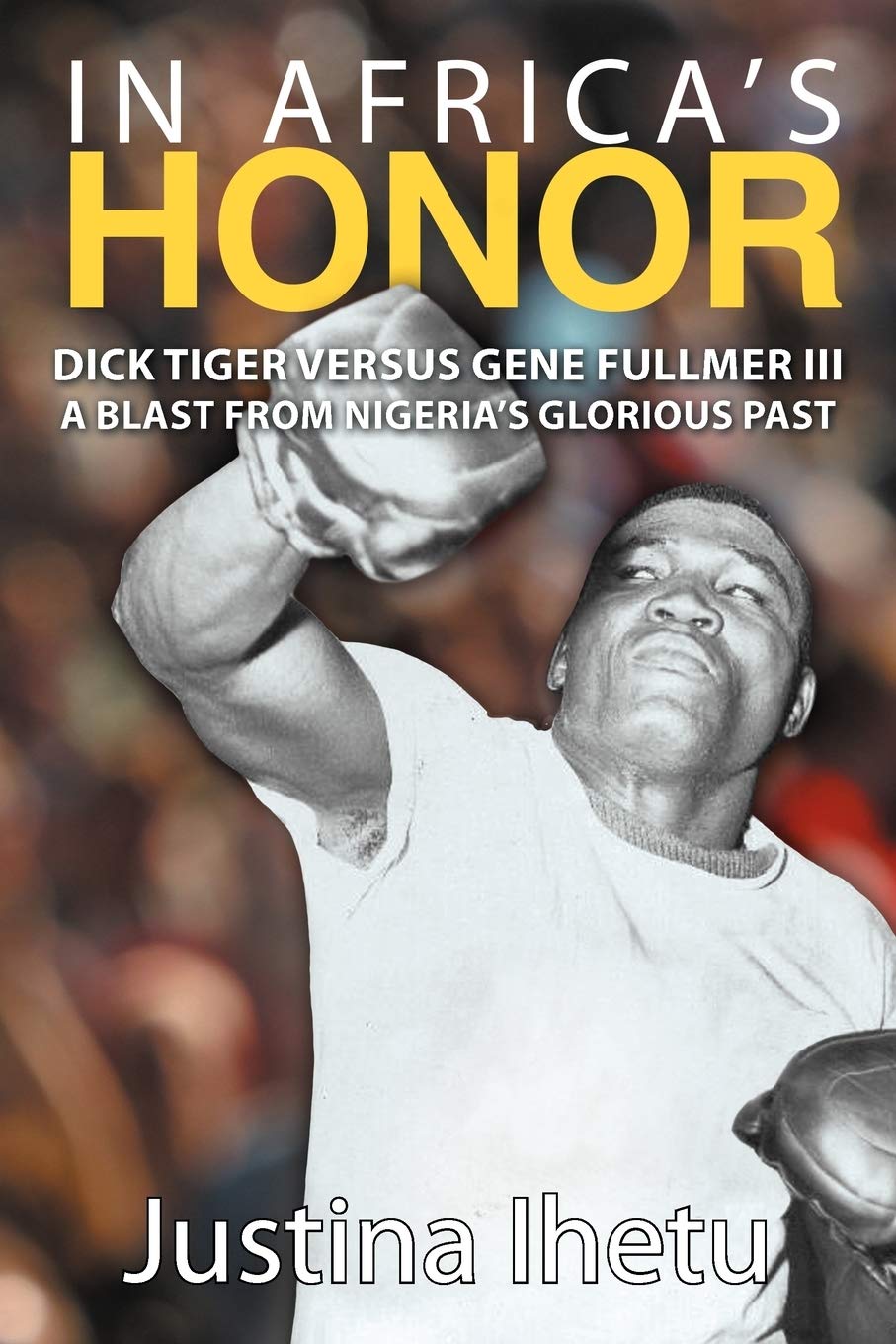
In Africa's Honor: Dick Tiger versus Gene Fullmer III-A Blast from Nigeria's Glorious Past
$4.13
by Justina Ihetu



In the era of the American Civil Rights Movement, and barely three years after Africa's most populous nation celebrated her independence from colonial rule, the Nigerian government brought her full weight to bear in a world championship title bout-the first ever in Black Africa. The Dick Tiger vs. Gene Fullmer III fight, held in Liberty Stadium in Ibadan, Nigeria, on August 10, 1963, was a forerunner for all the big fights in the African continent. Westerners didn't believe that a newly independent African nation could dare muster the audacity, or financial backbone, to stage a world championship event. In Africa's Honor chronicles this groundbreaking fight while narrating the details of Richard (Dick Tiger) Ihetu's life in and out of the boxing ring. Presented as a play by Justina Ihetu, Dick Tiger's daughter, and complete with archival photos, this drama showcases the patriotism and heroism of a boxer who had an inauspicious beginning. Ihetu provides insight into the wheeling and dealing behind the match, and she humanizes the principle players-laying bare their innermost thoughts and anxieties to help form a deeper understanding of the character, and circumstances that reveal Africa's promise, of unity, dignity, and honor. IN AFRICA'S HONOR DICK TIGER VERSUS GENE FULLMER III—A BLAST FROM NIGERIA'S GLORIOUS PAST By JUSTINA IHETU iUniverse, Inc. Copyright © 2012 Justina Ihetu All right reserved. ISBN: 978-1-4697-7762-7 Chapter One ACT ONE SCENE ONE Narrator #1: Crowds of market women, wailing and cursing, proceed to Chief Okeugo's compound, on this damp and steamy morning. His house is one of the largest concrete houses scattered in the rustic town. Palm trees and coconut trees line the dusty red-clay road leading into the main road. At his house, the women protest nonviolently, but without warning, events quickly take a turn for the worse. (Upon reaching Okeugo's house, all noise stops instantly when one of the leaders, Nwannedia, takes the stage to announce their arrival. She is slender, with a narrow face, and the youngest of the leaders. She has a high-pitched voice.) Nwannedia: Please, who's there? We, the market women of Oloko, want speak with Chief Okeugo, please! If anybody can hear me, please come listen to the southeast market women! (The women wait for about half an hour, but Chief Okeugo is a no-show. They begin to grow restless, so Nwannedia repeats her request.) Nwannedia: Is Chief Okeugo home? Please, come out and speak to us market women. We beg you! You can't keep taking food from our children's mouths! You can't keep us women suffering! (When no one heeds their requests, they commence "sitting on," a nonviolent protest of singing and dancing, designed to catch the attention of their intended "target"—in this case, Okeugo.) Market Women: (dancing and singing the following line ten times) Ma oghara ibu nwa beke, mma anyi egbuole Okeugo rie. Translation: If it were not for the white man, we would have killed Chief Okeugo and eaten him up. (When some of the chief's relatives cannot stand the commotion any longer, they burst out and, in his defense, begin throwing sticks and shooting bird arrows. The women fight back, wailing and cursing. Their leaders try to pacify them, but their pleas fall on deaf ears. The situation escalates into a frenzy as the women loot and burn Chief Okeogu's residence to the ground!) Nwannedia: Ewooh! No! Please, no— Ikonnia: No! Ewooh! Please stop! Don— Narrator #1: That was in the year 1929, the same year as the birth of the protagonist in this story, Richard (Dick Tiger) Ihetu. British colonial authorities bite off more than they can chew when they enact a tax law to swell the coffers of the colonial government. Their new law encounters tremendous resistance from the market women in southeastern Nigeria. Women and children had been exempt from taxation, but the new "reassessment of the tax law" includes a reassessment of the taxable wealth of the market women! Prices of locally made goods, which the women sell, are falling, while heavy customs duties are imposed on imported materials they depend on for daily use. With the colonial policies threatening and weakening the women's social and economic status, the market women make several attempts to hold a dialogue with the administrators but are shunned; therefore, they take it into their own hands to curb what they perceive to be the excesses of an unjust and insensitive foreign government. The colonizers maintain control indirectly, through local chiefs called "warrant chiefs." These chiefs dispatch court messengers to individual families in order to ascertain the value of the possessions of those families. One such chief is corrupt warrant chief, Okeugo. He refuses to heed the advice of fellow warrant chiefs to relax the enforcement of the unfair tax law. As a result, he meets with a most unfortunate reprisal when the militant market women attack. The market women in 1929 u