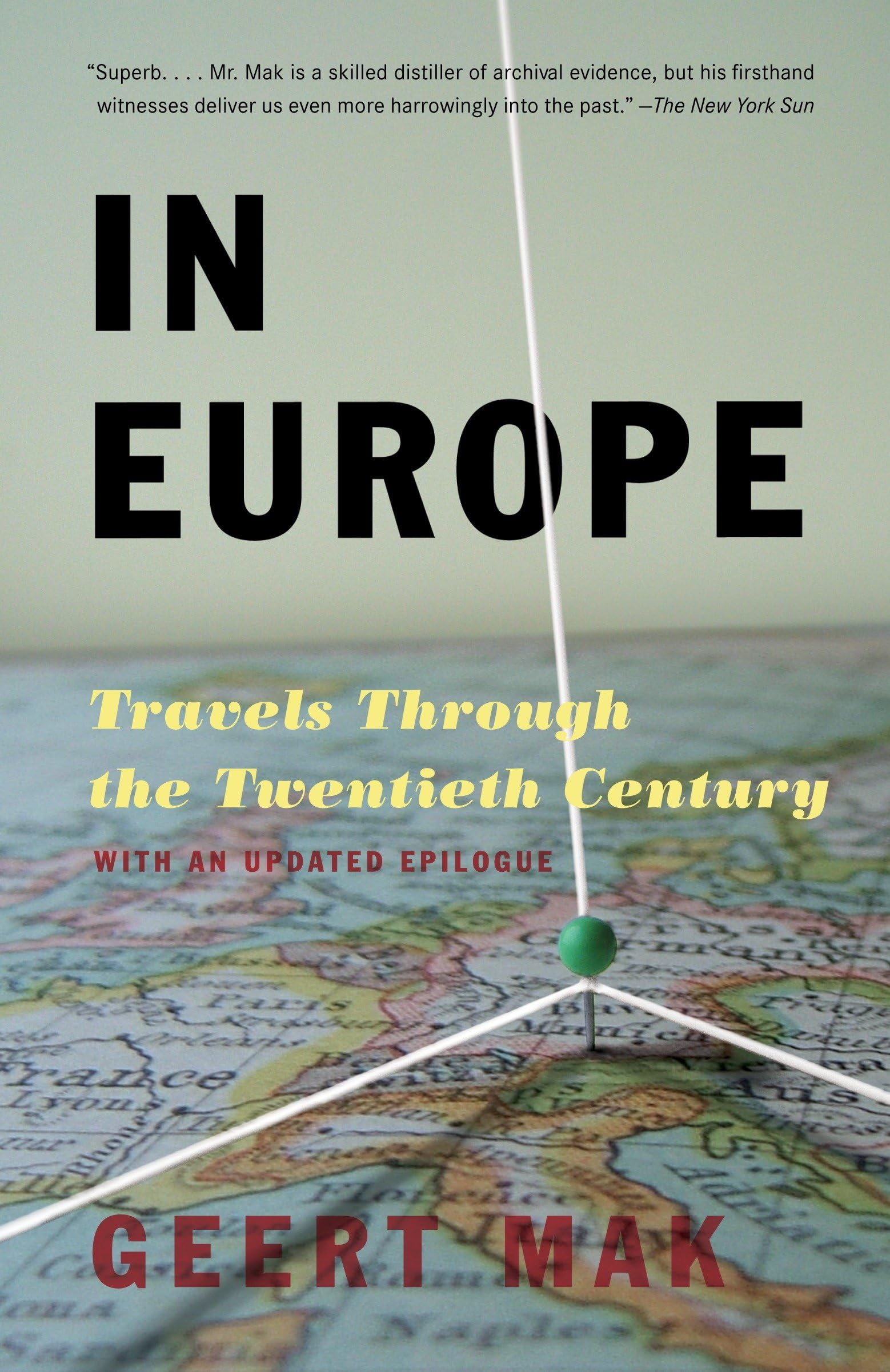



From the First World War to the waning days of the Cold War, a poignant exploration on what it means to be European at the end of the twentieth-century. Geert Mak crisscrosses Europe from Verdun to Berlin, Saint Petersburg to Srebrenica in search of evidence and witnesses of the last hundred years of Europe. Using his skills as an acclaimed journalist, Mak locates the smaller, personal stories within the epic arc of history-talking to a former ticket-taker at the gates of the Birkenau concentration camp or noting the neat rows of tiny shoes in the abandoned nursery school in the shadow of Chernobyl. His unique approach makes the reader an eyewitness to a half-forgotten past, full of unknown peculiarities, sudden insights and touching encounters. Sweeping in scale, but intimate in detail In Europe is a masterpiece. “Superb. . . . Mr. Mak is a skilled distiller of archival evidence, but his firsthand witnesses deliver us even more harrowingly into the past.”— The New York Sun “An original, fresh and first-hand documented essay of recent European history. It's an ideal reading for anyone doing 'le grand tour' across the Old Continent.”— The Washington Post “Dazzling, imaginative and mesmerizing.”— The Tucson Citizen “Subtle. . . It is a testament to Mak's warmth and skill as a writer that even in a chronicle of unrelenting barbarity he has portrayed a humanity worth saving.”— Time Geert Mak is one of The Netherlands' most popular writers. All his previous books became huge bestsellers: De engel van Amsterdam (The Angel of Amsterdam, 1992), Een kleine geschiedenis van Amsterdam (Amsterdam: A Brief Life of the City, 1994), Hoe God verdween uit Jorwerd (Jorwerd: The Death of the Village in late Twentieth-century Europe, 1996), and De eeuw van mijn vader (My Father's Century, 1999). Chapter One: Amsterdam When I left Amsterdam on Monday morning, 4 January, 1999, a storm was rampaging through the town. The wind made ripples on the watery cobblestones, white horses on the River IJ, and whistled beneath the high iron roof of Central Station. For a moment I thought that God’s hand had momentarily tilted up all that iron, then set it back in place. I was dragging my big, black suitcase. In it was a laptop, a mobile phone I could use to dispatch my daily columns, a few shirts, a sponge bag, a CD-ROM of the Encyclopaedia Britannica , and at least fifteen books to soothe my nerves. My plan was to begin with the baroque cities of 1900, with the lightness of the Paris World’s Fair, with Queen Victoria’s reign over an empire of certainties, with the upsurge of Berlin. The air was full of noises: the slapping of the waves, the crying of gulls on the wind, the roaring of the storm through the bare treetops, the trams, the traffic. There was very little light. The clouds chased across the sky from west to east, like dark-grey riders. For a moment they wafted a few notes along with them, the floating single strokes of a carillon. The newspapers reported that Morse code had now been phased out completely, and that the slipstreams of low-flying Ilyushins at Oostend airbase regularly sucked tiles off the neighbouring roofs. On the financial markets, the euro had made a brilliant debut. ‘Euro kicks off with challenge to dollar’s hegemony’ was Le Monde ’s headline, and that morning the currency had briefly risen as high as $1.19. But Holland that day was ruled by the wind, the last, untamed force that left its mark in all directions, north-east, south-west, a persistent slamming that had shaped the lakes and polders, the course of canals, the dykes, the roads and even the railway track along which I rode south, into the wet polder landscape. The boy with the blue tie and the pleasant face sitting beside me snapped open his computer right away, conjured up a whole series of spreadsheets and began phoning his colleagues. His name was Peter Smithuis. ‘The Germans want a hundred per cent solution, the other Europeans only need seventy-five,’ he spoke into the void. ‘What we can do now is look for something like a seventy-five-plus option, and neutralise the Germans by putting them back at a hundred per cent anyway . . . Oh, mmm. Off stream since July? Be careful, you know how it goes, if we let them decide too fast, everything will grind to a halt.’ The rain clattered against the windows of the compartment, under the Moerdijk Bridge the ships danced on the waves, at Zevenbergen a tree was in very early blossom, a thousand red dots in the water. Beyond Roosendaal the pylons became rusty, the only trace of a border between prim Holland and the rest of Europe. Before I had left I had a long talk with the oldest Dutchman I knew. Of all the people I spoke to that year, he was the only one who had lived through the entire century (with the exception of Alexandra Vasilyeva, that is, who was born in 1897 and had actually seen the czar and made her glorious stage debut at the Mariinsky theatre). His name was Marinus van der Goe