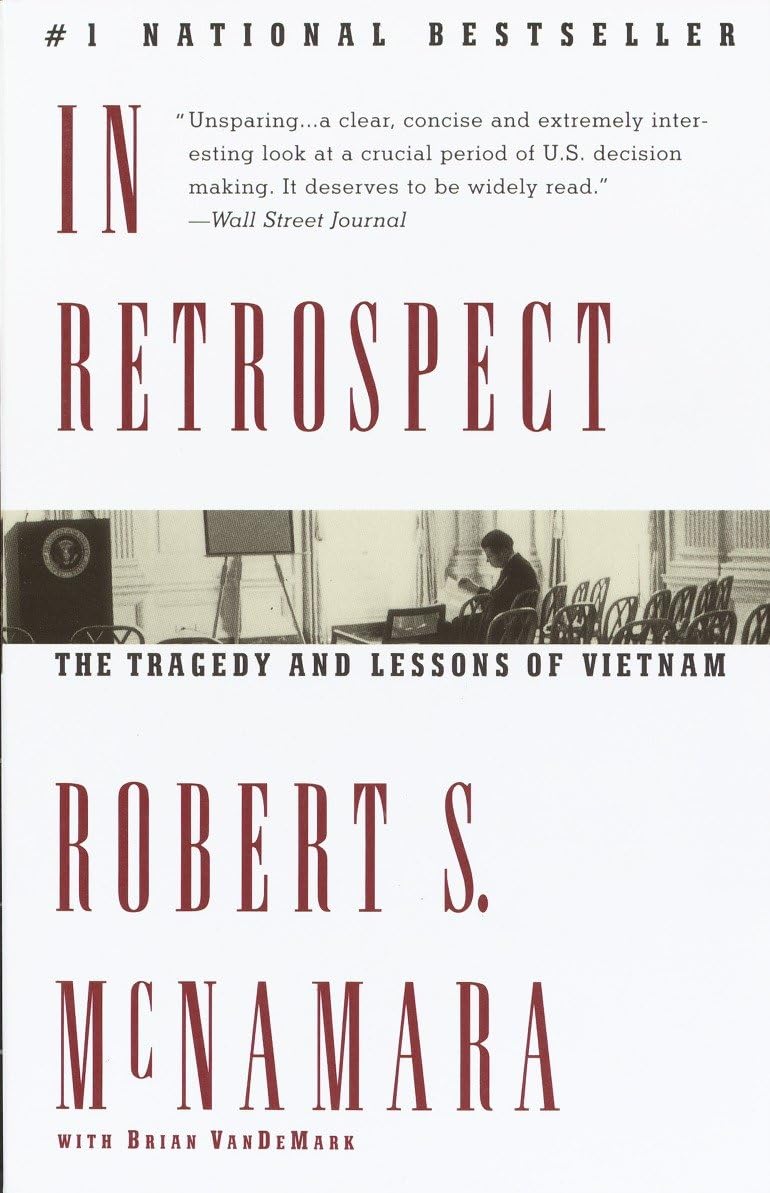



#1 NATIONAL BESTSELLER. The definitive insider's account of American policy making in Vietnam. "Can anyone remember a public official with the courage to confess error and explain where he and his country went wrong? This is what Robert McNamara does in this brave, honest, honorable, and altogether compelling book."—Arthur Schlesinger, Jr. Written twenty years after the end of the Vietnam War, former Secretary of Defense Robert McNamara's controversial memoir answers the lingering questions that surround this disastrous episode in American history. With unprecedented candor and drawing on a wealth of newly declassified documents, McNamara reveals the fatal misassumptions behind our involvement in Vietnam. Keenly observed and dramatically written, In Retrospect possesses the urgency and poignancy that mark the very best histories—and the unsparing candor that is the trademark of the greatest personal memoirs. Includes a preface written by McNamara for the paperback edition. nal bestseller--an indispensable document for anyone interested in the Vietnam War. McNamara's controversial book tells the inside and personal story of America's descent into Vietnam from a unique point of view, and is one of the most enlightening books about government ever written. This new edition features a new Foreword by McNamara. of photos. (Military History) The #1 national bestseller--an indispensable document for anyone interested in the Vietnam War. McNamara's controversial book tells the inside and personal story of America's descent into Vietnam from a unique point of view, and is one of the most enlightening books about government ever written. This new edition features a new Foreword by McNamara. of photos. (Military History) Robert S. McNamara was secretary of defense under Presidents Kennedy and Johnson, president of the Ford Motor Company, and president of the World Bank. After leaving the World Bank he was active in economic development efforts across the globe and in the arms control and non-proliferation movements. He died in 2009. from the Preface This is the book I planned never to write. Although pressed repeatedly for over a quarter of a century to add my views on Vietnam to the public record, I hesitated for fear that I might appear self-serving, defensive, or vindictive, which I wished to avoid at all costs. Perhaps I hesitated also because it is hard to face one's mistakes. But something changed my attitude and willingness to speak. I am responding not to a desire to get out my personal story but rather to a wish to put before the American people why their government and its leaders behaved as they did and what we may learn from that experience. My associates in the Kennedy and Johnson administrations were an exceptional group: young, vigorous, intelligent, well-meaning, patriotic servants of the United States. How did this group—"the best and the brightest," as we eventually came to be known in an ironically pejorative phrase—get it wrong on Vietnam? That story has not yet been told. But why now? Why after all these years of silence am I convinced I should speak? There are many reasons; the main one is that I have grown sick at heart witnessing the cynicism and even contempt with which so many people view our political institutions and leaders. Many factors helped lead to this: Vietnam, Watergate, scandals, corruption. But I do not believe, on balance, that America's political leaders have been incompetent or insensitive to their responsibilities and to the welfare of the people who elected them and to whom they are accountable. Nor do I believe they have been any worse than their foreign counterparts or their colleagues in the private sector. Certainly they have shown themselves to be far from perfect, but people are far from perfect. They have made mistakes, but mostly honest mistakes. This underscores my own painful quandary about discussing Vietnam. I know that, to this day, many political leaders and scholars in the United States and abroad argue that the Vietnam War actually helped contain the spread of Communism in South and East Asia. Some argue that it hastened the end of the Cold War. But I also know that the war caused terrible damage to America. No doubt exists in my mind about that. None. I want to look at Vietnam in hindsight, not in any way to obscure my own and others' errors of judgment and their egregious costs but to show the full range of pressures and the lack of knowledge that existed at the time. I want to put Vietnam in context. We of the Kennedy and Johnson administrations who participated in the decisions on Vietnam acted according to what we thought were the principles and traditions of this nation. We made our decisions in light of those values. Yet we were wrong, terribly wrong. We owe it to future generations to explain why. I truly believe that we made an error not of values and intentions but of judgment and capabilities. I say this war