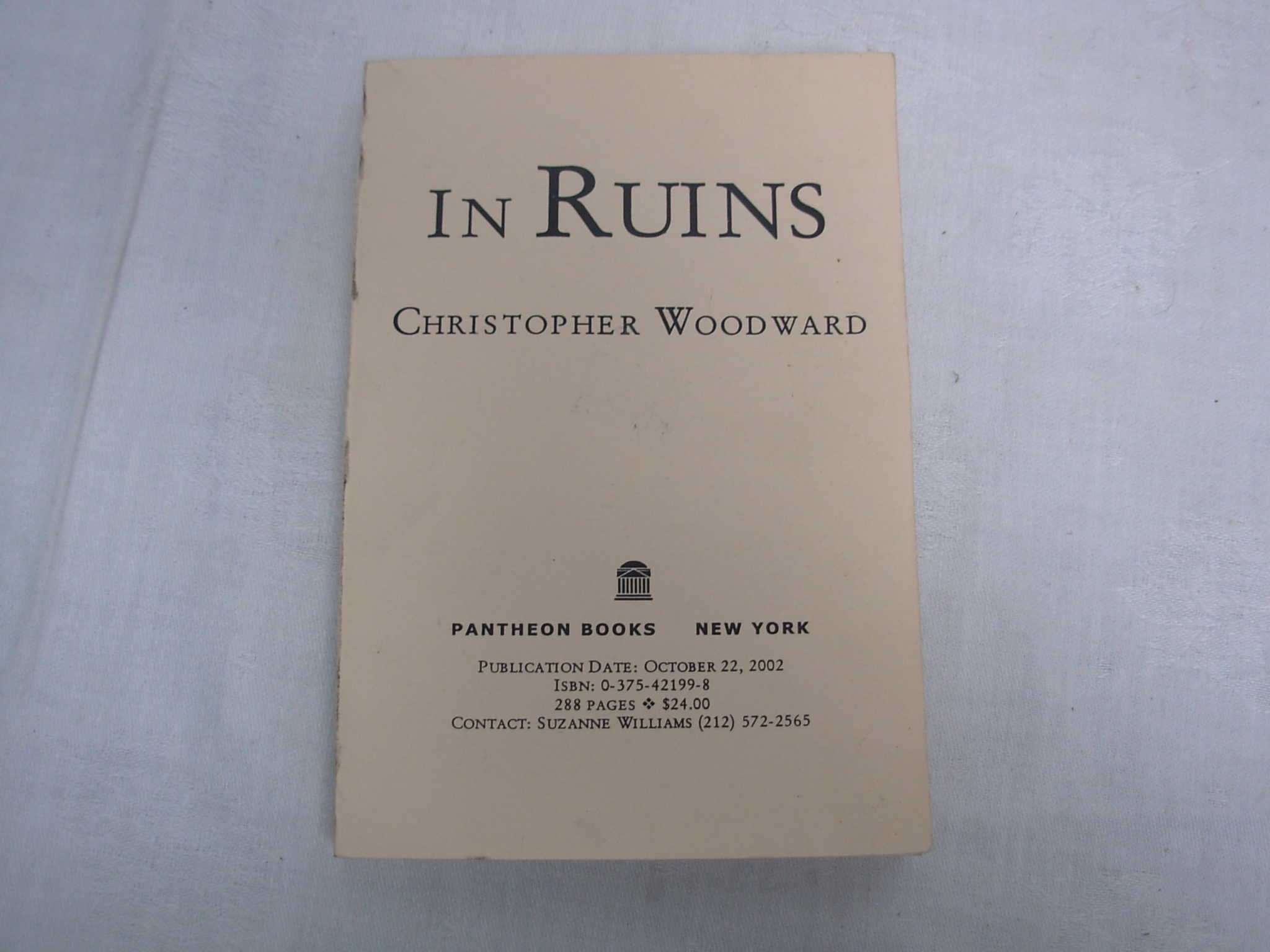



We live in a world of relentless progress, and yet we cannot pull ourselves away from the enchantment of what once was: the hold that an abandoned building can exert on us, the spell cast by the remains of past settlement. In Ruins is a meditation on ruins and, most particularly, a history of our fascination with them. When we contemplate ruins, Woodward suggests, we contemplate the prospect of the future. Ruins are also the jigsaw pieces of what once was, the clues to a past whose allure is heightened by the fact that it has vanished. And, finally, Woodward shows us how ruins serve as the source of inspiration for the artist who sees beauty in decay and desolation; he quotes by way of example what he calls the finest sonnet Shelley ever wrote: "Round the decay/Of that colossal wreck, boundless and bare/The lone and level sands stretch far away." The ruins of majestic buildings, monuments, or colossal figures have long been objects of contemplation and sources of creative inspiration. They are reminders of the vulnerability of empire, the fragility of artistic endeavor, and the transience of human ambition. Woodward, director of the Holburne Museum of Art (Bath, England), visits the remains of the Roman Colosseum, deteriorated English abbeys and monasteries, neglected mansions of Cuban sugar barons, and the abandoned palaces of the Moorish princes of Sicily and the sultans of Zanzibar, charting the impact of such decay on the literature and art of the 16th to 20th centuries. As images, symbols, or motifs, they have informed the canvases of Piranesi and Constable, the poetry of Shelley ("Ozymandias") and Byron ("Childe Harold"), and the fiction of Poe ("Fall of the House of Usher"), to cite only some of Woodward's many representations. In this penetrating study Woodward also elaborates on the 19th-century European gentry's fancy for commissioning landscape architects to create contemplative false ruins, or "follies," amid their woodland estates. Recommended for all libraries. Lonnie Weatherby, McGill Univ. Lib., Montreal Copyright 2002 Reed Business Information, Inc. In 1462, Pope Pius II praised classical ruins for their "exemplary frailty" and issued an edict to protect them; in the centuries that followed, generations of writers have delighted in their melancholy power. Woodward, a young British architectural historian, claims to have been obsessed with ruins since childhood; here he interweaves personal reflections (which hover just this side of preciousness) with historical descriptions of actual ruins—castles, follies, blitzed London, and, above all, Rome—and the writers and artists who have been captivated by them. For the true connoisseur, it seems, nothing ruins a ruin like repair. Rome, Woodward says, has failed to inspire anyone since the late nineteenth century, when archeologists cleared away the detritus of two millennia. The Colosseum was once dotted with shrines and sprouted rare plants whose seeds had been sown from the bodies of the exotic animals killed there. Now it is "as bald as the foundations of a modern construction site." Copyright © 2005 The New Yorker This is a sophisticated aesthetic exploration of ruined buildings and the fascinating hold they have on observers. Woodward readily engages readers with an accessible narrative style, seamlessly weaving into his narrative the thoughts of those, including painters, writers, and architects, who have pondered civilization's wrecks. Woodward notes that a shared trait of ruins is their incompleteness, which allows the artistic temperament to fill them in with imagination. He uses depictions of Roman ruins as an example, showing how each artist could see something different in them--a reminder of life's transience, of course, but more subtle expressions are also drawn in Woodward's perceptive narrative. England is his second locale of contemplation, where a taste for ruins called the Picturesque developed in the 1700s, with country squires attempting to create dilapidation if they did not have, like Lord Byron did, a genuinely ruined abbey of their own. Byron presaged the Romantic exultation in the imagery of ruins, an intense version of our own perverse pleasure in them. Woodward's work is a languorous delight. Gilbert Taylor Copyright © American Library Association. All rights reserved “Marvellous proof that the prospect of ruins can elicit the finest cadences of the language… A rich and absorbing volume.” -- Peter Ackroyd, The Times From the Trade Paperback edition. “Marvellous proof that the prospect of ruins can elicit the finest cadences of the language… A rich and absorbing volume.” -- Peter Ackroyd, The Times From the Hardcover edition. Christopher Woodward is the director of the Holburne Museum of Art in Bath, England. chapter 1 I Who Killed Daisy Miller? In the closing scene of Planet of the Apes (1968) Charlton Heston, astronaut, rides away into the distance. 'What will he find out there?' asks one ape. 'Hi