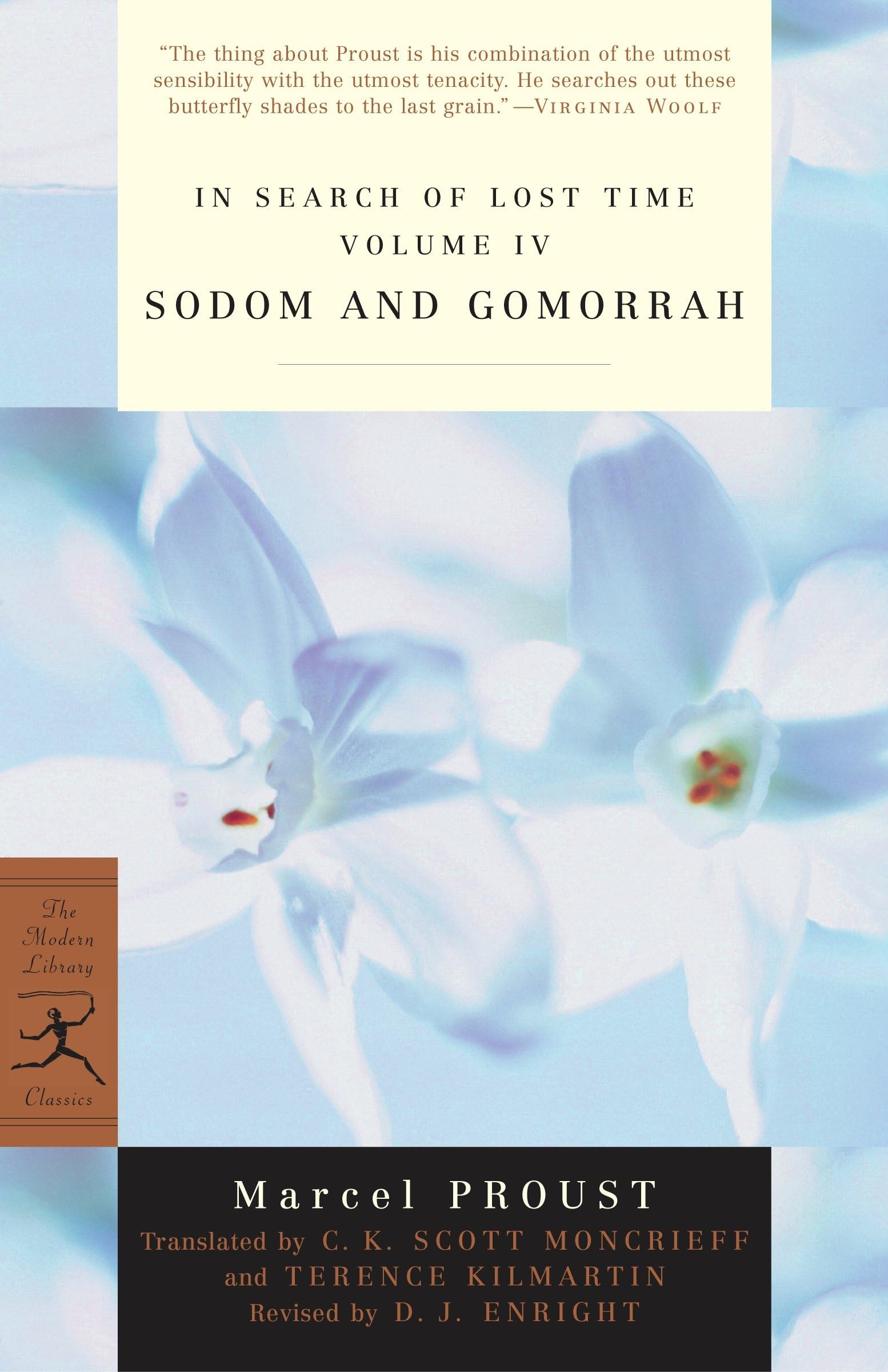
In Search of Lost Time Volume IV Sodom and Gomorrah (Modern Library Classics)
$18.93
by Marcel Proust



Sodom and Gomorrah opens a new phase of In Search of Lost Time . While watching the pollination of the Duchess de Guermantes’s orchid, the narrator secretly observes a sexual encounter between two men. “Flower and plant have no conscious will,” Samuel Beckett wrote of Proust’s representation of sexuality. “They are shameless, exposing their genitals. And so in a sense are Proust’s men and women . . . shameless. There is no question of right and wrong.” For this authoritative English-language edition, D. J. Enright has revised the late Terence Kilmartin’s acclaimed reworking of C. K. Scott Moncrieff’s translation to take into account the new definitive French editions of Á la recherché du temps perdu (the final volume of these new editions was published by the Bibliothèque de la Pléiade in 1989). "The thing about Proust is his combination of the utmost sensibility with the utmost tenacity. He searches out these butterfly shades to the last grain."--Virginia Woolf Marcel Proust was born in the Parisian suburb of Auteuil on July 10, 1871. He began work on In Search of Lost Time sometime around 1908, and the first volume, Swann’s Way, was published in 1913. In 1919 the second volume, Within a Budding Grove, won the Goncourt Prize, bringing Proust great and instantaneous fame. Two subsequent installments— The Guermantes Way (1920–21) and Sodom and Gomorrah (1921)—appeared in his lifetime. The remaining volumes were published following Proust’s death on November 18, 1922: The Captive in 1923, The Fugitive in 1925, and Time Regained in 1927. Sodom and Gomorrah By Marcel Proust Modern Library Copyright © 1999 Marcel Proust All right reserved. ISBN: 9780375753107 Chapter One M. de Charlus in society-A doctor-Characteristic face of Mme de Vaugoubert-Mme d'Arpajon, the Hubert Robert fountain, and the merriment of Grand Duke Vladimir-Mme d'Amoncourt, Mme de Citri, Mme de Saint-Euverte, etc.-Curious conversation between Swann and the Prince de Guermantes-Albertine on the telephone-Visits while awaiting my second and last stay in Balbec-Arrival in Balbec-Jealousy with regard to Albertine-The intermittences of the heart. As I was not in any hurry to arrive at the Guermantes soirie, to which I was not certain of having been invited, I whiled away the time outside; but the summer daylight seemed in no greater haste to move than I was. Although it was after nine o'clock, it was still the daylight that, on the Place de la Concorde, had given to the Luxor obelisk an appearance of pink nougat. Then it modified the tint and turned it into a metallic substance, with the result that the obelisk did not merely become more precious, but seemed thinner and almost flexible. You fancied that you might have been able to twist it, that this jewel had already been bent slightly out of true perhaps. The moon was in the sky now like a quarter of an orange, delicately peeled but with a small bite out of it. Later it would be made of the most resistant gold. Huddled all alone behind it, a poor little star was about to serve as the solitary moon's one companion, while the latter, even as it shielded its friend, but more daring and going on ahead, would brandish, like an irresistible weapon, like a symbol of the Orient, its marvelous, ample golden cresent. In front of the Princesse de Guermantes's httel, I met the Duc de Chbtellerault; I no longer remembered that half an hour before I was still haunted by the fear-which was soon indeed to take hold of me again-of coming without having been invited. We feel uneasy, and it is sometimes long after the moment of danger, forgotten thanks to our distraction, that we remember our unease. I said good day to the young Duc and made my way into the house. But here I must first note a trifling circumstance which will enable a fact that will follow shortly to be understood. On that, as on the preceding evenings, there was someone who had the Duc de Chbtellerault very much on his mind, without, however, suspecting who he was: this was Mme de Guermantes's doorman (known in those days as the "barker"). M. de Chbtellerault, very far from being an intimate-as he was of the cousins-of the Princesse, was being received in her drawing room for the first time. His parents, who had quarreled with her ten years ago, had made it up two weeks ago, and, obliged to be away from Paris on that evening, had asked their son to stand in for them. Now, a few days before, the Princesse's doorman had met a young man in the Champs-Ilysies whom he had thought charming but whose identity he had been unable to establish. Not that the young man had not proved as amiable as he was generous. All the favors that the doorman had imagined having to grant so young a gentleman, he had, on the contrary, received. But M. de Chbtellerault was as cowardly as he was imprudent; he was the more determined not to disclose his incognito inasmuch as he did not know whom he had to deal with; he would