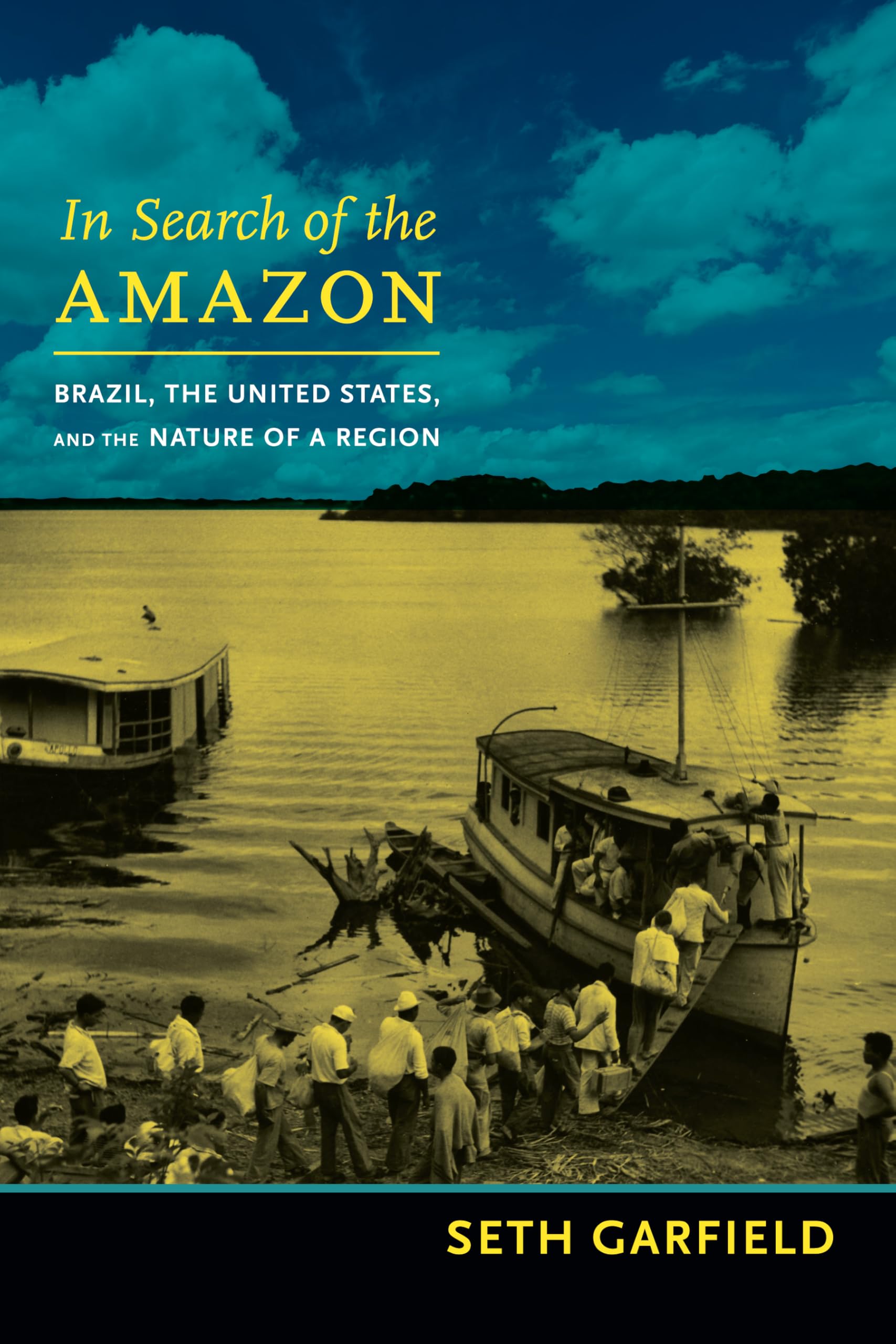
In Search of the Amazon: Brazil, the United States, and the Nature of a Region (American Encounters/Global Interactions)
$37.95
by Seth Garfield PhD



Chronicling the dramatic history of the Brazilian Amazon during the Second World War, Seth Garfield provides fresh perspectives on contemporary environmental debates. His multifaceted analysis explains how the Amazon became the object of geopolitical rivalries, state planning, media coverage, popular fascination, and social conflict. In need of rubber, a vital war material, the United States spent millions of dollars to revive the Amazon's rubber trade. In the name of development and national security, Brazilian officials implemented public programs to engineer the hinterland's transformation. Migrants from Brazil's drought-stricken Northeast flocked to the Amazon in search of work. In defense of traditional ways of life, longtime Amazon residents sought to temper outside intervention. Garfield's environmental history offers an integrated analysis of the struggles among distinct social groups over resources and power in the Amazon, as well as the repercussions of those wartime conflicts in the decades to come. "In equal measure environmental, economic, and diplomatic history, Seth Garfield's In Search of the Amazon is much more than the sum of its parts. With clear prose and sharp analysis, Garfield's wonderful new book is a model for how to write the social history of nature, placing the great, wondrous Amazon at the heart of America's transnational twentieth century."— Greg Grandin , author of Fordlandia: The Rise and Fall of Henry Ford's Forgotten Jungle City "In this path-breaking study, Seth Garfield explores one of the most significant U.S. interventions in Amazonia. During World War II, the United States was desperate for rubber after losing access to Asian markets. In alliance with Brazil, the U.S. government embarked on an aggressive initiative to jump-start the Amazon rubber trade. Garfield masterfully recasts U.S.-Amazonian relations, revealing the wartime roots of the ideological and bureaucratic structures that have shaped modern Amazonia."— Susanna B. Hecht , author of The Scramble for the Amazon and the Lost Paradise of Euclides da Cunha "Seth Garfield's extraordinary book reflects an enormous amount of research, knowledge, and thought about the Amazon. Besides recounting a fascinating chapter of World War II, Garfield places the history of the Amazon within a grid of political, social, and economic concerns that transcend the region's borders but are ultimately modulated by its particular circumstances of settlement and exploitation. He demonstrates the importance of wartime events in shaping subsequent disputes over the fate of the rain forest."— Barbara Weinstein , author of The Amazon Rubber Boom, 1850–1920 "The book is engagingly written and packed full of information and excellent illustrations. . . . It will appeal especially strongly to those interested in U.S. involvement in Latin America before the Cold War. By placing U.S. intervention in Amazonian and Brazilian histories, Garfield recounts another chapter in the making of this enigmatic region that is the wartime roots of the ideological and administrative structures that have shaped the place today." -- Mark Harris ― American Historical Review "[Garfield] succeeds best as a straightforward storyteller in the best tradition of talented historians." -- Angus Wright ― Environmental History "Garfield is to be commended for shedding so much light on the cultural and eonomic history of the Amazon in the twentieth century. This book is a must have for all those interested in development policy in the Amazon." -- Nigel Smith ― Journal of Historical Geography “I highly recommend this book for its systematic and nuanced treatment of a region in flux. Garfield traces important precursors of contemporary inter-regional migration, land conflict, environmental change, and regional development policies. Amazon specialists will enjoy the meticulous archival work, and geographers will appreciate the focus on environmental history and political ecology. Those with general Latin American interests will learn about an important but often overlooked chapter in regional change.” -- Brian J. Godfrey ― Journal of Latin American Geography “This thoughtful, well-rounded book is, then, an invaluable addition to the English language historiography of the Amazon that remedies a gap in the extant literature. It also foregrounds an aspect of the war effort far from the battlefields that made an important, if largely unacknowledged, contribution to Allied victory for which participating Brazilian rubbers tappers could retrospectively be proud.” -- Philip Chrimes ― International Affairs “Garfield makes an important contribution to Brazilian historiography…. [He] combines thorough research in US and Brazilian government documents and contemporary publications with discerning use of labor and criminal court cases and oral histories with rubber migrants.” -- Thomas D. Rogers ― Hispanic American Historical Review “Although this may see