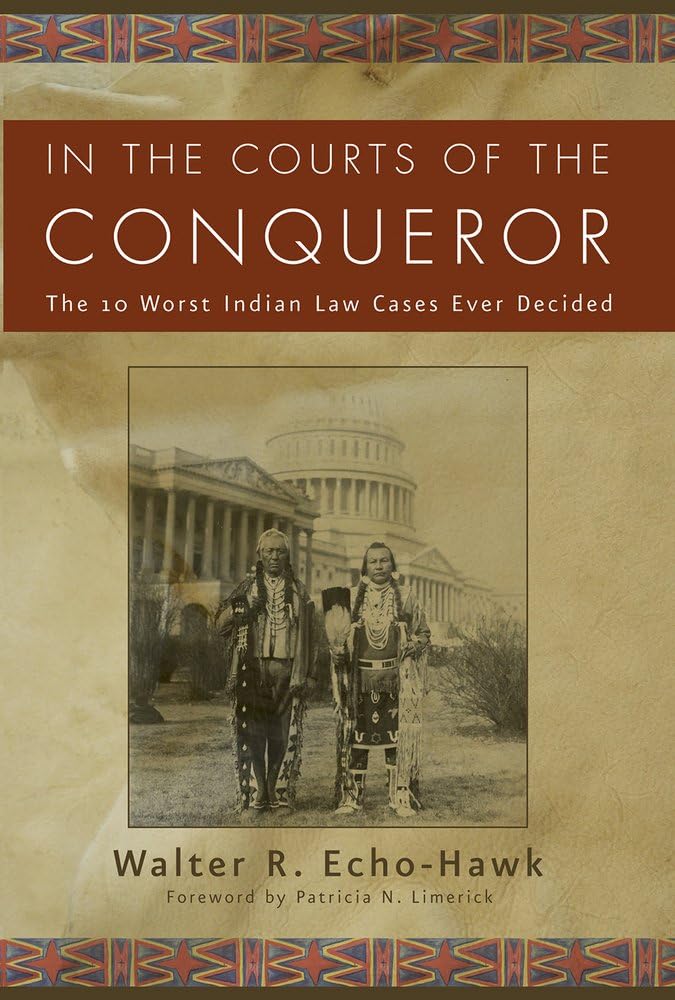
In The Courts of the Conqueror: The 10 Worst Indian Law Cases Ever Decided
$24.95
by Walter R. Echo-Hawk



Now in paperback, a vivid account of ten Supreme Court cases that changed the fate of Native Americans, providing the contemporary historical and political context of each case, and explaining how the decisions have adversely affected the cultural survival of Native people to this day. Walter R. Echo-Hawk is of counsel to the Crowe and Dunlevy law firm of Oklahoma. As a staff attorney for the Native American Rights Fund for thirty-five years, he represented tribes and Native Americans on significant legal issues during the modern era of federal Indian law. He is a prolific writer whose books include Battlefields and Burial Grounds . Walter R. Echo-Hawk (Pawnee) is of counsel to the Crowe and Dunlevy law firm of Oklahoma. As a staff attorney for the Native American Rights Fund for thirty-five years, he represented tribes and Native Americans on significant legal issues during the modern era of federal Indian law. In addition to litigation, he worked on major legislation, such as the Native American Graves Protection and Repatriation Act, and federal religious freedom legislation. He is a prolific writer whose books include the award-winning Battlefields and Burial Grounds . In the Courts of the Conqueror The 10 Worst Indian Law Cases Ever Decided By Walter R. Echo-Hawk Fulcrum Publishing Copyright © 2010 Walter R. Echo-Hawk All rights reserved. ISBN: 978-1-55591-384-7 CHAPTER 1 The Courts of the Conqueror IN THE VERY FIRST CASE to come before the United States Supreme Court involving a significant Native American issue, Chief Justice John Marshall ominously described the American judicial system as "the Courts of the conqueror." Thus clothed, the Supreme Court handed down a sweeping opinion that appropriated legal title to the United States, even though most of the continent was still owned and occupied at the time by Indian tribes. Since that fateful decision in Johnson v. M'Intosh (1823), American law has often worked against Native Americans, legitimizing the appropriation of their property and the decline of their political, human, and cultural rights as indigenous peoples at the hands of the government. By 1950, American Indians had hit the lowest point and were living life in abject poverty at the bottom of a segregated society bent upon stamping out their culture, reneging on remaining government commitments, and assimilating them out of existence. This book examines the troubling fact that American law rendered this destruction perfectly legal, and it explores the need to rethink the doctrines that underpin this national embarrassment. During the 1960s, the civil rights movement arrived in Indian Country. After years of heavy paternalistic rule by the Bureau of Indian Affairs, Indian tribes began to awaken to the possibility of emancipation from the dark side of federal guardianship and to the need to reclaim Native pride, culture, land, and sovereignty. I came of age in rural Oklahoma, and among Native youth then, our hero during the birth of the Red Power movement was the Ponca Indian activist Clyde Warrior. He rejected the stamp of inferiority impressed upon American Indians by the mass media and mainstream society by proclaiming, "the sewage of Europe does not run through these veins." Though his life was cut short, the awakening in Indian Country was carried forward by his organization, the National Indian Youth Council, and a generation of tribal leaders, activists, and lawyers who recast the civil rights movement into a Native American tribal sovereignty movement that more closely reflects the aspirations of America's indigenous peoples. That movement led to the rise of modern Indian nations. At the inception of this sovereignty movement, only a handful of American Indians were lawyers, perhaps a dozen, even though the condition of Native Americans has always been highly dependent upon the courts. My folks urged me to go to law school in the late 1960s to help correct problems in our Pawnee tribal community. Heeding their advice, I followed the moccasin tracks to law school made by visionaries such as F. Browning Pipestem (Otoe-Missouri/Osage), Urban Bear Don't Walk (Crow), John Echohawk (Pawnee), and others. Our goal was to learn the law and then use the white man's own rules to achieve justice in his courts. That strategy worked well in the courts of the conqueror. Significant legal battles were won by modern-day warriors during the early years of the sovereignty movement since even under the conqueror's own laws much of the oppression of Indian people was illegal. The successful use of law to solidify the presence of Native America is a great testament to the vitality of the American judiciary. However, those victories are not the subject of this book because they have been well documented by legal scholars and historians. This book explores the dark side of the law experienced by Native Americans and their efforts to overcome the hardships imposed upon them by Ame