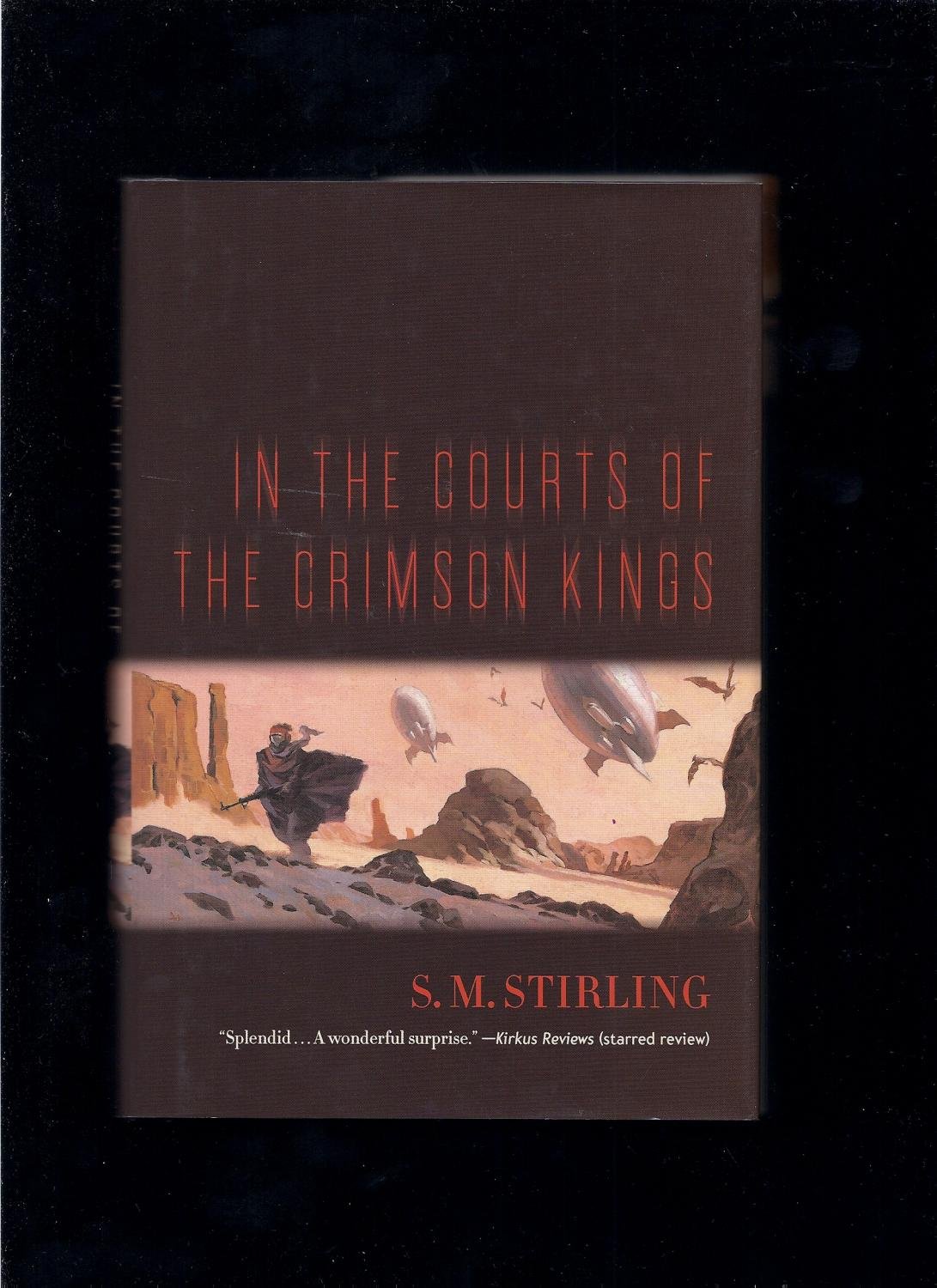



In the parallel world first introduced in S. M. Stirling’s The Sky People , aliens terraformed Mars (and Venus) two hundred million years ago, seeding them with life-forms from Earth. Humans didn’t suspect this until the twentieth century, but when the first probes landed on our sister worlds, and found life—intelligent life, at that—things changed with a vengeance. By the year 2000, America, Russia, and the other great powers of Earth are all contending for influence and power amid the newly-discovered inhabitants of our sister planets. Venus is a primitive world. But on Mars, early hominids evolved civilization earlier than their earthly cousins, driven by the needs of a harsh world growing still harsher as the initial terraforming runs down. Without coal, oil, or uranium, their technology was forced into different paths, and the genetic wizardry of the Crimson Dynasty united a world for more than twenty thousand years. Now, in a new stand-alone adventure set in this world’s 2000 AD, Jeremy Wainman is an archaeologist who has achieved a lifelong dream; to travel to Mars and explore the dead cities of the Deep Beyond, searching for the secrets of the Kings Beneath the Mountain and the fallen empire they ruled. Teyud Zha-Zhalt is the Martian mercenary the Terrans hire as guide and captain of the landship Intrepid Traveller. A secret links her to the deadly intrigues of Dvor il-Adazar, the City That Is A Mountain, where the last aging descendant of the Tollamune Emperors clings to the remnants of his power…and secrets that may trace their origin to the enigmatic Ancients, the Lords of Creation who reshaped the Solar System in the time of the dinosaurs. When these three meet, the foundations of reality will be shaken—from the lost city of Rema-Dza to the courts of the Crimson Kings. “Rollicking…. A terrific premise.” — Publishers Weekly (starred review) on The Sky People S. M. Stirling is the author of many SF and fantasy novels, including Island in the Sea of Time , Dies the Fire , and Protector . Excerpt Encyclopedia Britannica, 20th editionUniversity of Chicago Press, 1998Mars—ParametersOrbit: 1.5237 AUOrbital period: 668.6 Martian solar daysRotation: 24 hrs. 34 min.Mass: 0.1075 x EarthAverage density: 3.93 g/ccSurface gravity: 0.377 x EarthDiameter: 4,217 miles (equatorial; 53.3% that of Earth)Surface: 75% land, 25% water (incl. pack ice)Atmospheric composition:Nitrogen 76.51%Oxygen 20.23%Carbon dioxide 0.11%Trace elements: Argon, neon, kryptonAtmospheric Pressure: 10.7 psi average at northern sea level The third life-bearing world of the solar system, Mars is less Earthlike than Venus, although like Earth and unlike Venus its rotation is counterclockwise, and the length of the Martian day is nearly identical to that of Earth’s. The atmosphere is thinner than Earth’s, and is apparently growing thinner still; though it remains easily breathable for Terran humanity at the lower levels, uplands tolerable for Martians require oxygen masks of the type used by mountaineers on Earth. More significant is the fact that Mars has a thick, rigid crust that prevents the plate tectonics characteristic of the other two worlds. Average temperatures on Mars are roughly 10 degrees Celsius lower than those on Earth, due to the lower solar energy input. This effect is moderated by the higher percentage of carbon dioxide in the Martian atmosphere, a phenomenon puzzling to scientists because the planet lacks the plate tectonics needed to recirculate carbon compounds and, presumably, has less vulcanism. The year, twice the Terrestrial, and the greater eccentricity of the Martian orbit render seasonal contrasts greater than the Terran norm even at the equator. Temperatures on Earth may have been in a similar range, however, at some periods of geologic time (see “Snowball Earth”). It is believed that the gradual thinning of the Martian atmosphere and hence its reduced ability to hold heat has been offset to some degree by the gradual increase in the Sun’s energy output over time. The proportions of land and water on Mars are almost a precise reversal of those on Earth. Mars has seas surrounded by land, rather than land surrounded by oceans, and so the total land area is not dissimilar to that of Earth. The bulk of the water area is concentrated in the Great Northern Sea in the northern polar zone, with a smaller equivalent in the Antarctic Sea. Smaller bodies of water are present in parts of the main equator-girdling land mass . . . Mars, City of Zar-tu-KanTau-il-Zhi (Tower of Truth)May 1, 2000 AD “How can you work for the vaz-Terranan? They’re rich and they have some curious and powerful tembst, but by the First Principle, they’re ugly!” Jelzhau said, considering the board. He moved his Chief Coercive diagonally two squares and threatened her Despot. The woman who called herself Teyud za-Zhalt sipped at her flask of essence through the glass straw, savoring the musky tartness of the liquid, and then