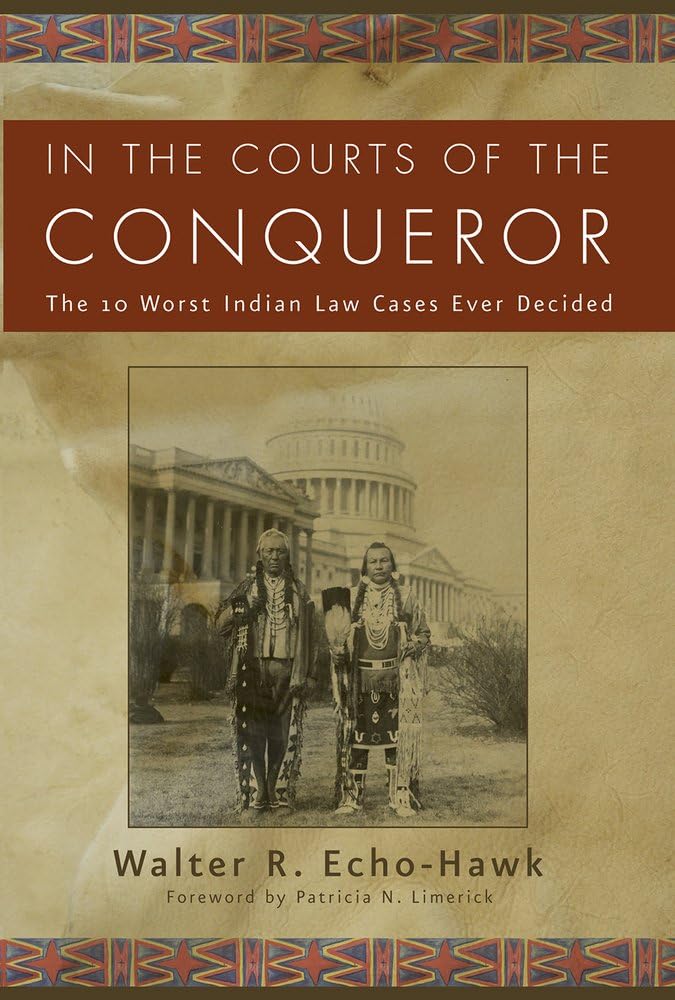
In the Courts of the Conqueror: The 10 Worst Indian Law Cases Ever Decided
$89.00
by Walter R. Echo-Hawk



The fate of Native Americans has been dependent in large part upon the recognition and enforcement of their legal, political, property, and cultural rights as indigenous peoples by American courts. Most people think that the goal of the judiciary, and especially the US Supreme Court, is to achieve universal notions of truth and justice. In this in-depth examination, however, Walter Echo-Hawk reveals the troubling fact that American law has rendered legal the destruction of Native Americans and their culture. Echo-Hawk analyzes ten cases that embody or expose the roots of injustice and highlight the use of nefarious legal doctrines. He delves into the dark side of the courts, calling for a paradigm shift in American legal thinking. Each case study includes historical, contemporary, and political context from a Native American perspective, and the case’s legacy on Native America. In the Courts of the Conqueror is a comprehensive history of Indian Country from a new and unique viewpoint. It is a vital contribution to American history. Walter Echo-Hawk (Pawnee) is of counsel to the Crowe & Dunlevy law firm of Oklahoma. As a staff attorney for the Native American Rights Fund for thirty-five years, he represented tribes and Native Americans on significant legal issues during the modern era of federal Indian law. In addition to litigation, he worked on major legislation, such as the Native American Graves Protection and Repatriation Act (NAGPRA), and federal religious freedom legislation. He is a prolific writer whose books include the award-winning Battlefields and Burial Grounds . "A no-holds barred account that deserves wide distribution." Library Journal and School Library Journal "This weighty text serves as a 'tour of the dark side of the law.' Echo-Hawk, who spent more than three decades at the Native American Rights Fund, exhaustively deconstructs the racist and colonial foundations of federal Indian law. Written in a style that conveys a sense of outrage and passion, the cases highlighted are notable because they represent injustice as well as unfinished business." CHOICE "Echo-Hawk is methodical and elegant in the way he leads us through the history and case law which has brought us to this point." News From Indian Country As evidenced by his book In the Courts of the Conqueror,” Mr. Echo-Hawk’s experience, achievement, success and perhaps most importantly, his wisdom, not only serve as a touchstone for legal practitioners, but his work has left an indelible mark upon the lives of those who live and work in Indian Country and for every American who truly values the notion of justice.” Oklahoma City Examiner Echo-Hawk’s book ought to retire the entire debate about judicial activism. It has become a conservative article of faith that judges should narrowly follow the law when deciding cases. But Echo-Hawk methodically picks apart that fiction.” —Mark Trahant, New West Walter Echo-Hawk has worked as a lawyer for the Native American Rights Fund for more than 35 years. He was instrumental in securing passage of two federal laws that respect Indian and religious freedoms and also the repatriation of Native American remains to Indian tribes. A prolific writer, his publications include an award-winning book BATTLEFIELDS AND BURIAL GROUNDS (1994). In the Courts of the Conqueror The 10 Worst Indian Law Cases Ever Decided By Walter R. Echo-Hawk Fulcrum Publishing Copyright © 2010 Walter R. Echo-Hawk All rights reserved. ISBN: 978-1-936218-01-1 CHAPTER 1 The Courts of the Conqueror IN THE VERY FIRST CASE to come before the United States Supreme Court involving a significant Native American issue, Chief Justice John Marshall ominously described the American judicial system as "the Courts of the conqueror." Thus clothed, the Supreme Court handed down a sweeping opinion that appropriated legal title to the United States, even though most of the continent was still owned and occupied at the time by Indian tribes. Since that fateful decision in Johnson v. M'Intosh (1823), American law has often worked against Native Americans, legitimizing the appropriation of their property and the decline of their political, human, and cultural rights as indigenous peoples at the hands of the government. By 1950, American Indians had hit the lowest point and were living life in abject poverty at the bottom of a segregated society bent upon stamping out their culture, reneging on remaining government commitments, and assimilating them out of existence. This book examines the troubling fact that American law rendered this destruction perfectly legal, and it explores the need to rethink the doctrines that underpin this national embarrassment. During the 1960s, the civil rights movement arrived in Indian Country. After years of heavy paternalistic rule by the Bureau of Indian Affairs, Indian tribes began to awaken to the possibility of emancipation from the dark side of federal guardianship and to