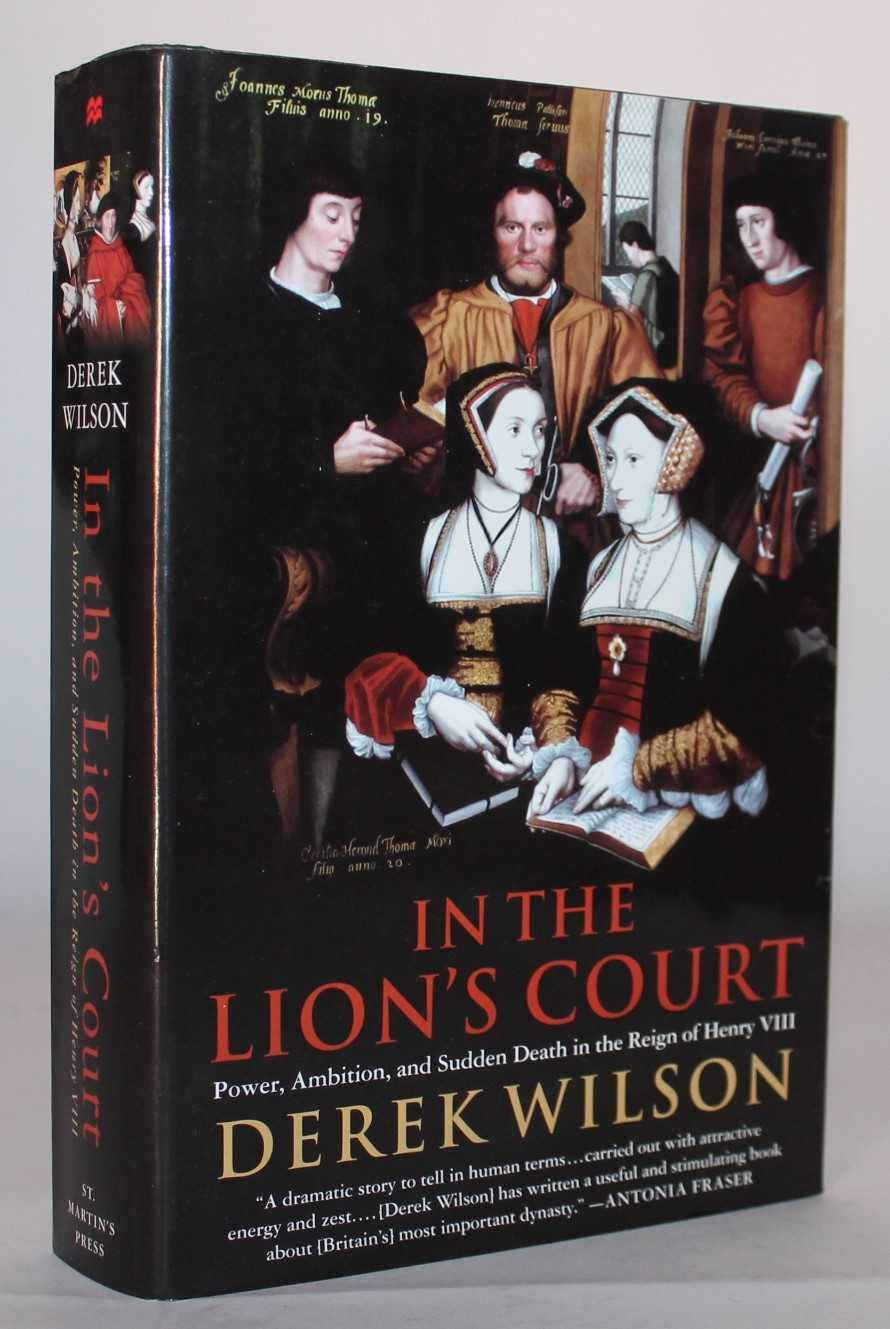
In the Lion's Court: Power, Ambition and Sudden Death in the Reign of Henry VIII
$8.01
by Robert A. Wilson



The story of Henry VIII and his six wives is a well-known example of the caprice and violence that dominated that KingÆs reign. Now renowned historian Derek Wilson examines a set of relationships that more vividly illustrate just how dangerous life was in the court of the Tudor lion. He tells the interlocking stories of six menùall curiously enough named Thomasùwhose ambitions and principles brought them face to face with violent death, as recorded in a simple mnemonic: "Died, beheaded, beheaded, Self-slaughtered, burned, survived." Biographer and novelist Wilson (The Tower of London) focuses his study on six Tudor men whose fates in the court of Henry VIII vividly echo those of the Tudor lion's six wives: "Divorced, beheaded, died,/ Divorced, beheaded, survived." Wilson proposes that the fates of Henry VIII's "six Thomases" Wolsey, More, Cromwell, Howard, Wriothesley, and Cranmer can be remembered by a similar rubric: "Died, beheaded, beheaded,/ Self-slaughtered, burned, survived." The promise of the subtitle is amply fulfilled in Wilson's six-part study, chronologically arranged and framed by a useful introduction and a valedictory epilog. The study contains a brilliant series of parallel portraits a fresh look at each Thomas's family and social origins, his education, his entry into "the lion's den" of the royal Council chamber, and his exit therefrom. The value of these portraits to today's reader is that, as Wilson promises, we can begin to understand what it was like to live through that time of great upheaval "when we draw alongside the people who did just that." Recommended for all libraries. Robert C. Jones, formerly with Central Missouri State Univ., Warrensburg Copyright 2002 Cahners Business Information, Inc. From the Magna Carta to the American Bill of Rights, there has been a steady, irreversible, Anglo-American trend toward the guarantee of individual rights against the coercive power of the state. But Wilson shows that the trend had some rather gigantic deviations. In his depiction of the capricious and dangerous atmosphere at the court of Henry VIII, Wilson avoids the more sensational victims of Henry's wrath, particularly his wives. Instead, he illustrates the broader nature of the tyranny by focusing on the fates of six men, all called Thomas, who suffered ignominious fates, including Thomas More, who was appointed chancellor by Henry but lost his head because he would not bless Henry's marriage. In this milieu of persecution and betrayal, paranoia seemed the safest course. This revealing and disturbing book is a valuable reminder that our liberties are never fully secure, and require vigilance and sometimes courage to be maintained. Jay Freeman Copyright © American Library Association. All rights reserved Derek Wilson, one of our leading biographers and novelists, came to prominence thirty years ago, after graduating from Cambridge University, with A Tudor Tapestry: Men Women and Society in Reformation England . This was followed by several critically acclaimed and best-selling books, such as Rothschild: A Story of Wealth and Power; Sweet Robin: Robert Dudley, Earl of Leicester; Hans Holbein: Portrait of an Unknown Man ; and, most recently, The King and The Gentleman: Charles Stuart and Oliver Cromwell 1599-1649 . He has also written and presented numerous radio and television programs. Now, after three decades of study and reflection, he returns to those themes he first explored in A Tudor Tapestry.